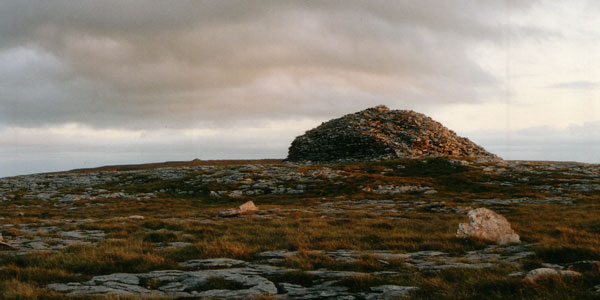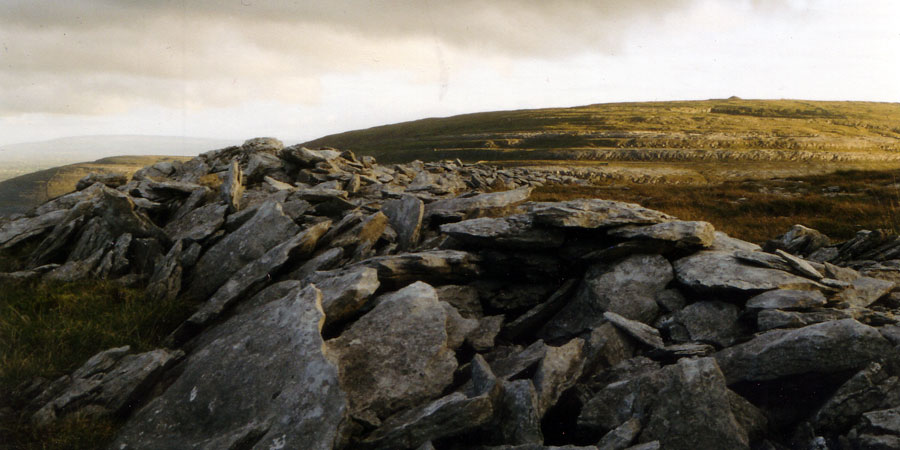
The large stone cashel on Blackhead on the northwest edge of the Burren. This site has fantastic views out across the Aran Islands and Galway Bay. The mountains of Connemara can be seen in the distance.
Guided Tours
Home Page
Map
Email

Westropp's Burren notes

The Burren in County Clare is one of the most unusual and interesting landscapes to be found in Ireland. The limestone karst mountains are largely denuded of soil, so the landscape is composed of cracked, fissured, incredably weathered grey rock. The Burren has often been described as a lunar landscape. The cracks in the limestone pavement which give the Burren its strange appearance are called grykes, and are the result of erosion.

This rocky patch of west Clare is bounded by Galway Bay on the north, the Atlantic Ocean with the Aran Islands to the west, the Shannon and drumlin country to the south and east. There are many caves in the mountains which were formed when the glaciers that sculpted the hills began to melt. The Ailwee Caves have been operating as an attraction for several years now.

Large stone age cairn, surrounded by up to 100 hut sites on Turlough Mountain. The cairn on Sliabh Carran can be seen in the distance on the horizon just to the left. It is about 2 km to the east.

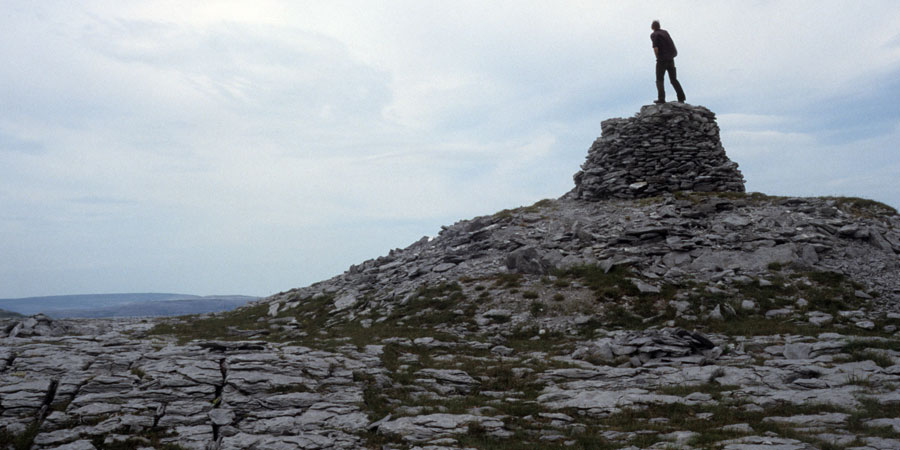
There were plenty of people living in the Burren during the neolithic, to judge by the wealth of ancient sites found there. There are several large hill-top cairns on the summits along Galway Bay, including Sliabhcarran, Turlough Mountain and Blackhead (above), which looks out across the Atlantic. Turlough Mountain hs a large settlement site, possibly a stone age village of some 100 huts (below). Not far east of the huts is a huge circular hillfort, which may also date from the neolithic.

Some believe that the Burren was over-farmed during the neolithic, with it's covering of trees removed to make way for grazing. This would mean the unusual appearance of the area is man-made. There was certainly a large population living there in ancient times, as the large number of megalithic and other stone monuments shows.

An aerial shot of the huts and cairn on Turlough Mountain. The cairn is at the top towards the right. Photo from the Book of the Burren.

There are a large number of stone forts, similar to the more famous sites on the nearby Aran Islands, sacttered throughout the Burren. A quick look at the OS map will show how many townland names begin with 'Lis', 'Caher' and 'Dun'.

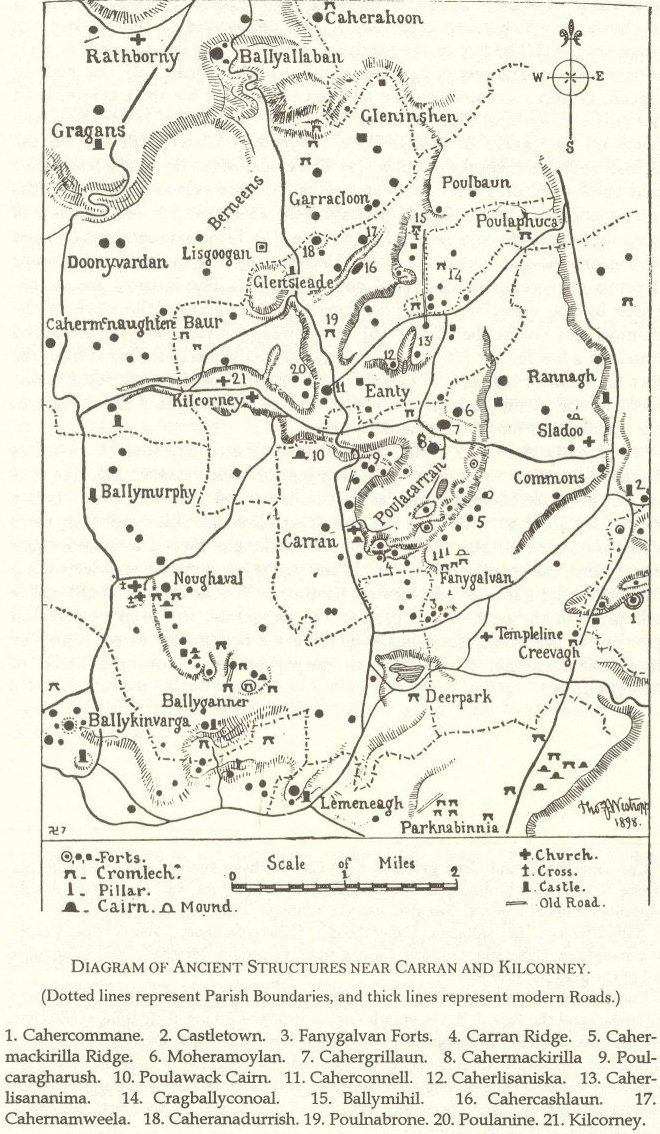
A map of the main central area of the Burren, showing the profusion of neolithic sites. Poulawack cairn, which is at the centre of the Burren, is at the bottom, centre.

There are a great number of early and medieval Christian sites in the region, which includes a fine collection of high crosses at Kilfenora. Churches and holy wells are almost as thickly clustered throughout the Burren as the earlier stone age remains. One of the more interesting sites is at Kilmacduagh just to the east of the Burren, near Gort. This well preserved site has a complete round tower which is leaning over.

The large stone age cairn, known as Seefin on the summit of Blackhead in the Burren. The views are quite simply amazing. There are many cairns called Seefin around the country; they are associated with Fionn MacCumhail, the leader of the Fianna, an Iron age band of warriors who protected Ireland.