The
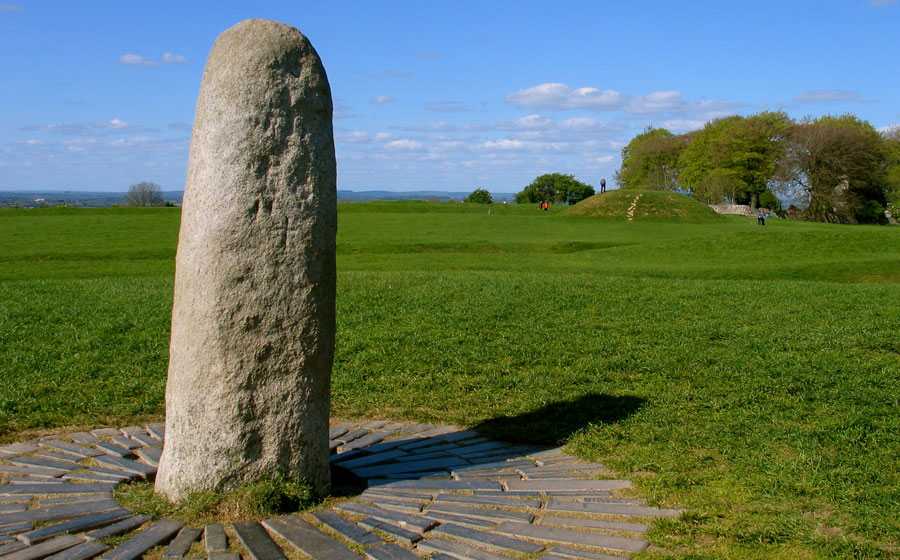
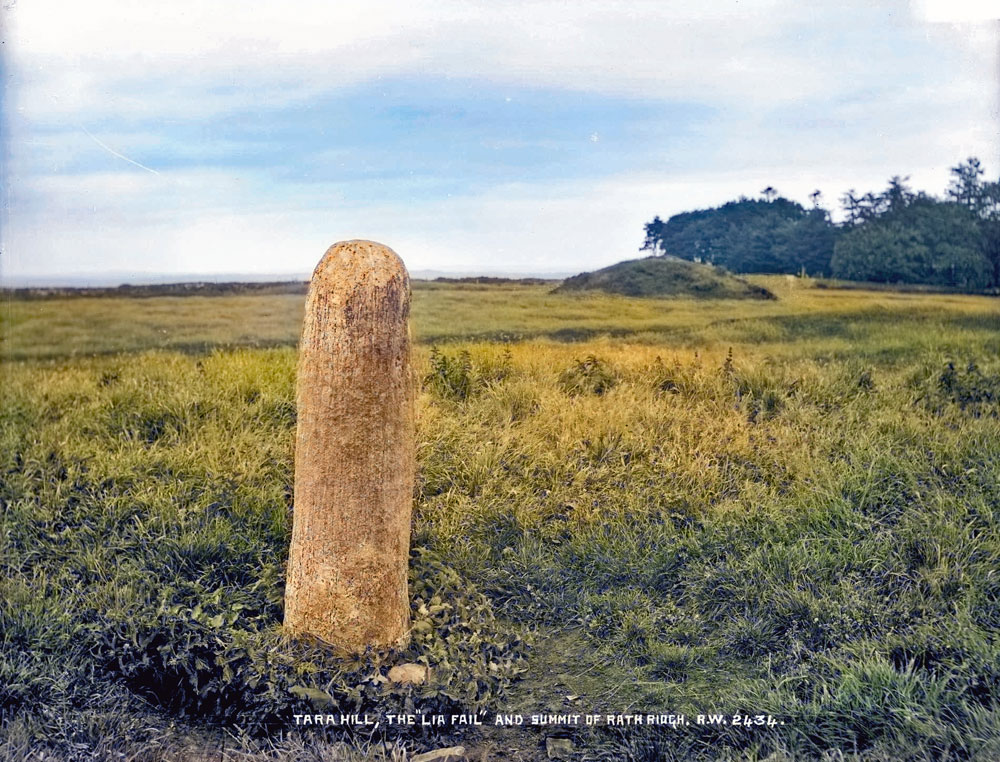
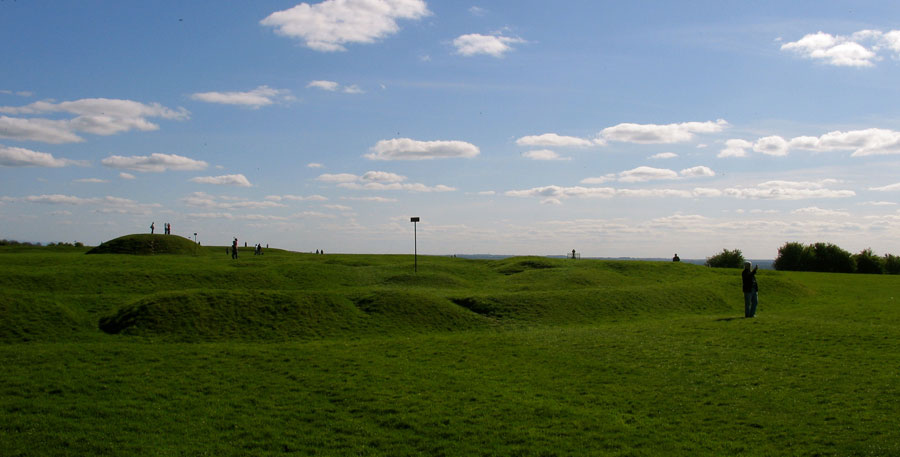
Lia Fail or Stone of Destiny stands on the Forrad, a large barrow on the Hill of Tara. The stone originally stood close to the Mound of the Hostages 300 meters to the north.
The Mound of the Hostages
The Mound of the Hostages (Duma na nGiall) is the
oldest visible monument on the Hill of Tara, one of the
most famous places in Ireland. The mound, which
encases a megalithic tomb built before 3000 BC, was
used as a place for the deposition of human remains for
more than 1,500 years after its construction. By then,
arguably, the mythical status of Tara had already begun
to crystallise, and the extensive ritual landscape we see
there today had begun to take shape.
The Mound of the Hostages, Tara: a pivotal monument in a ceremonial landscape, Muiris O’Sullivan, 2006.
The oldest visible building at Tara is the small passage-grave on the summit
of the hill which is known as the Mound of the Hostages. The name
comes from some of the many mythological stories associated with the monument.
The monument is undifferenciated, with one fairly small chamber and no side recesses. The Mound of the Hostages was built during the mid-neolithic around 3500 BC, with continual re-use for 1,500 years, right throughout the bronze age which followed the neolithic farming era.
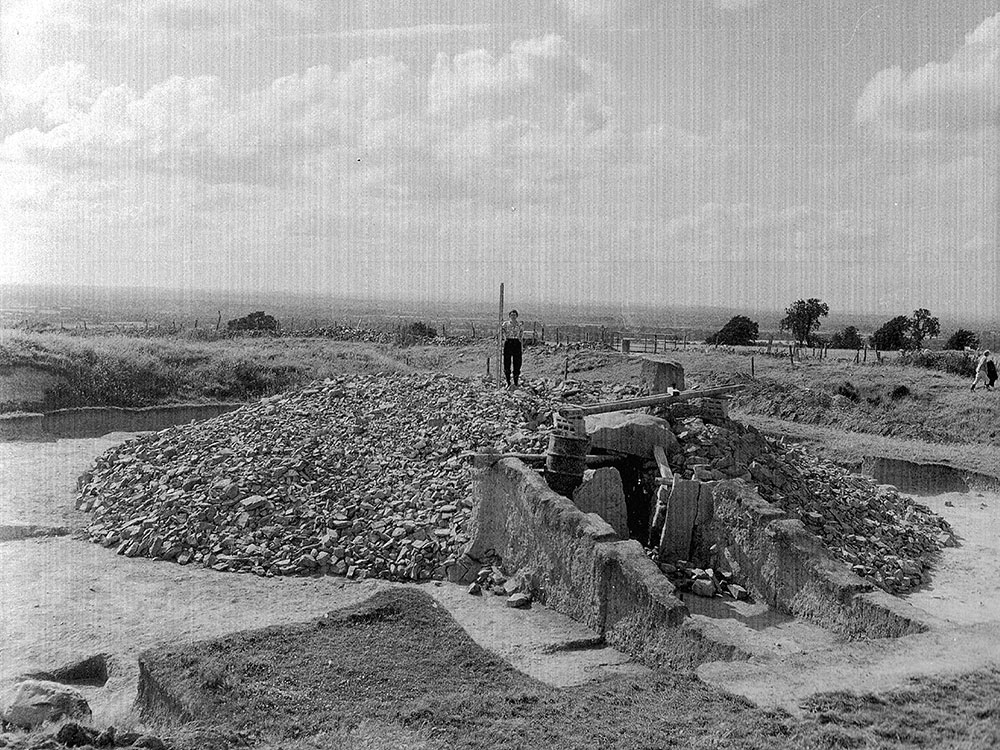
The Mound of the Hostages in 1958, with the covering mantle of soil was removed.
While the Mound of the Hostages remained unopened it was the subject of many fantastic and mythological stories, and was considered to be a major sidhe or entrance into the Otherworld. The monunent was excavated by both Seán P. Ó Ríordáin beginning in 1952 and completed by Ruaidhrí de Valera in 1959, following Ó Ríordáin's sudden death.
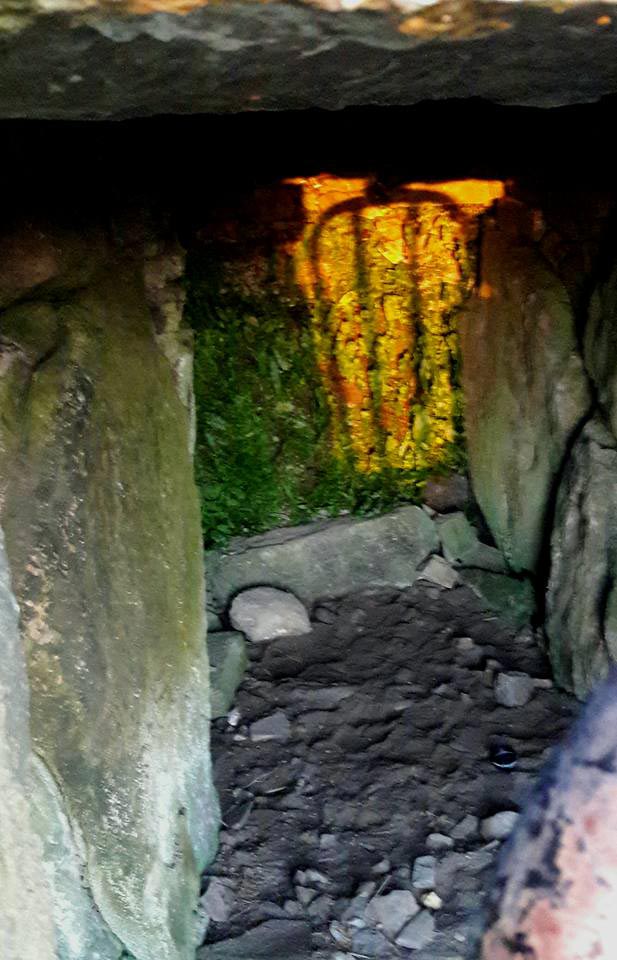
Sunrise, November 5th, 2017, photo by John Condon
The short passage within the Mound of the Hostages, which is four meters long, is oriented to the southeast, allegedly to
the sunrises on Samhain and Imbolc, the November and Feburary cross-quarter days. However, the passage is so short that the sun can enter for a number of days around the crossquarter days, and the monument is most likely aligned on the minor lunar standstills. A similar alignment is found at Listoghil, the central monument at Carrowmore in County Sligo and a number of monuments at Loughcrew megalithic complex, which is visible from the top of the Hill of Tara.
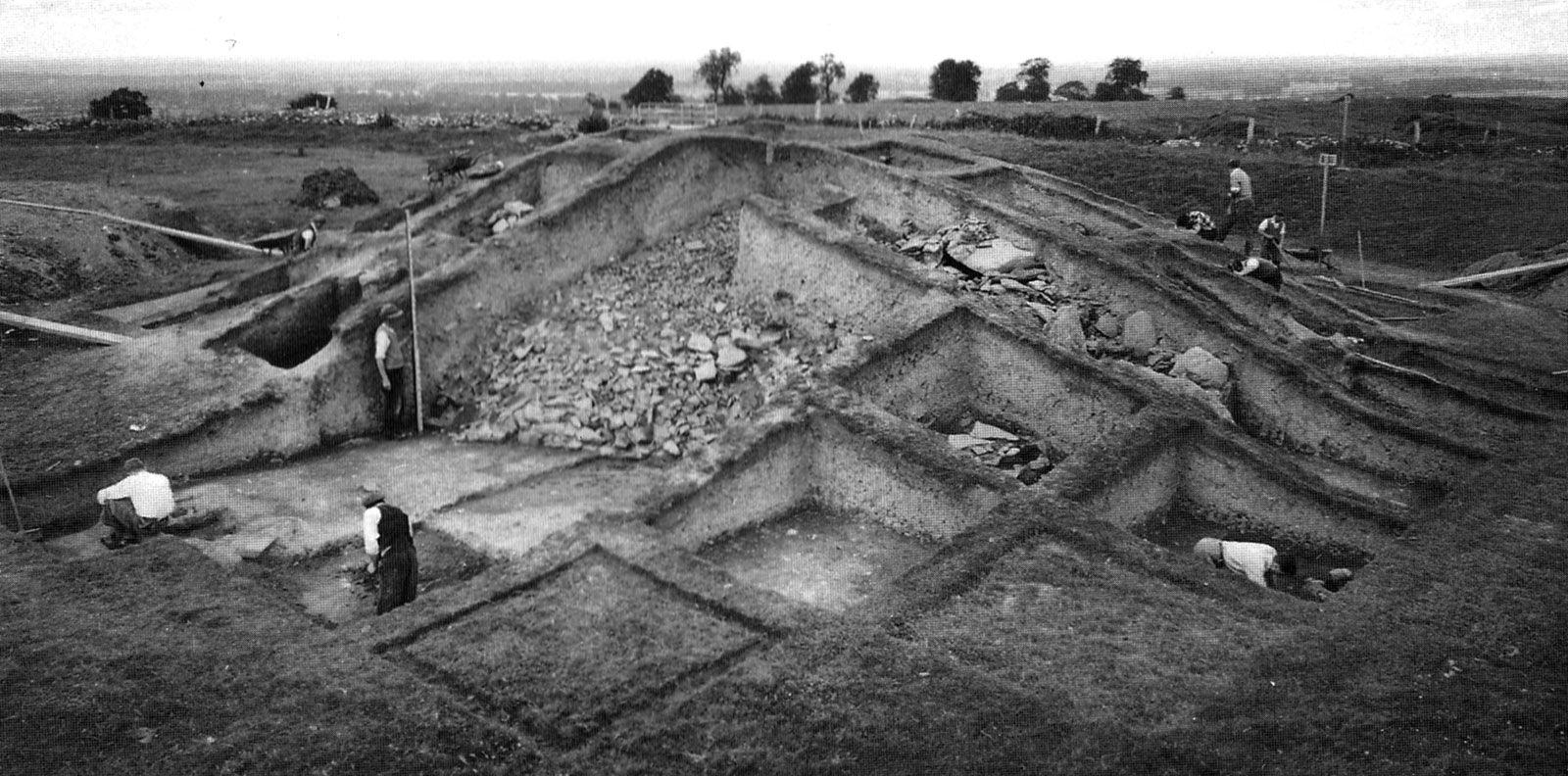
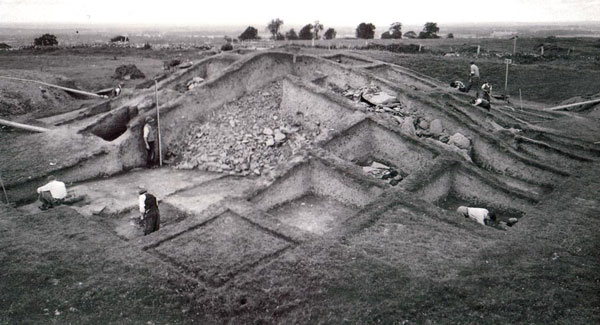
Excavations underway at the Mound of the Hostages in 1955. The site was divided into a series of grids. Eventually the entire mound and cairn were removed.
The Chamber
The chamber at the Mound of the Hostages is divided into three compartments by two sill stones; the floor was paved
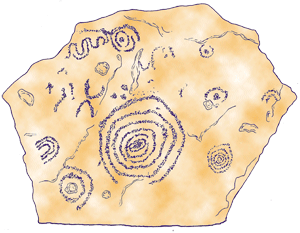
with large flat flagstones. There is one decorated stone, a large flat slab on the left side of the chamber.
The megalithic art within the Mound of the Hostages.
The mound was excavated by Sean P. O'Riordan between 1955 and 1959; what you
see today is the restored mound after the excavation. O'Riordan found evidence
of an earlier structure under the mound. There is a stone cairn covered by a
clay mantle. The Mound of the Hostages is three meters high, twenty-one meters
in diameter and is one of the few known sites of this kind with no evidence of kerbstones. Fourknocks to the northeast is another example of a passage-grave with no kerbstones.
When Ó Ríordáin began exploring the Mound of the
Hostages, his priority as an archaeologist was to adopt a clinical approach, impervious to prevailing ideas about the site.
He soon discovered that the earthen mound had served as a cemetery during the early Bronze Age. Continuing his investigations, he revealed the entrance to a megalithic tomb on the
eastern side of the mound. This tomb contained a rich and
complex assemblage of human bone, pottery and a variety of
stone and bone objects, mainly personal ornaments.
The earliest features recorded underneath the Mound of
the Hostages date from about the mid-fourth millennium
(cal.) BC and include the remains of individual fires, spreads
of charcoal and a ditch running partially underneath the
cairn. The pits and fires could plausibly be interpreted as part
of the preparatory ritual for the construction of the tomb, but
the ditch is less easy to explain in this way. It arcs under the
western part of the cairn and may mark the eastern edge of
an enclosure focused to the west of the Mound of the
Hostages.
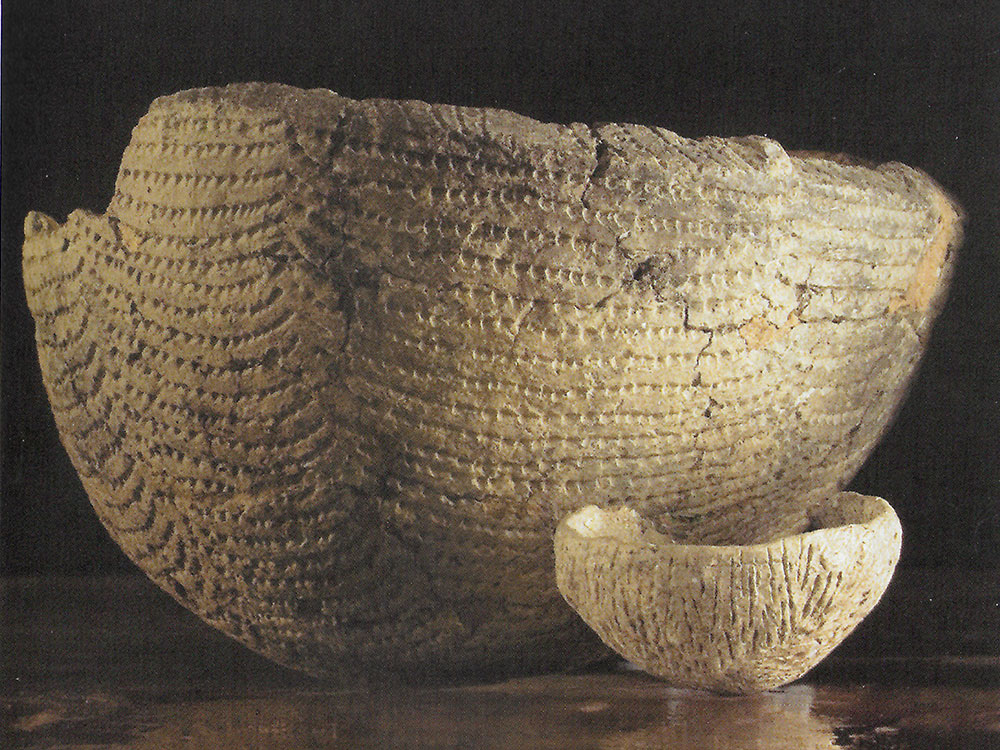
The large and small Carrowkeel Ware pots, both of which contained cremated human remains, found within the Mound of the Hostages.
If there was a pre-cairn enclosure, what was its purpose? Early Neolithic hilltop enclosures are known in Ireland
(there may have been one at Knowth, for example) and it is
possible that their function was to host ceremonial occasions.
In the centuries after 3500 (cal.) BC, as the process of
building the megalithic tomb began, any unevenness in the
ground was submerged beneath a layer of soil and the
orthostats defining the passage tomb were erected in a specially prepared slot-trench. The tomb consists of three successive compartments separated by low sill stones, the roof
stones surviving over the two inner compartments. Megalithic
art was applied to two of the orthostats. Uniquely, three cist-like structures were built against the outer faces of the
orthostats and filled with cremated human bone. Here, and
in the tomb, the excavators in the 1950s recovered a remarkable collection of burnt and unburnt human bone, representing hundreds of individuals, accompanied by a rich array of
artefacts, some of which are decorated.
The ancient rituals give us an uneasy glimpse of the
prehistoric subconscious. We may wonder, for example, why
so many unburnt human skulls lay buried together in the
cremated bone in the middle part of the tomb, with no
corresponding torsos or limbs. Without allowing our
imaginations to lead us to dark places, we might ask why
infant long-bones, always unburnt long-bones, turned up
occasionally but consistently amongst the cremated adult
bone. This suggests that human bone deposition at Tara may
not simply have been a final service to an individual, a
formal leave-taking in the manner of today, but rather an
element of ceremonies focused on the place itself.
Foundation rituals, for example, appear to have played an
important role at the Mound of the Hostages. Collections of
human bone were found in the foundation trench of the
tomb, banked against the backs of orthostats and knowingly
deposited rather than accidentally lost from the tomb. Traces
of human and animal bones, as well as a mass of soft organic
material, were located beneath the centre of the covering
cairn. Furthermore, a series of small bone cremation deposits,
many in specially arranged stone settings, were placed in the
ground around the perimeter of the area covered by the cairn
and have produced radiocarbon determinations centring
around 3200 (cal.) BC. At least one of these cremations was
found c. 10m west of the cairn, in a narrow extension of the
excavation beyond the immediate environs of the mound.
This raises the possibility of undiscovered Neolithic deposits
elsewhere on the hill, especially to the west of the Mound of
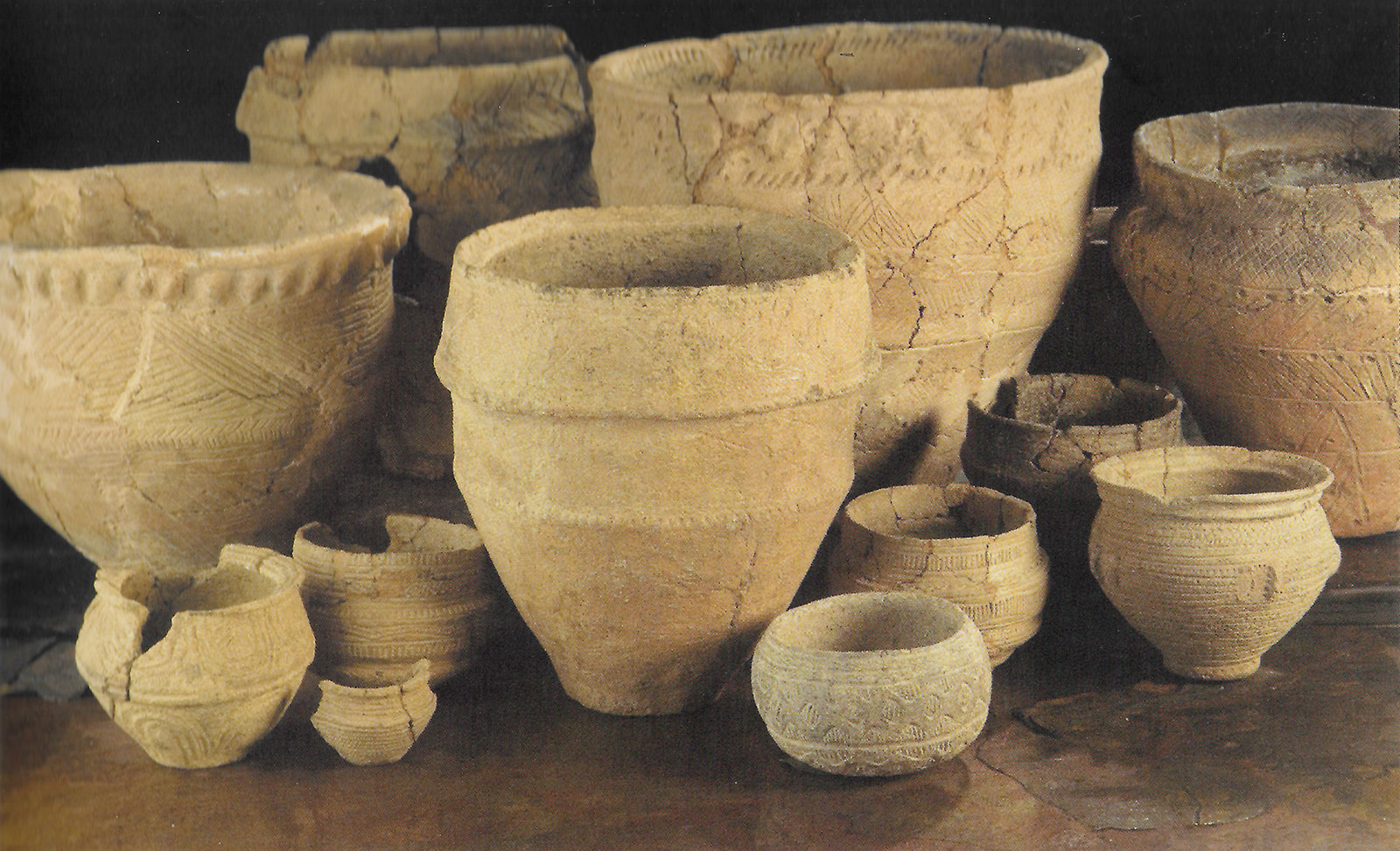
Collection of Neolithic artefacts found amongst the cremated
human bone in the megalithic tomb, Mound of the Hostages.
The mound produced one of the largest collection of burials and associated artifacts
from any Irish neolithic site. These finds included a thirty centimeter thick layer
of cremated bones and a whole range of pendants, antler pins, pottery shards, stone balls and both a large and a miniature Carrowkeel-ware pot, each of which contained cremated and unburned human remains.
Use for burial continued throughout the Bronze age, when nearly forty cremated burials were
placed in the clay mantle of the mound. There was one inhumation, the
body of a fourteen year old boy, which was placed under a burial urn. Finds
with this burial included fiaence beads which came from the eastern Mediterranean.
The Lia Fáil, or Stone of Destiny, which now stands at the centre of
a fort called the Forrad, is believed to have originally stood outside the entrance to the
Mound of the Hostages. This Stone was moved to its present location at the centre
of the Forraid in 1824 to commemorate the Battle of Tara which took place in 1798. The Stone marks the mass grave of four-hundred United Irishmen put to death here.
The stone is a granite pillar, 1.5 meters tall, and is said to be one of the four
treasures brought to Ireland by the Tuatha De Danann. Its
fame rests in its power to recognise the legitimaite king: it would emit
a mighty roar when the true king stood upon it, though some say it lost
this power when Christ was born. The stone is extremely phallic in shape,
so no wonder that that its Irish name is Bodh Fergus, Fergus' Penis. Fergus
was Fergus Mac Roi, a champion of Ulster, one of Cuchullain's teachers
and a lover of Queen Maeve.
A selection of the bronze age pottery discvered during excavations in the Mound of the Hostages.
Excavations at the Mound of the Hostages
In the early summer of 1952 the then taoiseach, Éamon de
Valera, turned the first sod of the Tara excavation project in a
ceremony witnessed by a large crowd of spectators. The excavations were directed by Seán P. Ó Ríordáin, Professor of
Celtic Archaeology at University College Dublin, who had
previously conducted large-scale excavations at Lough Gur in
County Limerick, amongst other important sites. Initially he
focused on Ráith na Senad, which had previously been investigated by the British Israelites. He also explored the northern
boundary of Ráith na Ríg, and in 1955 he turned his attention
to the Mound of the Hostages. After his second season, in
1956, Ó Ríordáin fell ill. He died in 1957, and it was his successor in UCD, Professor Ruaidhrí de Valera, who completed
the excavation of the Mound of the Hostages in 1959. Finally,
as part of the Discovery Programme investigation of Tara in
the 1990s, Helen Roche re-excavated Ó Ríordáin’s cuttings
across the ditch of Ráith na Ríg.
The Mound of the Hostages, Tara: a pivotal monument in a ceremonial landscape, Muiris O’Sullivan, 2006.
It has been suggested that the Stone of Scone was the Ulster coronation stone, and that there was one for each provence; indeed, each local tribal area would have had its own inauguration stone.
Excavations underway at the Mound of the Hostages in 1955.
O'Riordain had a section dug across the bank and ditch in 1953, and found that the ditch was 3.5 meters deep and cut from bedrock. Another excavation was undertaken by Helen Roche in 2002, and the ditch was dated to the Iron age, about 100 BC.
The Rath of the Synods, onr of only three sites in Ireland with four encircling banks. This site was damaged by the British Israelites during their search for the Ark of the Covenant. Beyond is the Mound of the Hostages.