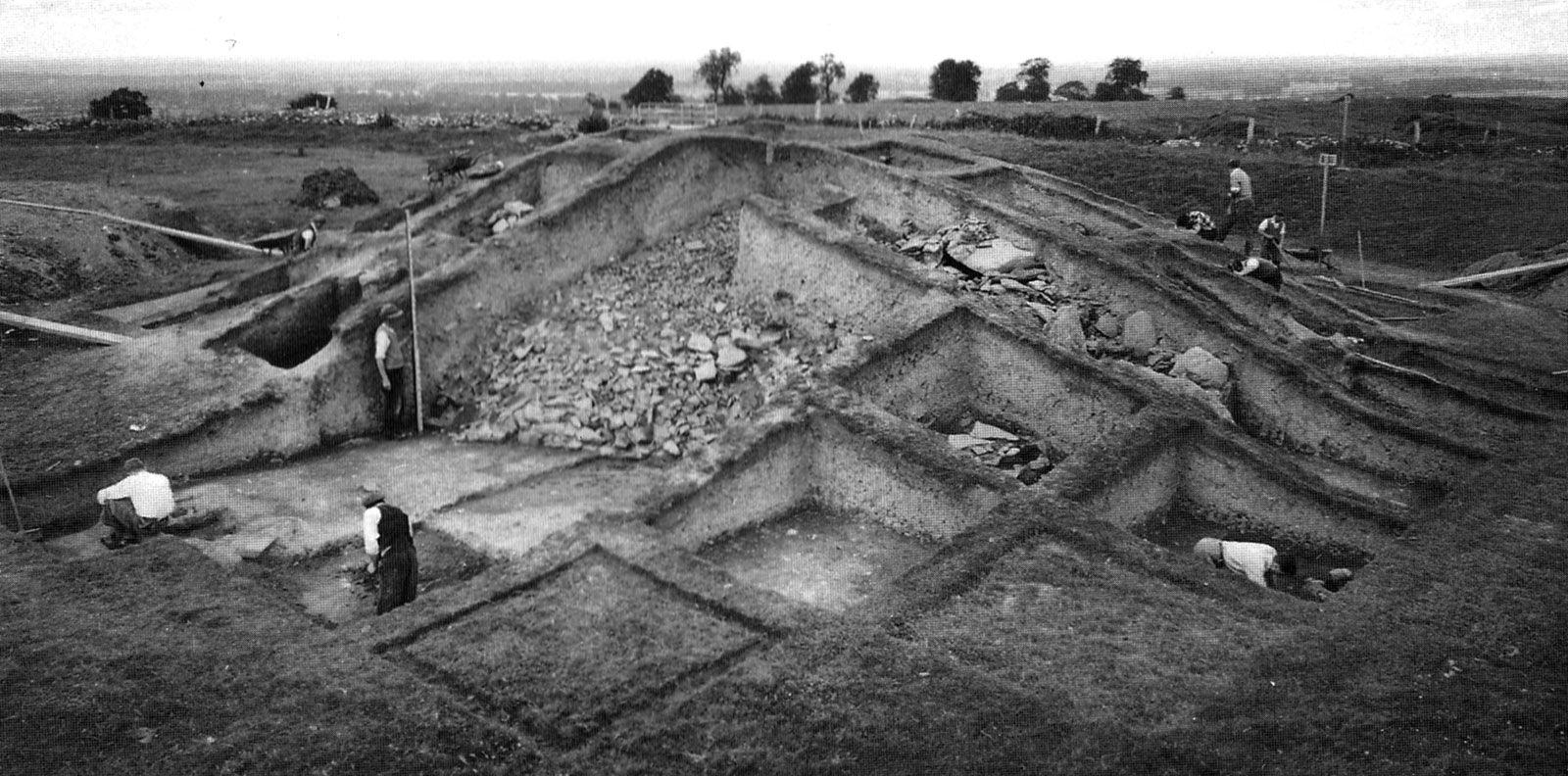
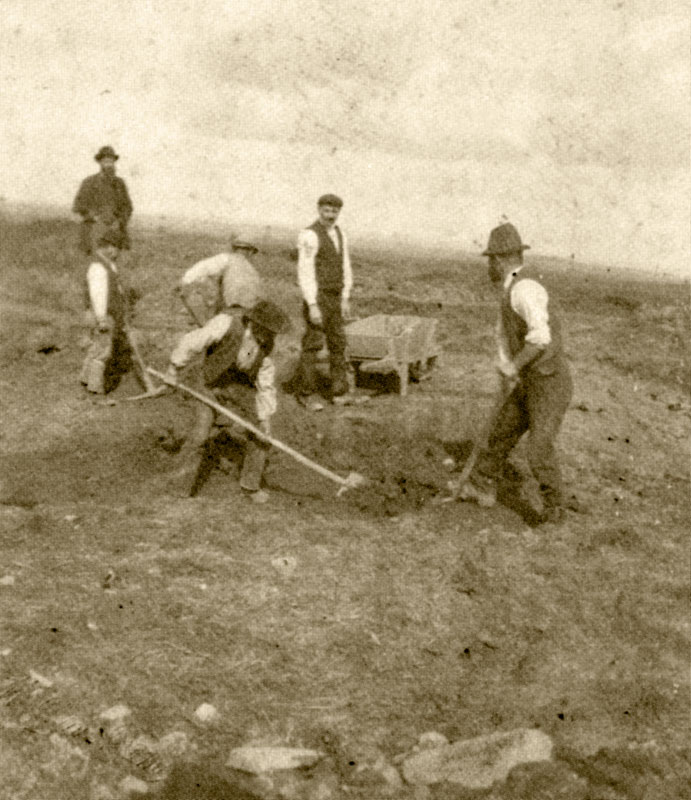
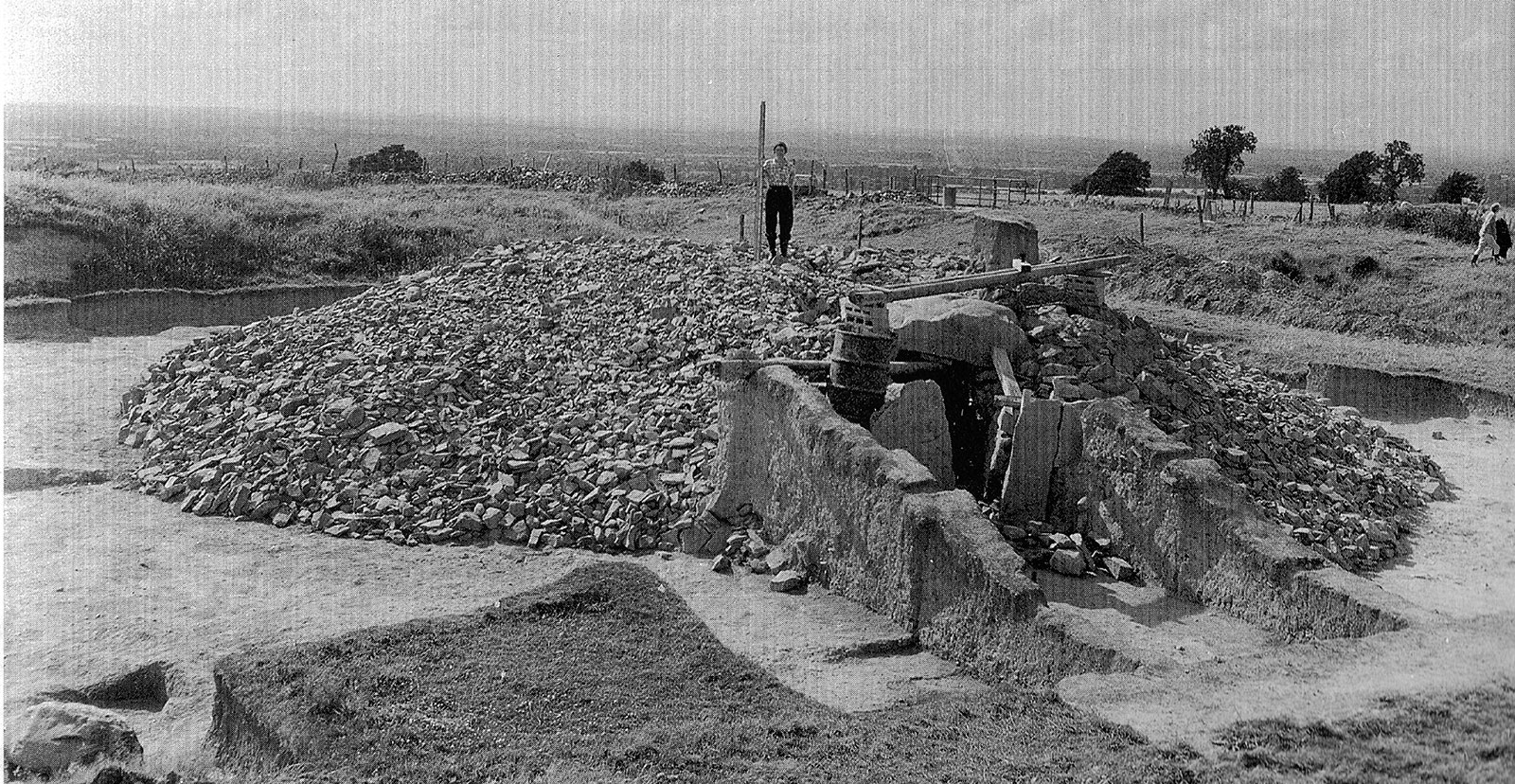
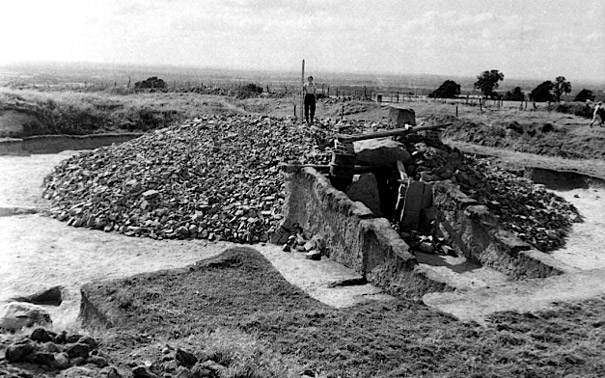
Excavations in 1955 at the Mound of the Hostages, the neolithic chambered mound at Tara.
The Hill of Tara
On the ancient Hill of Tara, from whose heights the High Kings once ruled all Ireland, from where the sacred fires in pagan days announced the annual resurrection of the sun, the Easter Tide, where the magic of Patrick prevailed over the magic of the Druids, and where the hosts of the Tuatha De Danann were wont to appear at the great Feast of Samain, to-day the fairy-folk of modern times hold undisputed sovereignty. And from no point better than Tara, which thus was once the magical and political centre of the Sacred Island, could we begin our study of the Irish Fairy-Faith.
Though the Hill has lain unploughed and deserted since the curses of Christian priests fell upon it, on the calm air of summer evenings, at the twilight hour, wondrous music still sounds over its slopes, and at night long, weird processions of silent spirits march round its grass-grown raths and forts. It is only men who fear the curse of the Christians; the fairy-folk regard it not.
Evans-Wentz, Fairy Faith in Celtic Countries, 1911.
The Hill of Tara is surely Ireland's most famous and mythical ancient site. This low and not particuarly imposing hill rises to 155 meters above sea level, but offers a majestic view across the Plains of Meath and much of the centre of Ireland. There are many ancient monuments spread across the hilltop ranging from the early neolithic to early Christian times. Tara is probably best known as the seat of the High Kings of Ireland, and is frequently mentioned in various mythological texts.
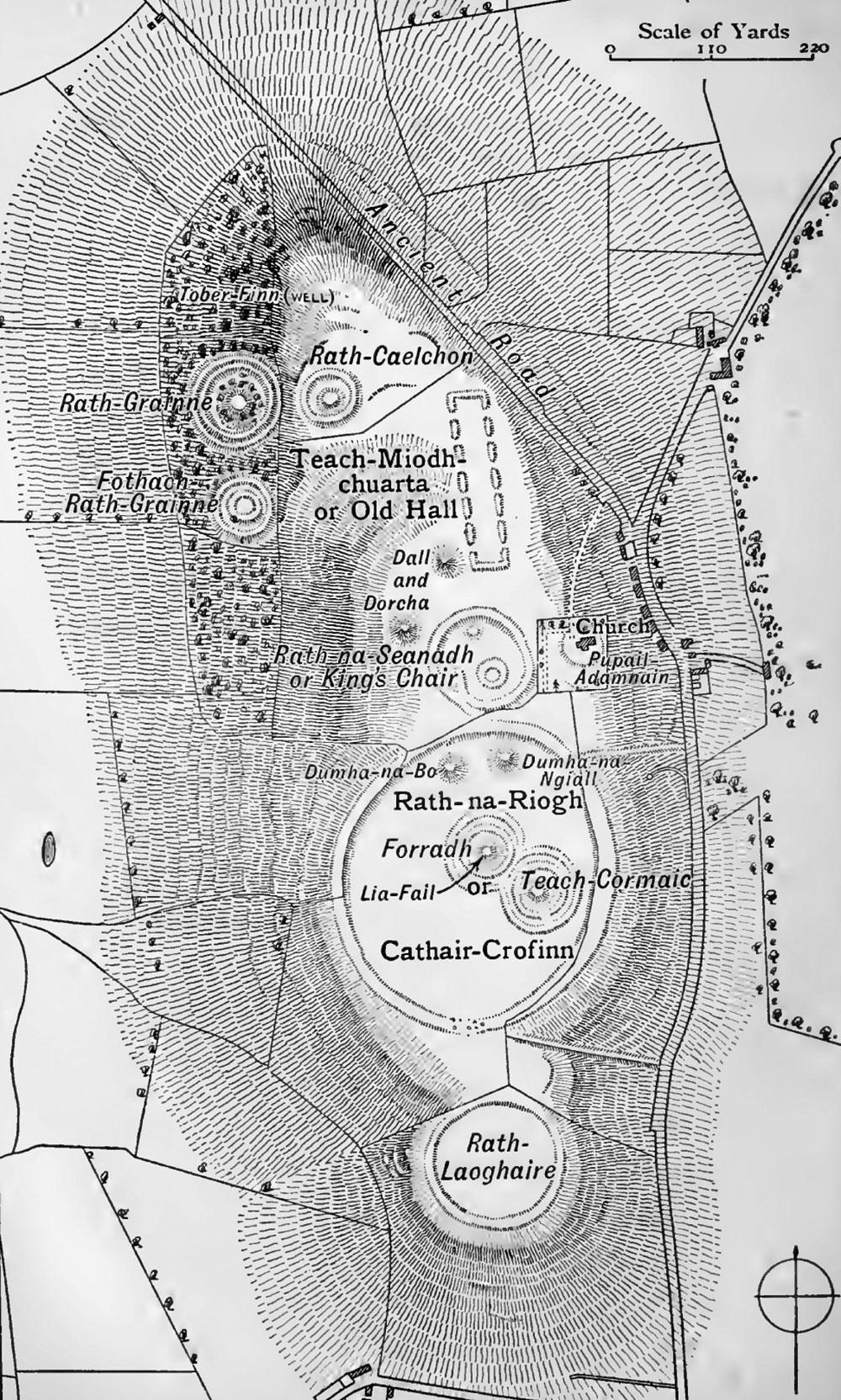
Map showing location of principal monuments on the Hill of Tara.
Monuments on the Hill of Tara
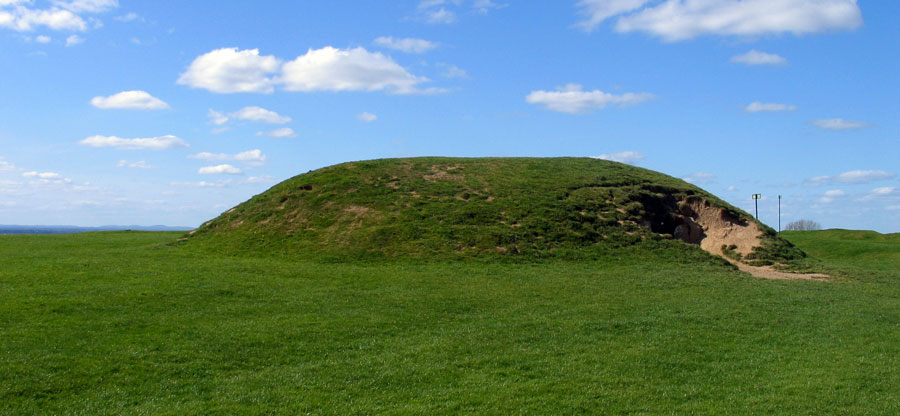
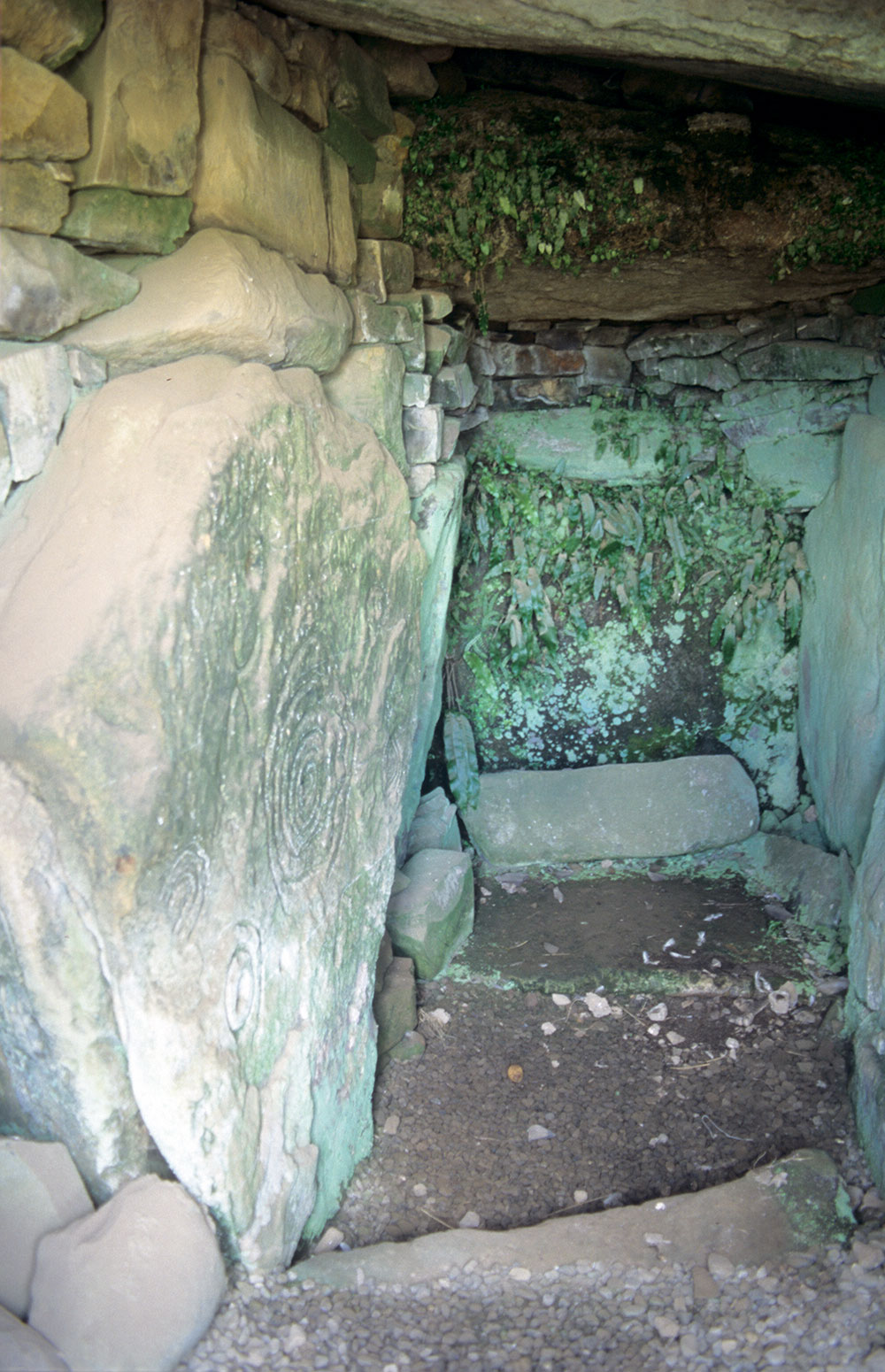
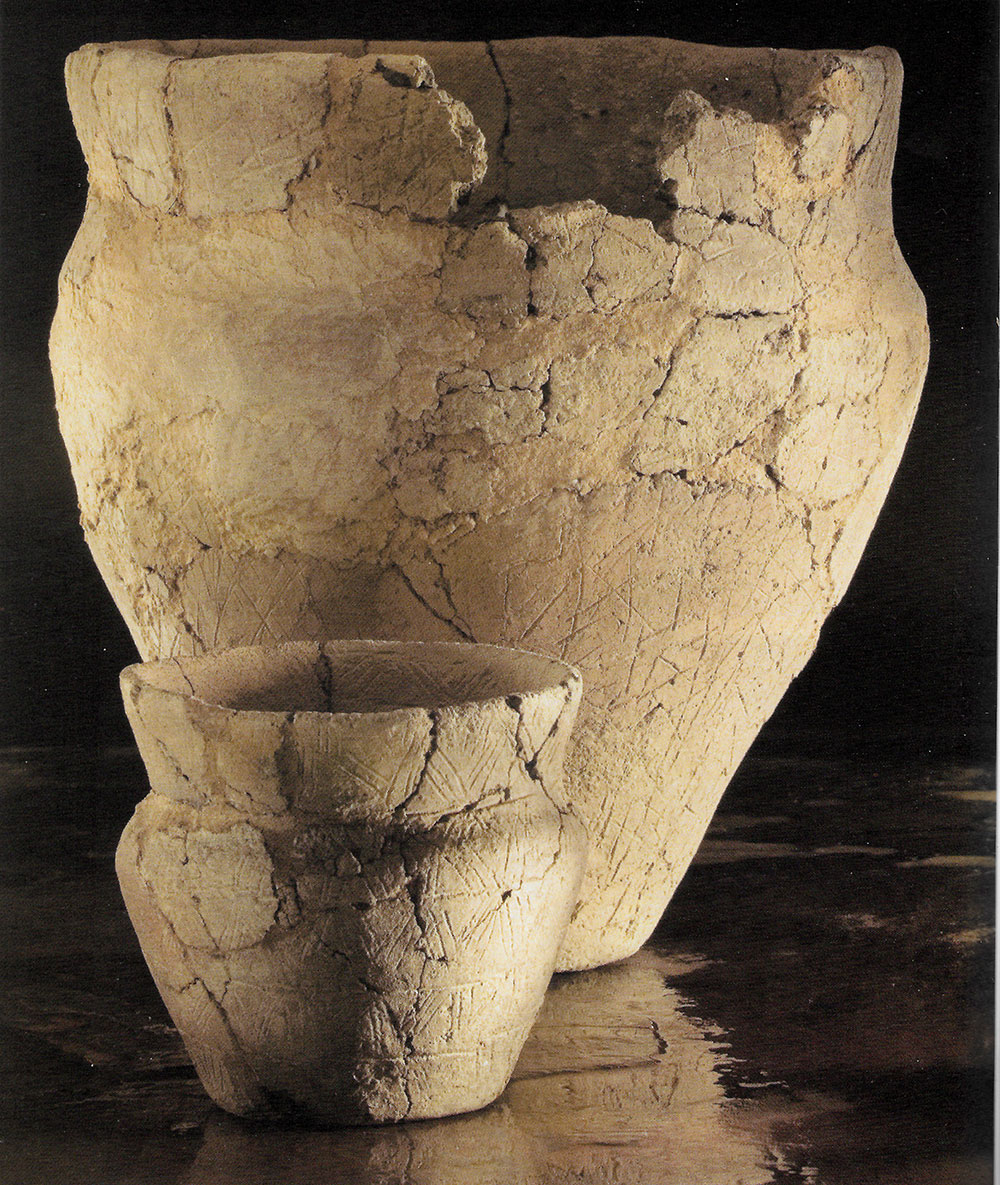
The oldest monument on the Hill of Tara is the Mound of the Hostages, a neolithic passage-grave which saw continued use for burials throughout the bronze age. The Mound of the Hostages has a short passage, which contains a fine example of neolithic carving. This chamber is oriented to capture the sunrises around Samhain and Imbolc, in harmony with chambers at Carrowmore and Loughcrew.
Surrounding the Mound of the Hostages is a huge rock-cut ditch dating from the neolithic, which was discovered during O'Riordan's excavations in the 1950's. There is evidence for a huge pallisade or henge feature constructed from massive treetrunks. These are the oldest features at Tara, with many more later monuments visible as lines and bumps radiating out across the hilltop. There are thirty monuments visible on the surface at Tara, with at least another thirty under the ground and not visible to the naked eye.
The Mound of the Hostages, a neolithic chambered mound, is one of the oldest visible monuments at the great multi-period site of Tara. The Loughcrew Hills can be seen to the left of the photo.
The view from Tara
The view from the Hill of Tara is widely regarded as one of the best in Ireland. The hill is about forty kilometers from the east coast, located just where there is an extensive view to the west across the midlands and into the heart of Ireland.
Standing at the top or southern extremity of this remain, and bearing in mind
the various prose and bardic histories of the Irish annalists, one cannot
help reverting to ancient heroic times, and again, in imagination, peopling
it with its earthly occupants. Here sat in days of your kings with golden
crowns upon their heads; warriors with brazen swords in their hands;
bards and minstrals with their harps; grey-bearded ollamhs; druids with
their oak-leaf crowns.....
Sir William Wilde.
The main monuments at Tara consist of barrows, raths, ringforts and enclosures, which
are spread across the two kilometers long hill. Like most other ancient sites
in Ireland, the neolithic people arrived here first. The oldest building
at Tara is a small chambered cairn on the summit of the hill which is
known as the Mound of the Hostages. This mound, dating to about 3000
BC, lies just within the northern edge of a massive enclosure known
as Raíth na Ríg, The Fort of the Kings, which measures a colossal 318 meters north to south
by 264 meters east to west and encloses an area of about five hectares, or some 12.5 acres in total. Within this great enclosure, dated to the First century BC are th pair of cojoined ringforts called the Forrad and Teach Cormaic, and within
the Forrad stands the famous Lia Fail or Stone of Destiny.
The Lia Fail was the Irish coronation stone; and it is much celebrated in our most ancient legendary history and literature. It Stood in Tara; and the supreme kings of Ireland were crowned sitting or standing on it. It was rockoned one of the wonders of Ireland; for according to the ancient legend it uttered a shout whenever a king of the true Scotic or Irish race sat on it. And so it was used to test the claim of every new aspirant to the throne: if he was of the royal line all heard the shout; but, on the other hand, if the stone was silent when he sat on it, he was instantly discarded. But according to Keating, the lia Fail retained this virtue only till the time of Conor Mac Nessa, the renowned king of Ulster, who lived at the beginning
of the Christian era; for all the oracular images and idols over the whole world were silenced at the birth of our Lord.
The proper name of the stone was Fal (pronounced fawl), for Lia means merely "a stone" and Lia Fail means the stone of Fal. We may judge of the estimation in which it was held when we know that Ireland received from it the ancient, and now familiar poetical name
of Inisfail, that is to say, the Island of the (Lia) Fail.
Just north of the Mound of the Hostages are the tumbled remains of the Rath
of the Synods, which is cut into by the grounds of the modern church.
Just north again is a long, linear earthwork, Teach Midchuarta, the
so called Banqueting Hall, which is probably the remains of a cursus,
or ceremonial pathway. West of the hall is Rath Grainne and the Cloenfherta,
the Sloping Trenches. To the south of Rath na Rig is Rath Loegaire,
and about one kilometer further south on the other end of Tara ridge is Rath
Maeve, a massive enclosure.
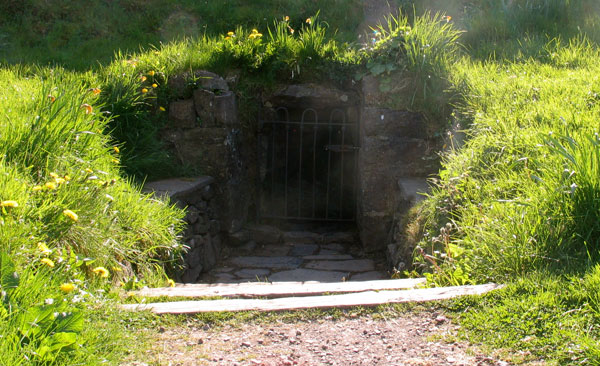
The Well of the Dark Eye, also known as The Healer, on the east side of the Hill of Tara.
In addition there are several wells at Tara. Local lore says there were
seven wells on the hill; some have been destroyed and filled in. The
best known of the wells lies just east of Rath na Rig and has many names:
The Well of the Dark Eye, Well of the White Cow, the Physican and the
Healer. The water is delicious and as some of the names suggest, it
is said to have healing powers.
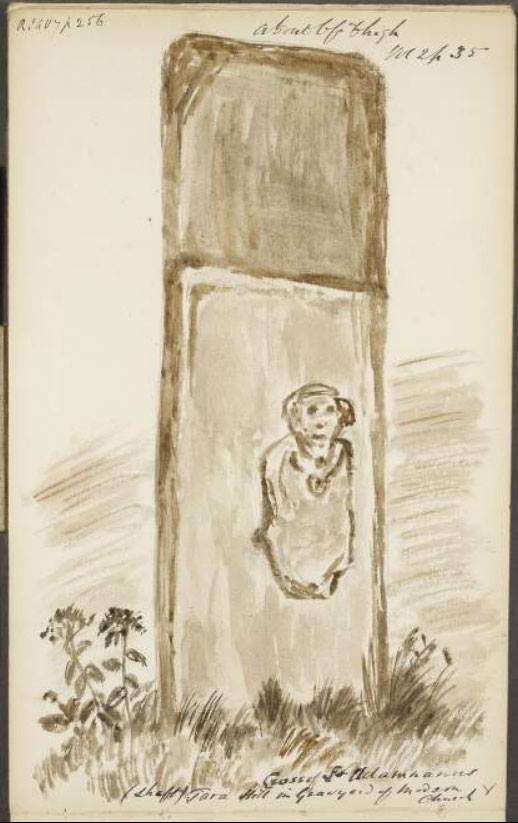
Du Noyer's illustration of the carving on what he called St. Adomhnan's Cross at Tara.
In the graveyard are two pillar stones,
one tall and thin, one short and stumpy, which are said to be part of
the kingship ritual at Tara. The taller stone has a carving of a Sheela-na-Gig.
Tea, daughter of Lugaidh, son of Ith, whom Eremon married in Spain, was the Tea who requested of Eremon a choice hill as her dower, in whatever place she should select it, that she might he interred therein, and that her mound and her gravestone might be thereon raised, and where every prince ever to be born of her race should dwell. The hill she selected was Druim Caein, i.e. the hill of Caen, i.e. Teamhair. It is from her it was called, and in it she was interred.
Annals of the Four Masters
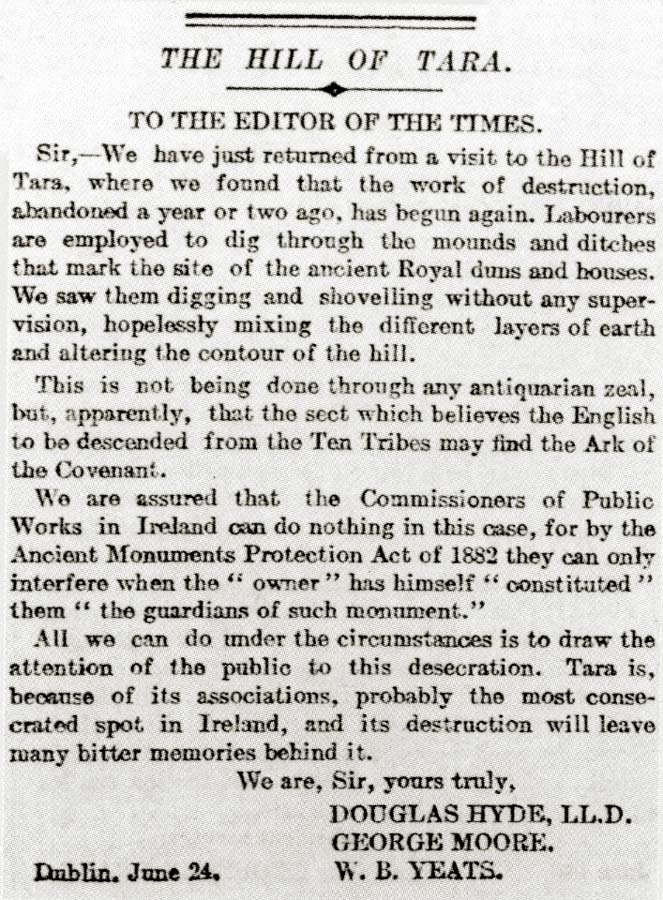
The British Israelites
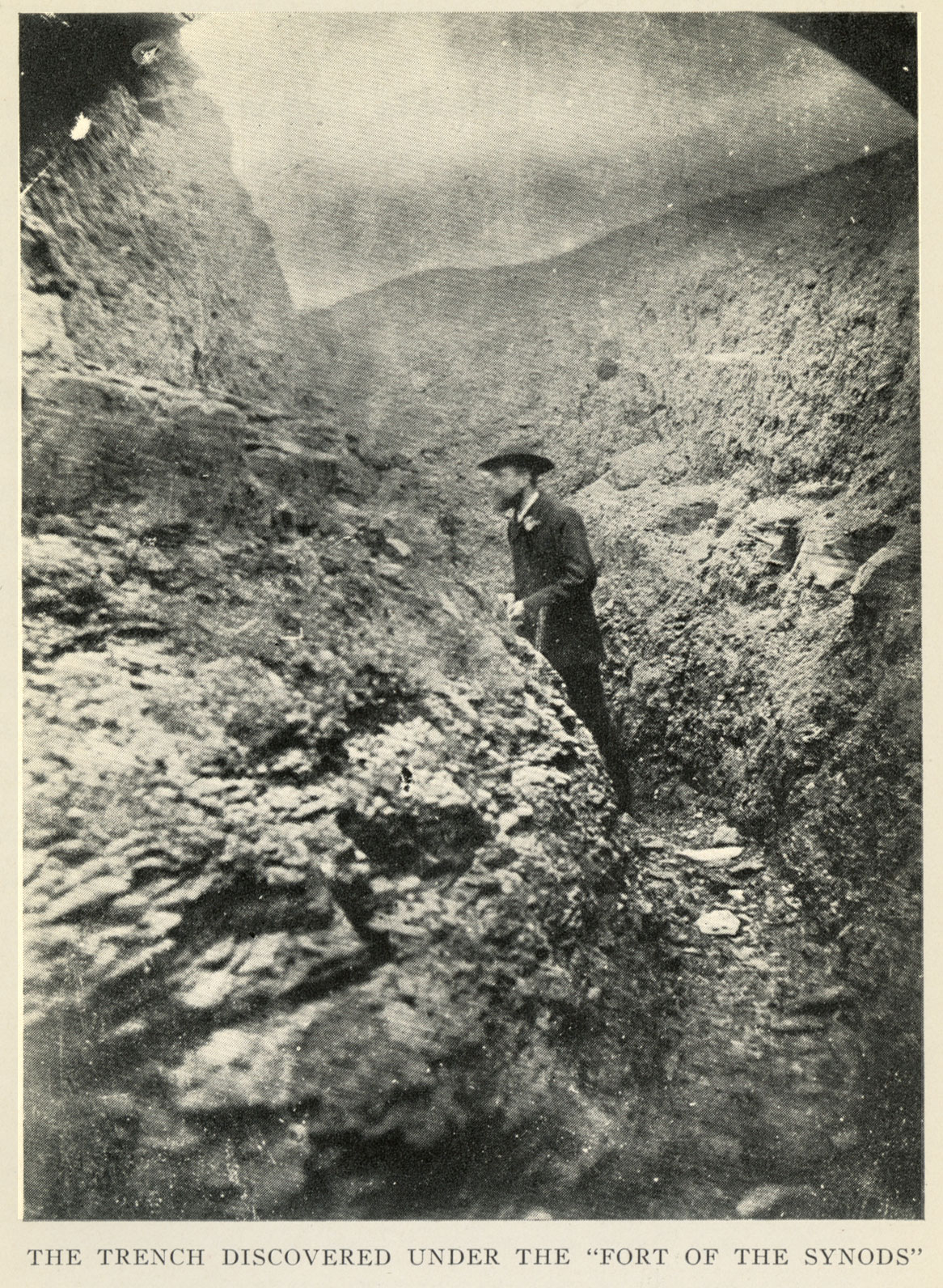
Between 1899 and 1902 a group known as the British Israelites went digging on the Hill of Tara, looking for the Ark of the Covenant. You can find a detailed account of their activities and beliefs on the excellent Voices from the Dawn website. The diggers rummaged through the Rath of the Synods. digging a huge and deep trench.
A lecture on the history of the Hill of Tara by archaeologist Sam Moore.
Excavations in 1952 and 1953
A series of exvavations
A MAN I praise that once in Tara's Halls
Said to the woman on his knees, 'Lie still.
My hundredth year is at an end. I think
That something is about to happen, I think
That the adventure of old age begins.
To many women I have said, "Lie still,""
And given everything a woman needs,
A roof, good clothes, passion, love perhaps,
But never asked for love; should I ask that,
I shall be old indeed.'
Thereon the man
Went to the Sacred House and stood between
The golden plough and harrow and spoke aloud
That all attendants and the casual crowd might hear.
'God I have loved, but should I ask return
Of God or woman, the time were come to die.'
He bade, his hundred and first year at end,
Diggers and carpenters make grave and coffin;
Saw that the grave was deep, the coffin sound,
Summoned the generations of his house,
Lay in the coffin, stopped his breath and died.
William Butler Yeats
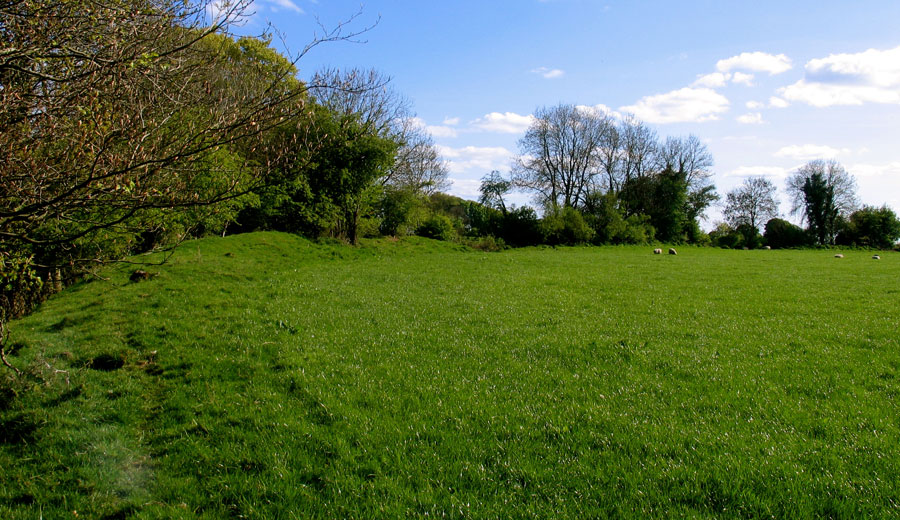
Rath Maeve, a massive earthen henge, located one kilometer to the south of the main monuments at Tara.