Dolmens at Carrowkeel
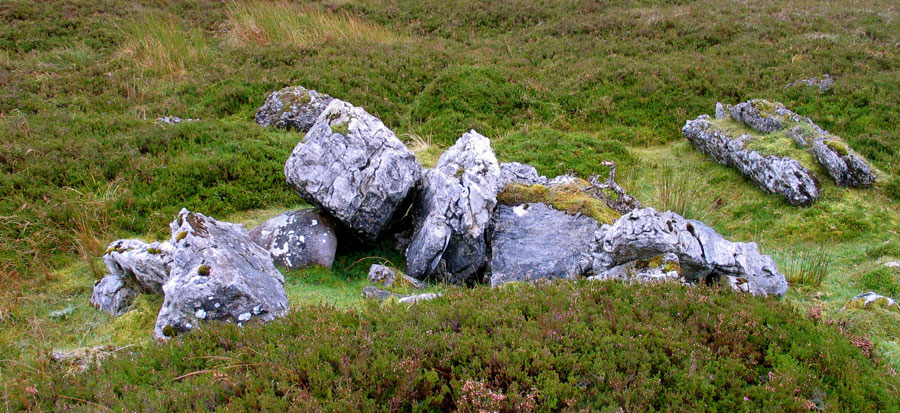
Not far from the south kerbs of Cairn H is the remains of a dolmen or stone table of some kind. Today the monument appears as a jumble of stone in the bog.
This is a most interesting little structure. There are four chunks of sandstone, small boulders, that are set out in a cross shape on the cardinal directions. Within this may be the remains of a small cist, at least three limestone slabs can be seen.
This was covered by a large flat slab of limestone, which was smashed sometime before 1911. This innocent little monument may be an original setting out position for the astronomical observations and alignments on the ridge of Carrowkeel.
Small table type structures may have been fixed positions for observations of sun and moon sets to stand, and may predate the cairns.
R. A. S, Macalister, 1911.
A short distance south-east of Carn H is a massive block of limestone which, when sound, measured about 5 feet 7 inches by 4 feet by 1 foot 8 inches. It is now split into fragments. It had been placed on four round boulders of sandstone, now partly buried in the peat, which were arranged in a lozenge form and, roughly speaking, faced the cardinal points.
Three limestone slabs set on edge are added, apparently placed with the intention of forming a cist. The use of sandstone erratics has already been commented upon in describing Carn F: it suggests that the builders appreciated the difference between the two kinds of stone, and recognized the greater strength of the sandstone blocks.
Plate XVI, fig. 1, represents this structure, which is, however, an exceptionally difficult subject for the camera, on account of the collapse of the cover-stone, which gives it the indefinite appearance of a shapeless pile of stones.
2. A few paces east of Carn K is a square structure of large limestone slabs. There had originally been a cover, as we learned, which was, however, smashed up by rabbit-hunters. Fragments of this stone are lying about. Doubtless anything the cist may have held was then removed.
The chamber measured about 6 feet by 4 feet 6 inches by 2 feet 5 inches high. There is no evidence that this cist was ever covered by a heap of stones. This structure is shown in Plate XVI, fig. 2.
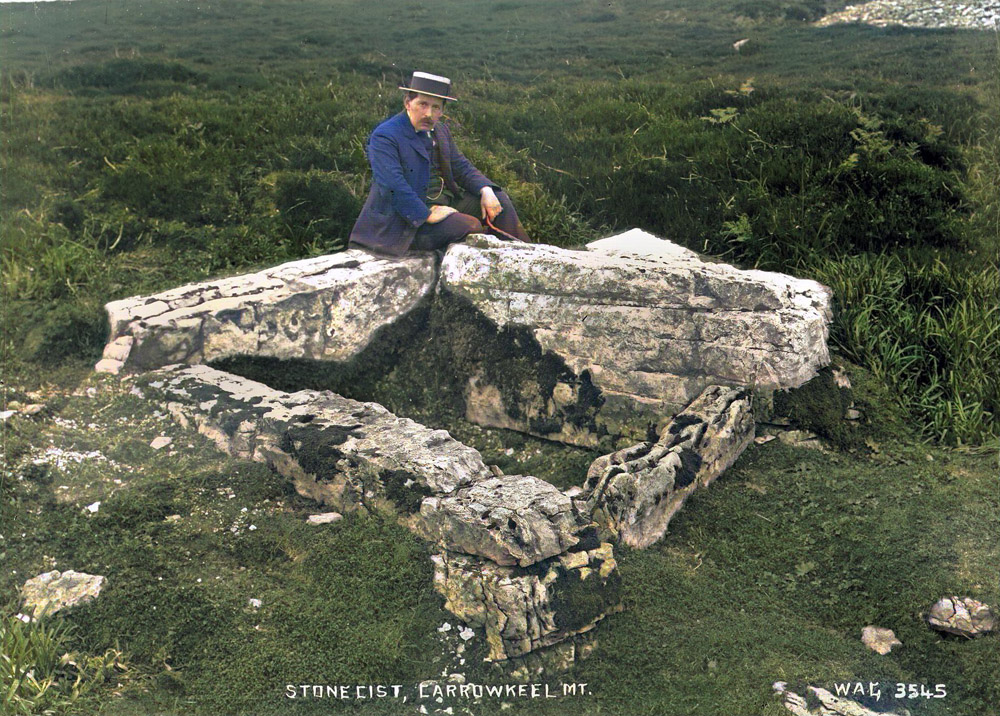
The length and breadth of the slabs, beginning with the large stone in the foreground and working round in order to the smallest stone, are respectively 7 feet by 1 foot 2 inches; 5 feet 2 inches by 1 foot 3 inches; 6 feet 5 inches by 1 foot 2 inches; 3 feet 3 inches by 6 inches.
On the eastern edge of the ridge called Carn Mor, and about midway between the two groups of Carns E, F and M, N, is a standing stone 7 feet 6 inches high, 5 feet wide at the base, but tapering to a point, and 2 feet thick. We came to the conclusion that it belongs to geology rather than to archaeology, showing no sign of having been erected artificially.
Of course it may have been accepted by the carn-builders and used by them for whatever purposes standing stones were set up. There are no marks of any kind on the stone.
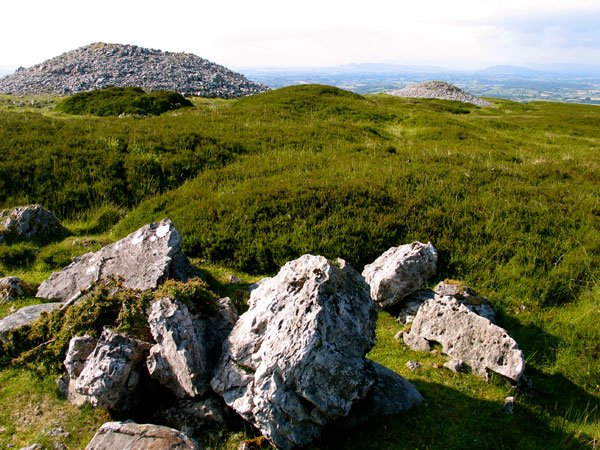
There is also a flat slab on the west side of Cairn G which may have performed a similar function as an observation platform. This large slab may cover a cist, similar to the cist near Cairn K.
It is interesting that the three cairns have possibly earlier megalithic structures beside them. Beside the Cairn H dolmen is a green mound with several large limestone flags which Macalister thought were natural, but looks to be another monument of some kind.
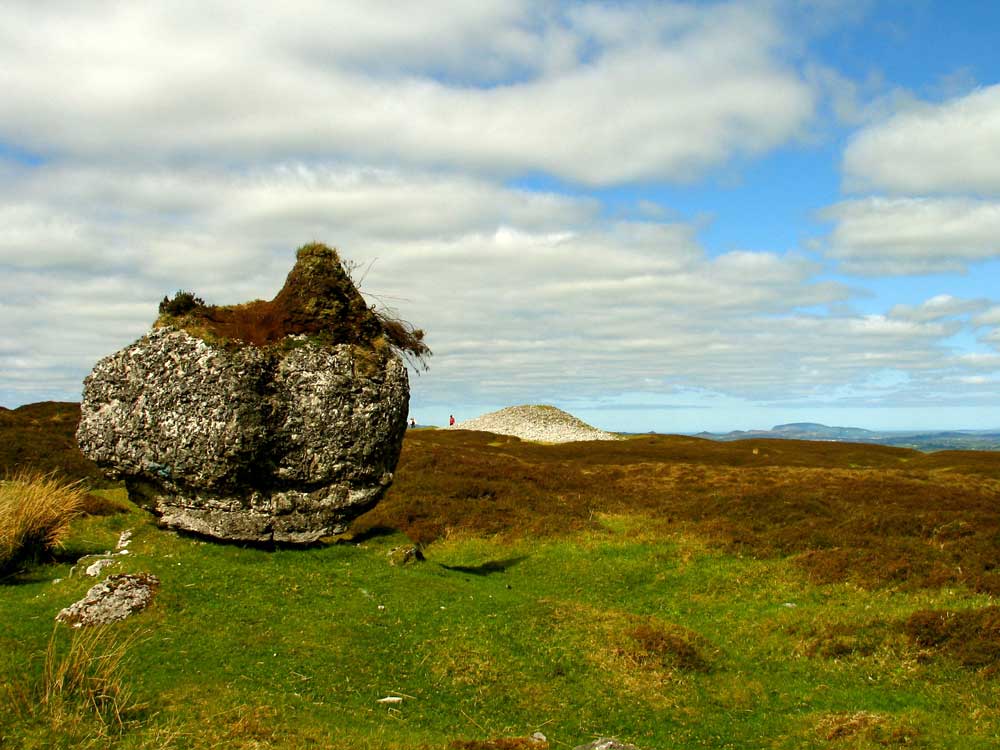
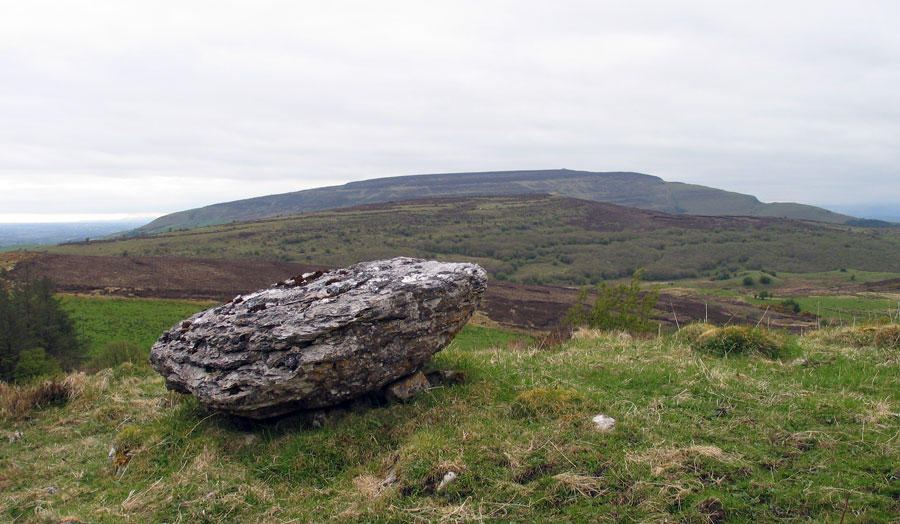
Close by is the beautiful erratic boulder shown in the picture above. This stone is natural, but falls on a line with the chamber of Cairn G and Doomore: the axis of the midsummer sunset. The stone may function as a sundial and cast shadows on H and G at sunrise on the winter solstice and November/Feburary cross quarter days.