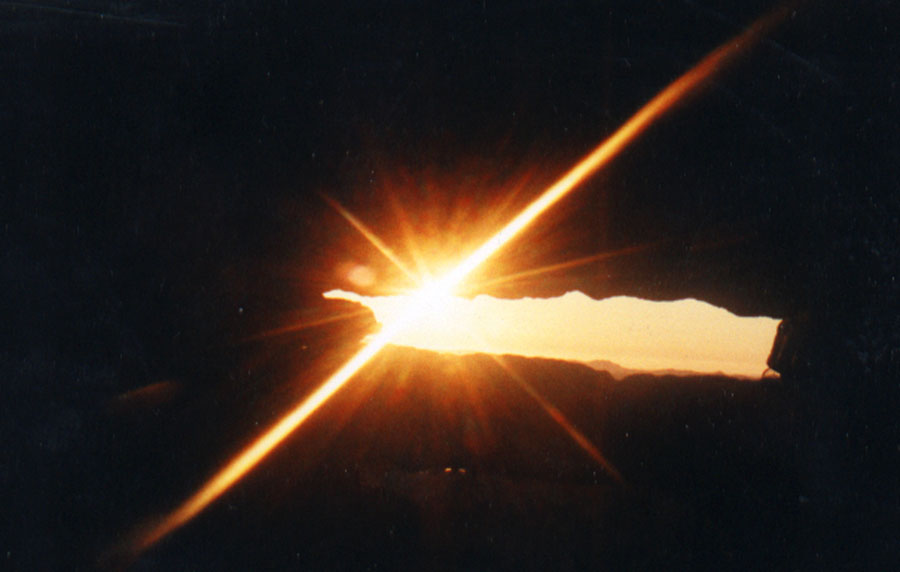
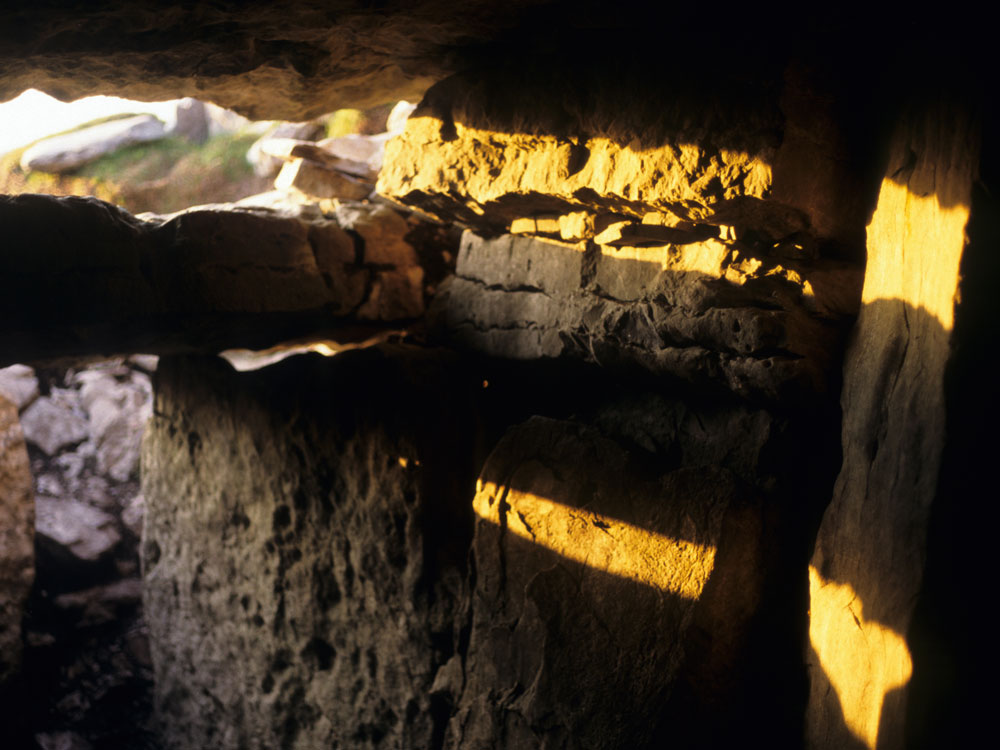
The dramatic entry of the sun into Cairn G near the summer solstice. The distant
hill of Doomore can be seen through the roofbox. This picture was taken
in 1997.
Astronomical Observations from Cairn G
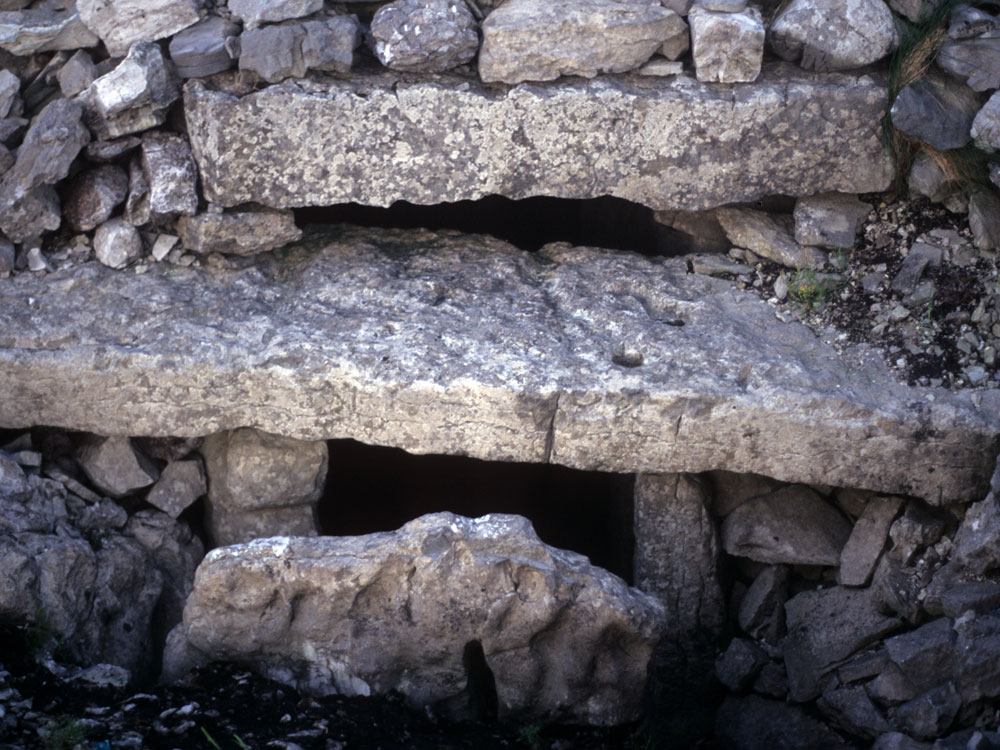
Above the entrance of Cairn G is an opening or slot which seems to be an early version of a roofbox. The only other example currently known in Ireland is at Newgrange in the Boyne Valley, which is famously aligned to the winter solstice sunrise. Another somewhat unconvincing example was found at Crantit on the
Orkney Islands, where there are about 80 neolithic chambered cairns, several of which have proven astronomical alignments.
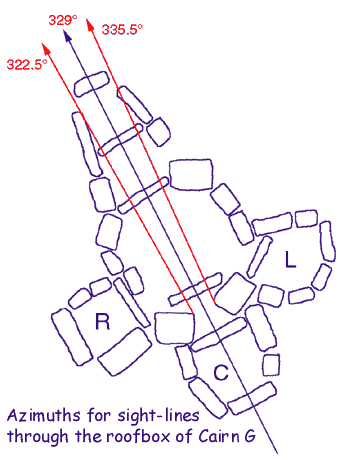
The roofbox at Cairn G in Carrowkeel.
The Carrowkeel roofbox has several features in common with the one at Newgrange.
It is located over the entrance to the chamber; a stone door
is present; and the roofbox admits a beam of light from the sun
at sunset over several weeks on either side of midsummer.
However, there are also some features about Cairn G which are different
to Newgrange. The passage is much shorter than Newgrange, only
about two meters long, and so the roof box opens directly into the chamber. The entrance to Cairn G is pointing in the opposite direction to Newgrange, the same orientation as Kerbstone 52 at the back of Newgrange.
The short length of passage means that the sun can shine into the chamber
for a much longer period of time than Newgrange. The sun enters the chamber of Cairn G for approximately
a month before and after midsummer, though it only spends about
two weeks in the rear left recess of the chamber.
Another factor to consider is that even though the sun has been displaced by 1.5° (three solar diameters) to
the west or left, it is impossible that the midsummer sunset could ever have shone
into the end recess of Cairn G. It currently enters the left resess of the cruciform chamber.
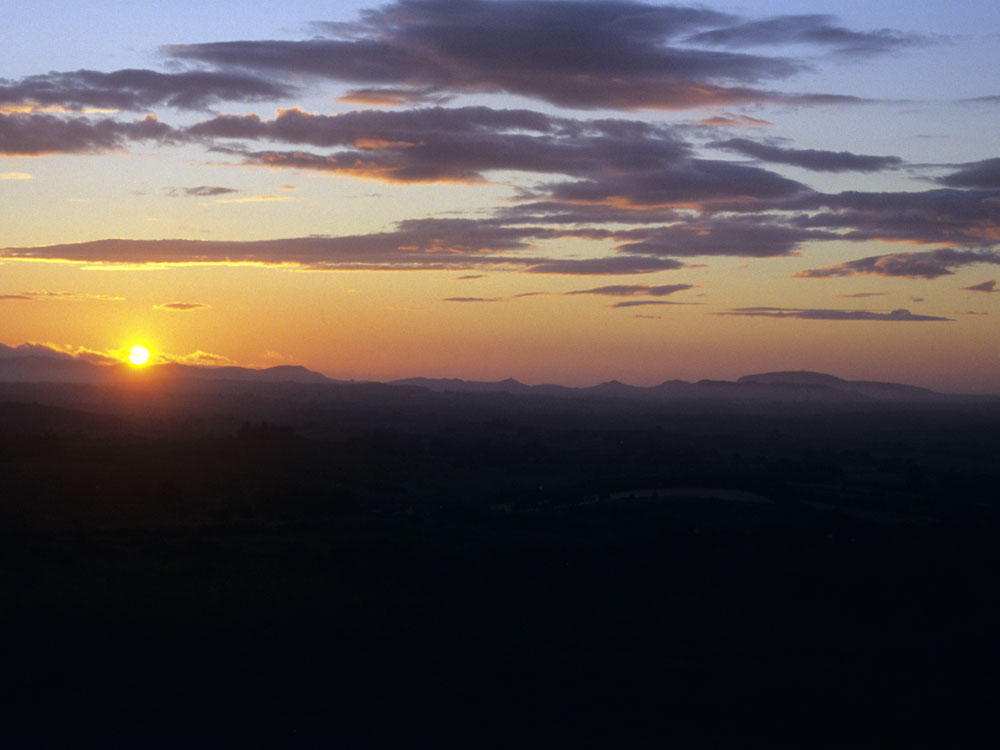
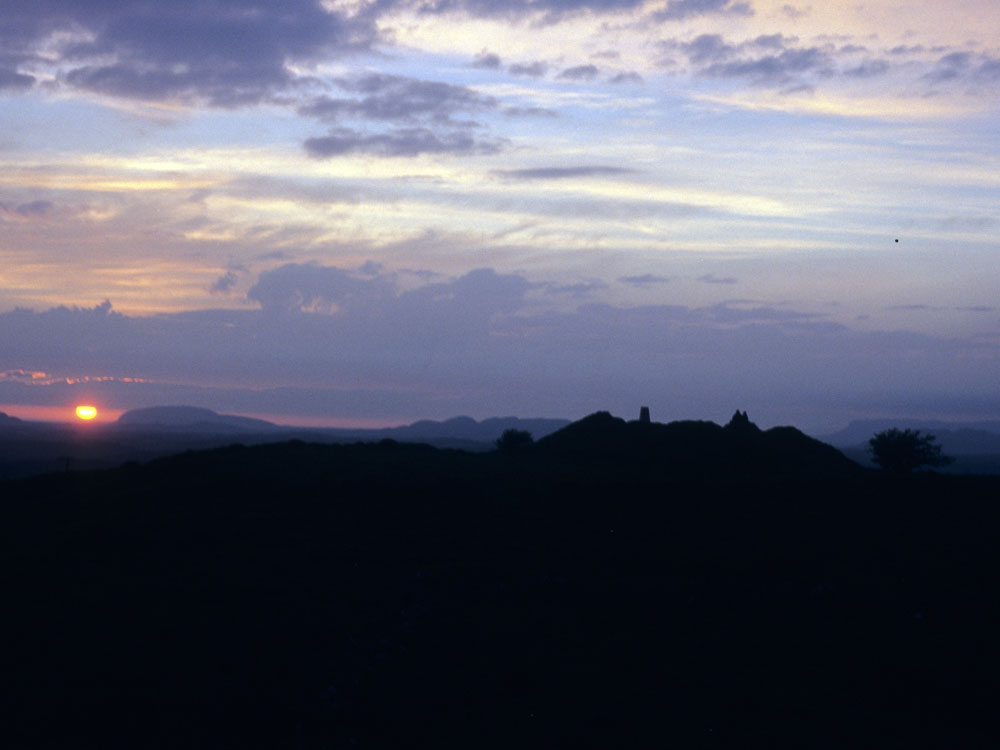
Sunset about one week from midsummer viewed from Carrowkeel. From the chamber of Cairn G it is possible to monitor the movement of the sun as it passes along the ridge of the Ox Mountains to standstill at Doomore.
The alignment of the chamber is oriented directly the setting extreme lunar standstill. In Irish arechae-astronomy, the moon always gets overlooked in preference to the sun, which is much easier to monitor. At Newgrange virtually no research has been conducted into the rising moon at midsummer, which undoubtedly illuminates the chamber at specific points during the lunar cycle. Each month the full moons rises and sets approximately 180° opposite the sun's rising and setting positions.
The setting full moons on either side of the winter solstice also illuminate the chamber
of Cairn G in much the same fashion as the sun does each summer. I have been present in Cairn G for several cold midwinter moonsets, but the moon tends to set into thick banks of
cloud over the Ox Mountains, too faint and obscure to capture in a photograph back in the late 1990's.
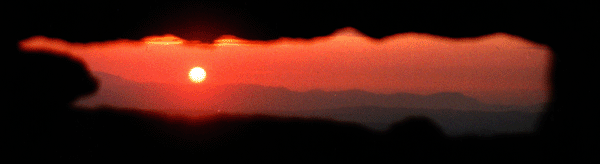
Sunset through the roofbox. This picture was taken about two weeks before midsummer in 1997. The hill of Doomore, the misdummer solstice marker, is to the right.
Ritual Astronomy
Some form of religious and ritual astronomy undoubtedly played a major role in the design and
location of the Irish passage-graves. Stone and chalk balls are a kind of neolithic artefact commonly found in the chambers of these monuments. Quite possibly they may have been used as teaching or recording aids, placed in the roofbox to show
solar and lunar positions on the horizon. Some of the examples found in Carrowkeel are on display in the National
Museum in Dublin.
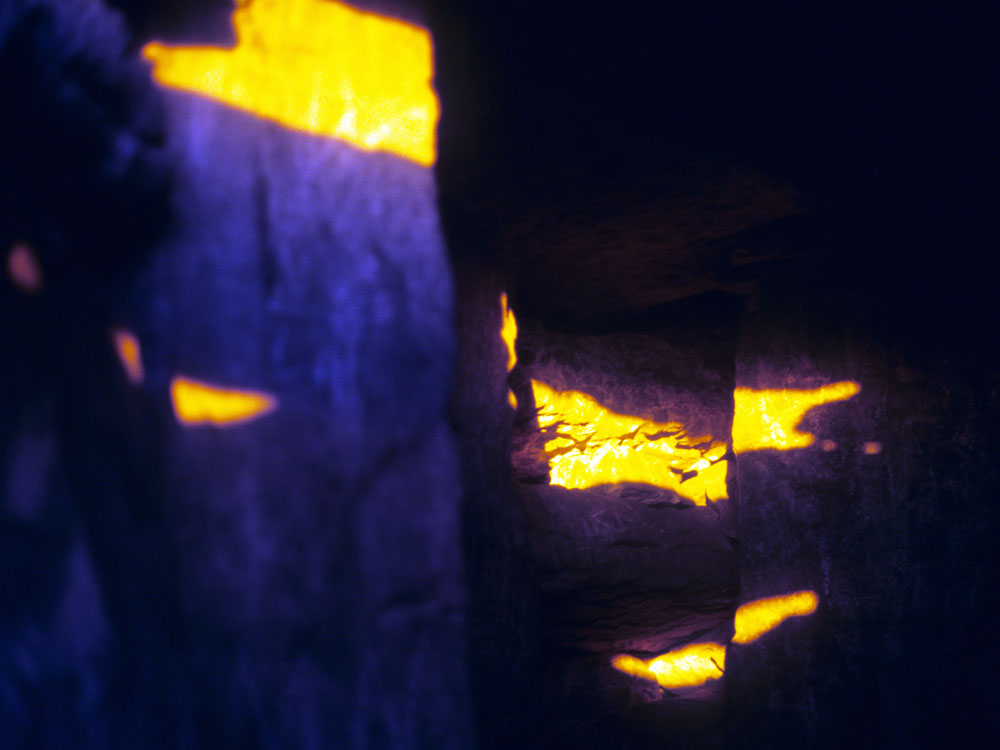
Sunset on the summer solstice enters Cairn G through the roofbox.
The sun can shine into this monument for about six weeks on either side of midsummer.
The main axis of Cairn G is aligned to the left edge of Knocknarea mountain where Queen Maeve's cairn is clearly visible on the summit. This is a similar orientation to Cairn B, Cairn E and Cairn K, and is approximately the position of the northern extreme setting midwinter full moon.
The lunar standstill occurs every 18.6 years, when the moon reaches its maximum swing away
from the ecliptic. While plenty of research has been done on lunar extremes at Stonehenge and Caillinish, relatively little is known about how Irish monuments relate to the moon.
Plan of Cairn G.
Lunar Standstills
The lunar standstill is difficult to predict precisely and a distant foresight, usually a mountain was preferred for making observations. Knocknarea, which can be translated as the Hill of the Moon is the main foresight for Carrowkeel, but it is too far to the north for the lunar standstill to reach.
The best candidate is the small cairn on Croghaun in the Ox mountains, which is visible through the roofbox from the back of the chamber. When viewed from within Cairn G, the cairn on Doomore marks the midsummer and Croghaun the lunar extreme or 'lunstice' setting positions. It has been suggested that the roofbox at Cairn G was used for predicting eclipses.
Summer
solstice sunbeam within the chamber of Cairn G.
Knocknarea is located on the western end of the Cuil Iorra peninsula, which could possibly be translated as the Remote Angle. The lunar standstill was undoubtedly a great ritual event in a calendar of astronomical observations which were made by our neolithic ancestors. It defines an axis between the central ridge of Carrowkeel and Knocknarea.
Knocknarea mountain was also used as a foresight from Moytura which is situated east of Carrowkeel across Lough Arrow.
Summer solstice sunset from the neolithic cairn called Shee Lugh on the highest part of Moytura across Lough Arrow to the east of Carrowkeel.
The summer solstice sun drops behind Knocknarea when viewed from
Shee Lugh, the cairn on highest point of the ridge of Moytura, which is known as the Seat of the Sun God of the Túatha Dé Danann, Lugh of the Long Arm. This cairn is where Lugh Lamh Fada, the young champion and grandson of Balor of the Evil Eye, sat during the mythical Battle of Maigh Tuireadh.
The physical locations and astronomical orientations of the Sligo neolithic monuments, coupled with their mythological associations, open the way for a broader interpretation of the meaning of these monuments.
The main group of cairns at Carrowkeel. Cairn G with it's roofbox is in the foreground, Cairn H is to the right, and Cairn K is on the summit in the distance. At this time, about 1995 the entrance to the chamber was blocked.