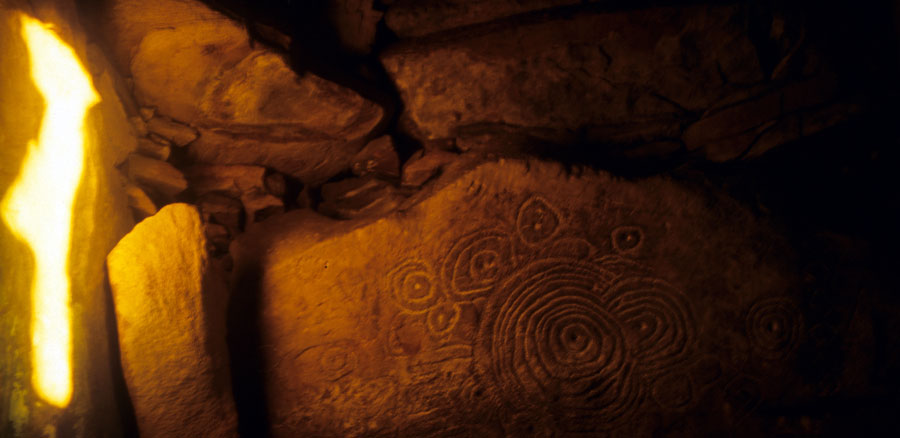
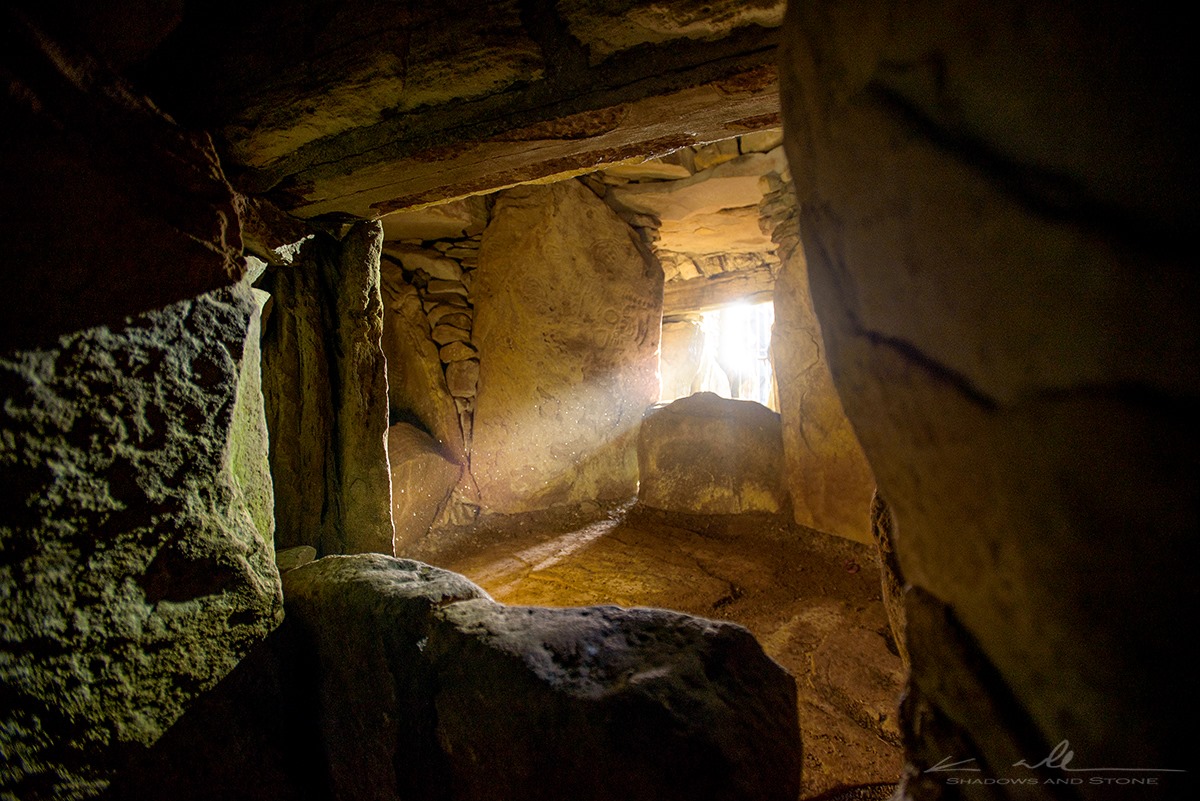
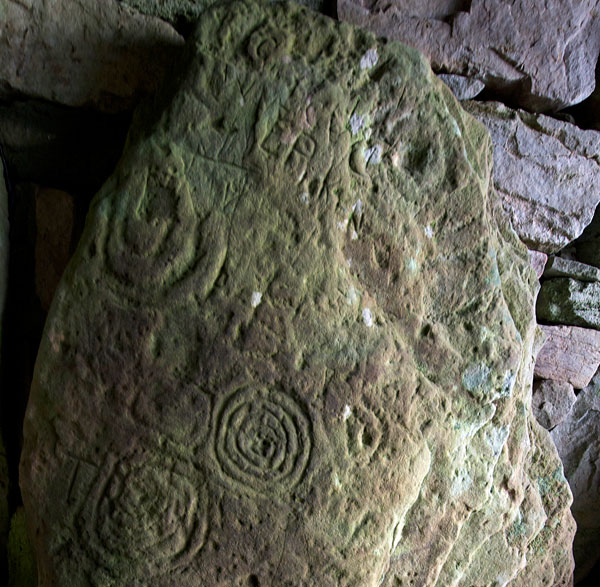
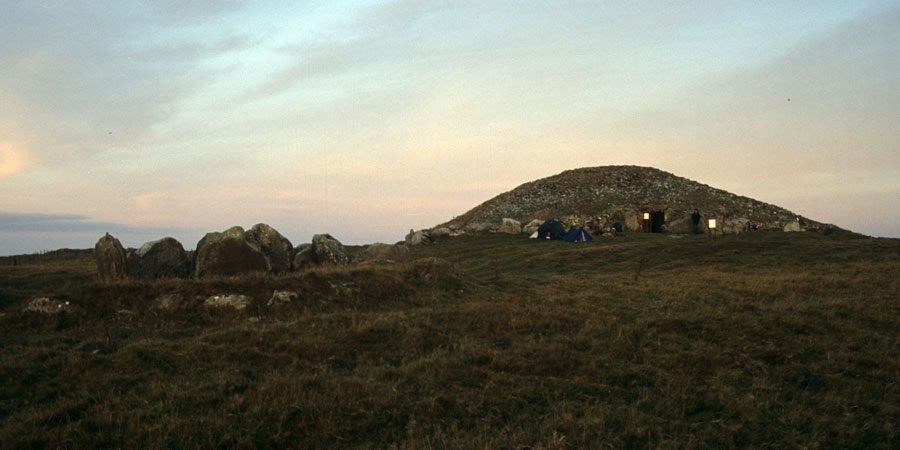
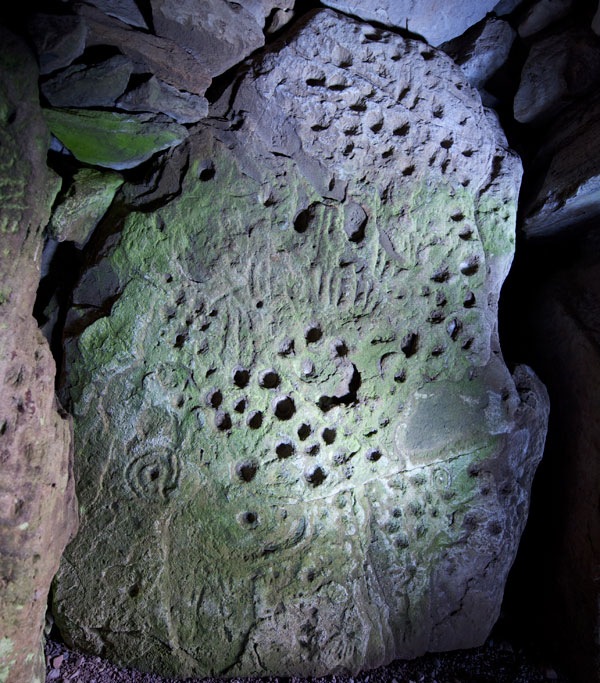
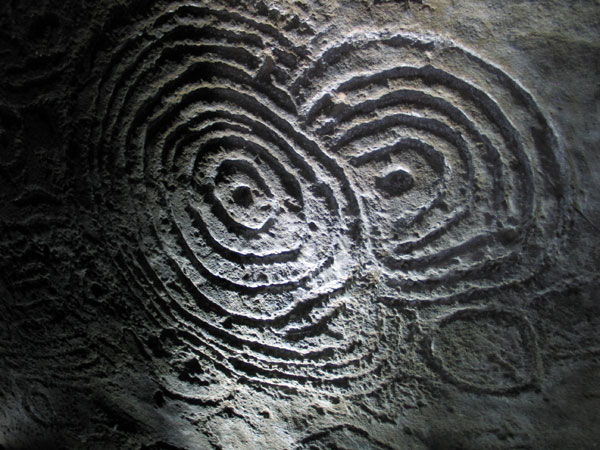
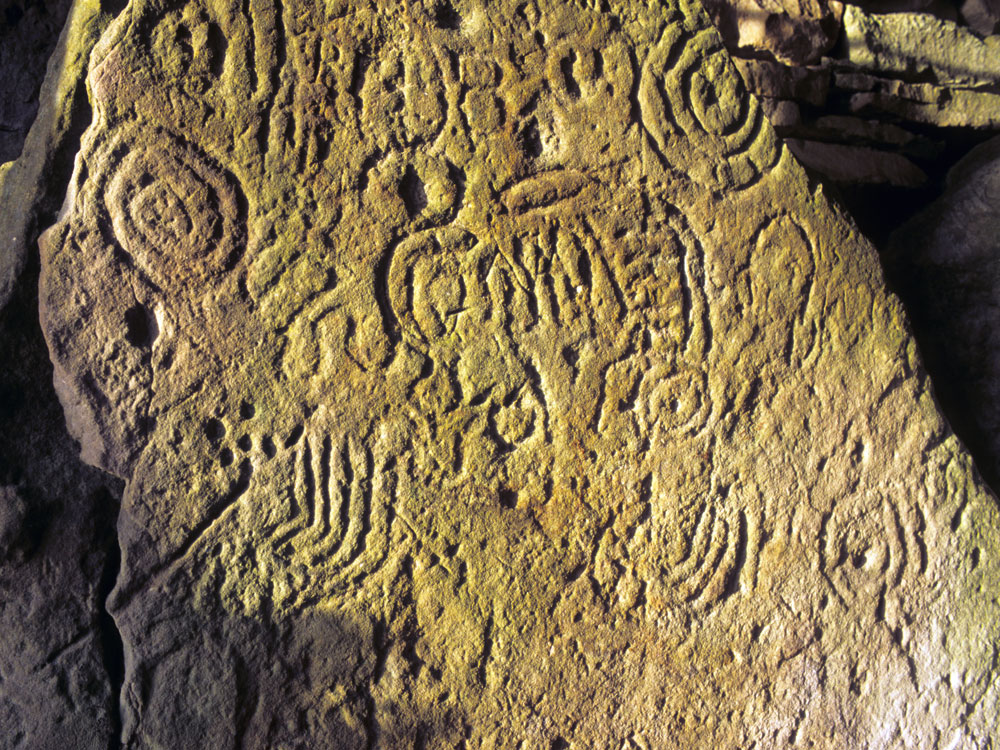
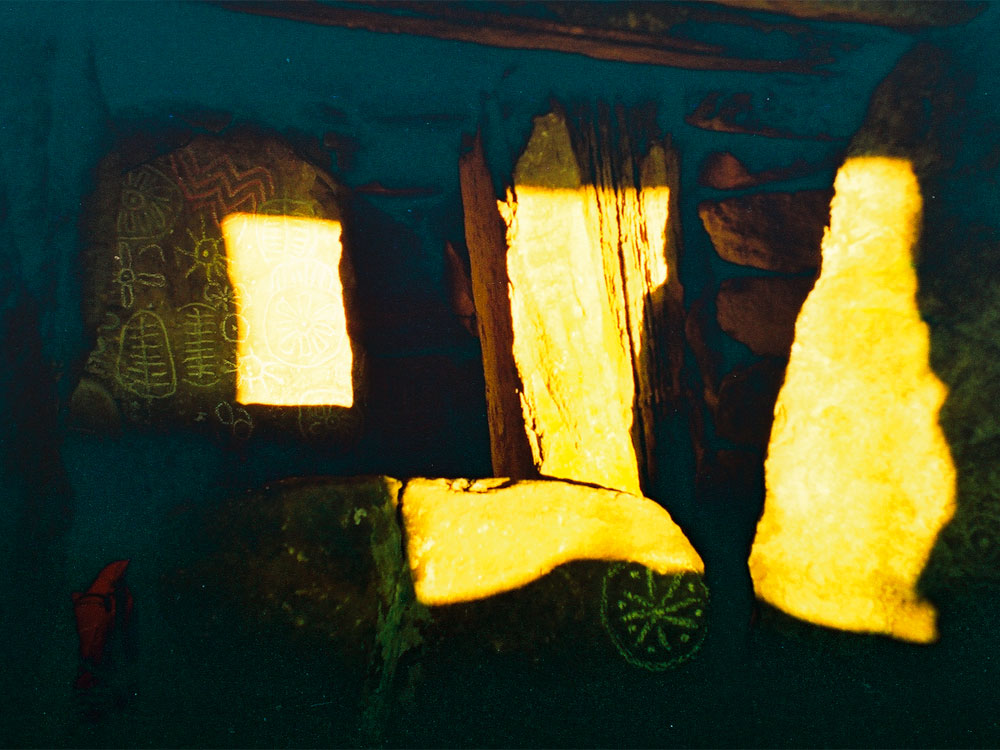
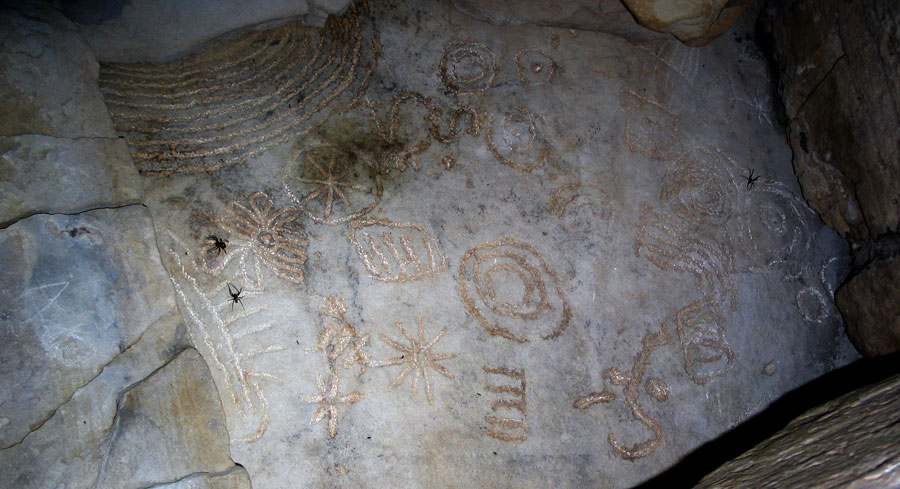
The main panel of art within is lit up with a beam of light, which penetrates the chamber not long after sunrise in early November and Feburary. Cairn L, Loughcrew November 1997.
Megalithic art at Loughcrew
Loughcrew
is the home of a superb collection of megalithic art; many of the stuctural
stones of the chambers bear engravings, and doubtless there were many
more in the past. Eugene Conwell, who 'discovered' Loughcrew while on
a picnic with his wife, had a few of the stones illustrated for his lectures
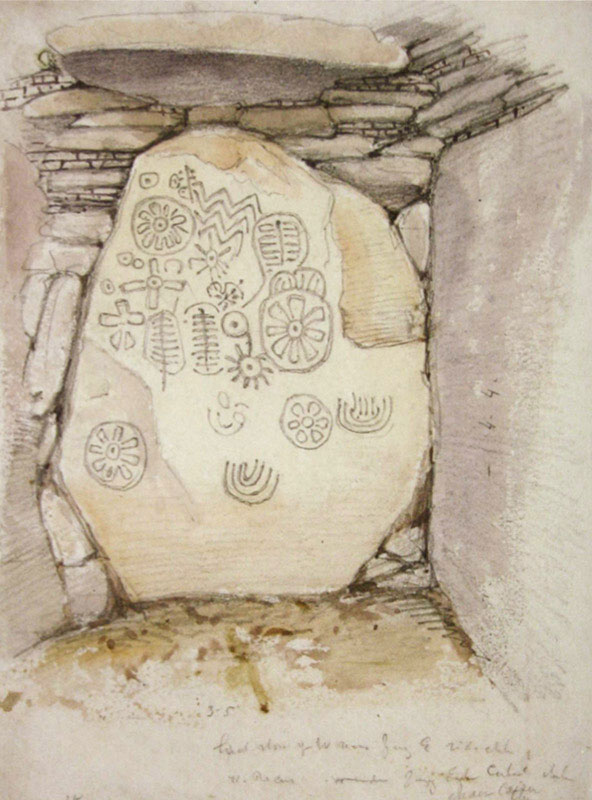
to the Royal Irish Academy. The Hag's Chair, left is one of his illustrations.
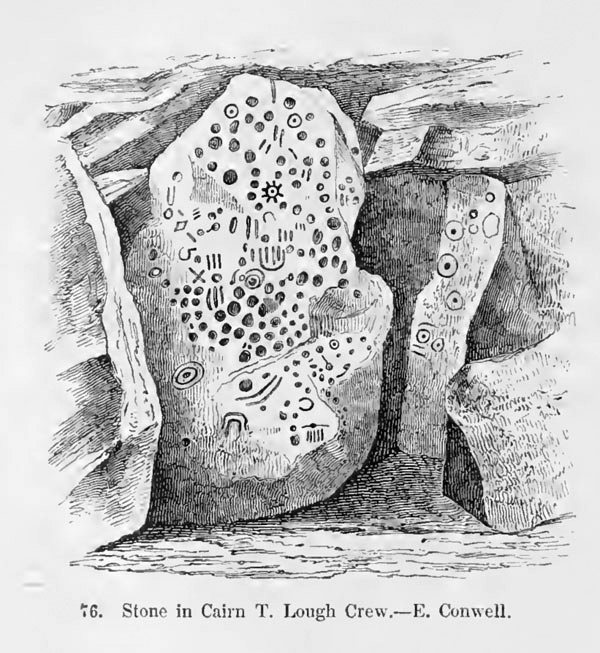
The Dutch artist du Noyer recorded many of the Loughcrew engravings in
the 1860's, a very valueable record since many of the stones have greatly
weathered since then. Two of his illustrations are reproduced below. More
of Du Noyer's illustrations can be seen in Michael Herity's 1975 book
Irish Passage Graves.
Du Noyer's engraving of the endstone within Cairn T.
Excerpt from Pagan Ireland by Wood-Martin.
What the peculiar marking called 'rock-scribing' represents is a question still unanswered, though numerous conjectures have been hazarded. Cup - markings, incomplete rings, a series of circles round a central cup — sometimes with a radial groove through the circles — these are the commonest types. It has often been advanced that these incisions in the hard rock could only have been produced with metallic implements, but it is stated that a person experimenting, with only the assistance of a flint chisel and a wooden mallet, cut, in the space of two hours, nearly an entire circle on a block of granite
which bore archaic devices.
The megalithic chambers in the carns on the hills over Loughcrew, County Meath, are more lavishly adorned with types of primeval sculpturing and devices than those at present known in any district except France, for Ireland possesses a collection of this species of pre-historic ornamentation which, in singularity, number, and quaintness of design, is approached in point of interest only by some of the great stone chambers of the district of the Morbihan.
In Ireland, cup-markings appear to be the commonest form of ornamentation, and they present two leading varieties, i.e. circular hollows of more or less depth, and of a
diameter varying from eighteen inches to as little as one inch. These depressions sometimes occur singly, but usually they are in groups; not unfrequently around,
or partly enclosing each, may be observed one or more
incised lines, often of considerable depth, to which
other markings and variations are occasionally added.
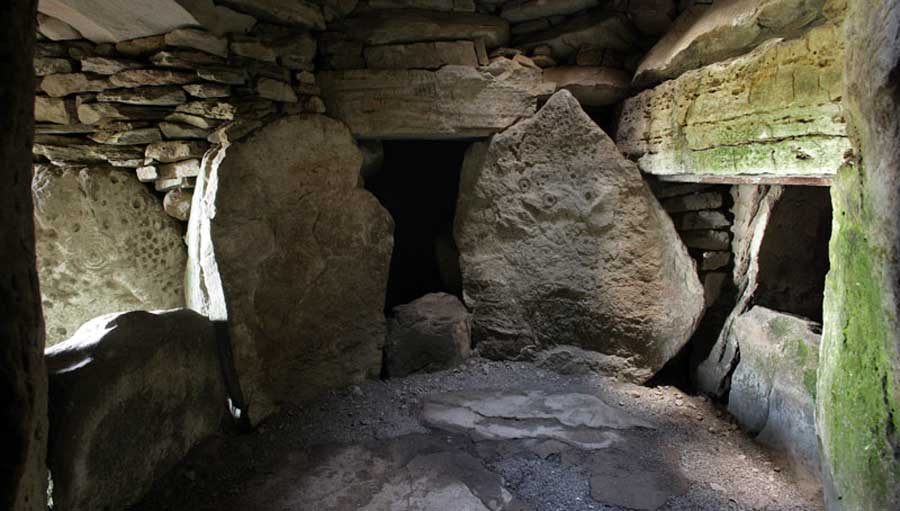
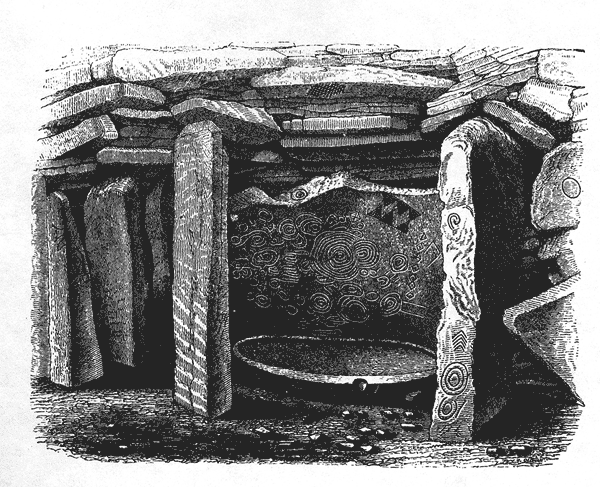
Within the chamber of Cairn T.
Somewhat similar rock-scribings abound in Yorkshire,
in Northumberland, on the Cheviot Hills, near Edinburgh, and in the Orkneys. Various attempts have
been made to decipher their meaning. The Right Rev. Charles Graves, Bishop of Limerick, propounded the theory that these circular rock-carvings were rude maps of raths, and observes:
'It was to be presumed that the persons who carved the inscriptions intended to represent circular objects of some kind; but what could these objects have been?
Some have suggested shields. This notion seems incon-sistent with the fact that the same stone presents so many circular symbols of different sizes, varying from the small shallow cup of an inch or two in diameter to the group of concentric circles two feet across.
It also seems probable that, as shields, in general, used to bear distinctive devices, these would reappear in the inscriptions; but the inscribed circles exhibit no such variety as might have been expected on this hypothesis. Again, if the circles represent shields, what could be meant by the openings in the circumference of many of them. Lastly, what connexion could there be between the idea of shields and the long lines appearing in the Staigue monument, or the short lines on that of Ballynasare? '
Another idea was, that these figures were designed
to represent astronomical phenomena. This notion
was perhaps the most obvious, and the least easily disproved. It harmonizes also with what has been handed down respecting the elemental worship of the Pagan Celts.
Nevertheless it seems open to obvious objections. In astronomical diagrams, one could hardly fail to recognize a single symbol conspicuous amongst the rest as denoting the sun or moon, or two such symbols denoting both these bodies. One might also expect to see some delineation—even by the rudest hand—of the phases of the moon.
We look in vain for these indications of an astronomical reference in the groups of lines and circles. Again, this supposition fails to account for the openings in the circles, and the lines which appear in connexion with them.'
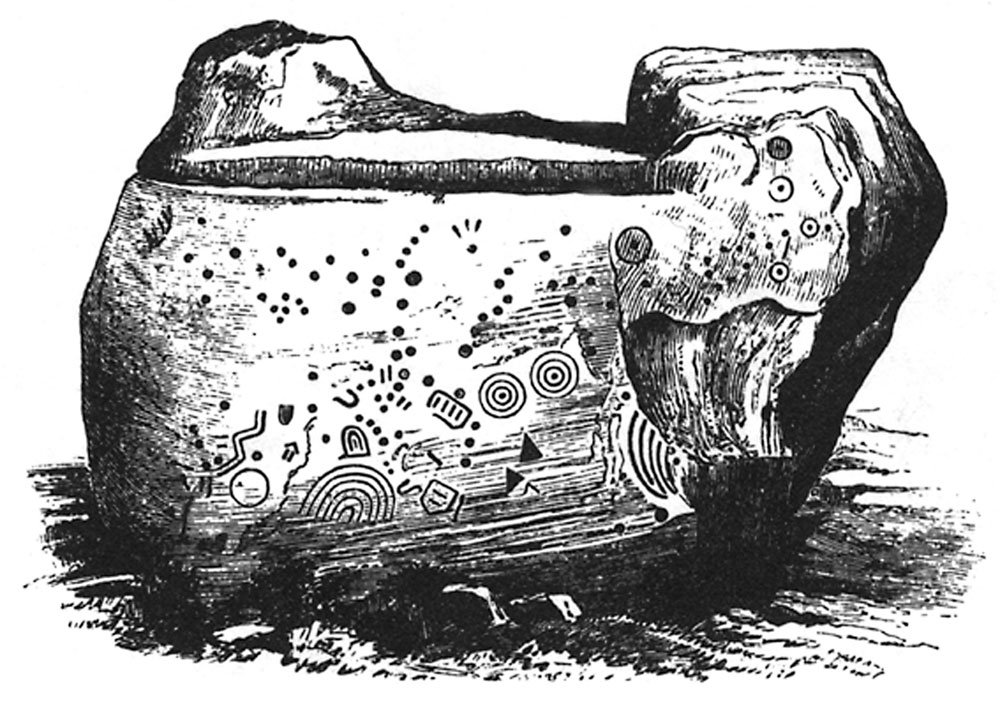
Conwell's engraving of the elabourate right hand recess in Cairn L, from about 1870.
It has been suggested that these circles were intended
to serve as moulds in which metal rings might be cast.
This explanation is decisively negatived by the fact
that the circle occurs on parts of the rock which are
not horizontal. Another proposed idea is that the
circles were used for the purpose of playing some game.
The great dissimilarity which exists between the figures
on the different stones renders this explanation untenable. The theory which appeared the most probable, was that the circles were intended to represent the
circular buildings of earth or stone of which traces still exist in every part of Ireland. This conjecture was
supported by the following considerations:
Conwell's engraving of the Hag's Chair at Cairn T, from about 1870.
'The circles are of different sizes; and some of them
are disposed in concentric groups. The dwellings and fortified seats of the ancient Irish were circular; they were of various sizes, from the small cloghan or stone house often feet in diameter to the great camp, including an area of some acres; and the principal forts had several concentric valla. The openings in the
inscribed circles may have been intended to denote the entrances. The other inscribed lines may have
represented roads passing by, or leading up to, the forts.'
Conwell's engraving of a passage stone in Cairn T, from about 1870.
The conjecture that these carvings were primitive
maps, representing the disposition of the neighbouring
forts, appeared to be a fanciful one, and the drawings
were laid for many years on one side; finally, however,
Bishop Graves having re-examined this subject, came to
the conclusion that his original theory was correct, that
the centres of the circles and the neighbouring cups and
dots arranged themselves, generally, three-by-three; in
straight lines, or approximately so, and that the ancient
raths marked on the Ordnance Survey maps appear, to
some extent, to be also arranged three-by-three in
straight lines.
An engraved slab on the right side of the passage of Cairn T is like a crude version of the large double spiral on kerbstone 67 at Newgrange.
Another class of 'rock-scribings' consists of scorings,
such as are found upon the flagstones of sepulchral
carns, as at Lough Crew, Dowth, and New Grange.
There is also a class of irregular scorings, some of
which may be genuine Ogham, although roughly and
irregularly executed, whilst others are of a character
which precludes their classification under this heading.
Equinox sunrise at Cairn T.
Some of the so-called 'cup-markings' on sepulchral
monuments have been caused by the action of Nature,
being the well-known 'ripple marks' common in the
old red-sandstone series; but anyone familiar with
geological formations would not confound the artificial
with the natural work, though depressions—very like
genuine 'cup-markings'—are created on the upper
surface of calcareous rocks by the solvent action of
rain-water; but even ignoring the undoubted traces of
the pick or pointed instrument occurring on some of
the 'cup-markings,' it is impossible to suppose that the
concentric or spiral rings, which frequently surround
the 'cups,' could be the result of geological causes.
'We shall, I think,' remarks H. M. Westropp, who
advances a very simple theory as to their formation,' be
led to a more just conclusion as to their origin, if we bring before our mind that the savage and primitive man has the same fondness for imitation, the same love
of laborious idleness as the child. A child will pass
hours whittling and paring a stick, building a diminutive
house or wall, and tracing forms on the turf. The
savage will wear away years in carving his war-club and
polishing his stone-adze.
Decorated passage stone within Cairn T.
These considerations lead me
to attribute these carvings and sculpture to the laborious
idleness of a pastoral people, passing the long and
weary day in tending their flocks and herds; they
amused themselves by carving and cutting those various
figures, and the rude outlines of primitive men, in
various countries, like the rude attempts at drawing by
children, cannot but bear a family resemblance to one
another, their utter absence of art being frequently
their chief point of relationship.'
W. F. Wakeman thus depicts another aspect in
which these rock carvings may be regarded: — 'Many
men of ancient and modern times, confined by necessity
to a listless existence, in an inhospitable region, might
very naturally have beguiled their hours by carving with
a stone, or metallic instrument — such figures as their
fancy prompted — upon the nearest object which happened to present a surface more or less smooth.
Scorings or designs made under such circumstances, would be, in character, as various as the skill or humours of their authors. Now, when in many districts
of the country, and some of them widely apart, we find
upon the sides of caves and rocks, and within the
enclosure of Pagan sepulchral tumuli, a certain well-defined class of engravings, often arranged in groups, and with few exceptions, presenting what may be styled a family type, we can hardly imagine them to be the result of caprice.'
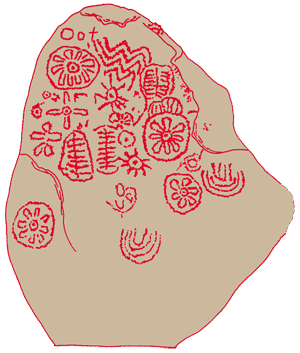
Some 26 stones within Cairn T bear decoration, most notably the backstone of the end-recess (Elizabeth Twohig's illustration is shown,
above).
American researcher Martin Brennan demonstrated in the early 1980's
that the equinox sunrises illuminate this complex slab of megalithic symbols.
This is Brennan's great contribution to Irish megalithic research: how
the engravings interact with the beams of light and by extension the heavenly
bodies. Brennan's groundbreaking book, The Stars and the Stones has line
drawings of many of the engravings at Loughcrew. The book has recently
been re-published as the Stones of Time.
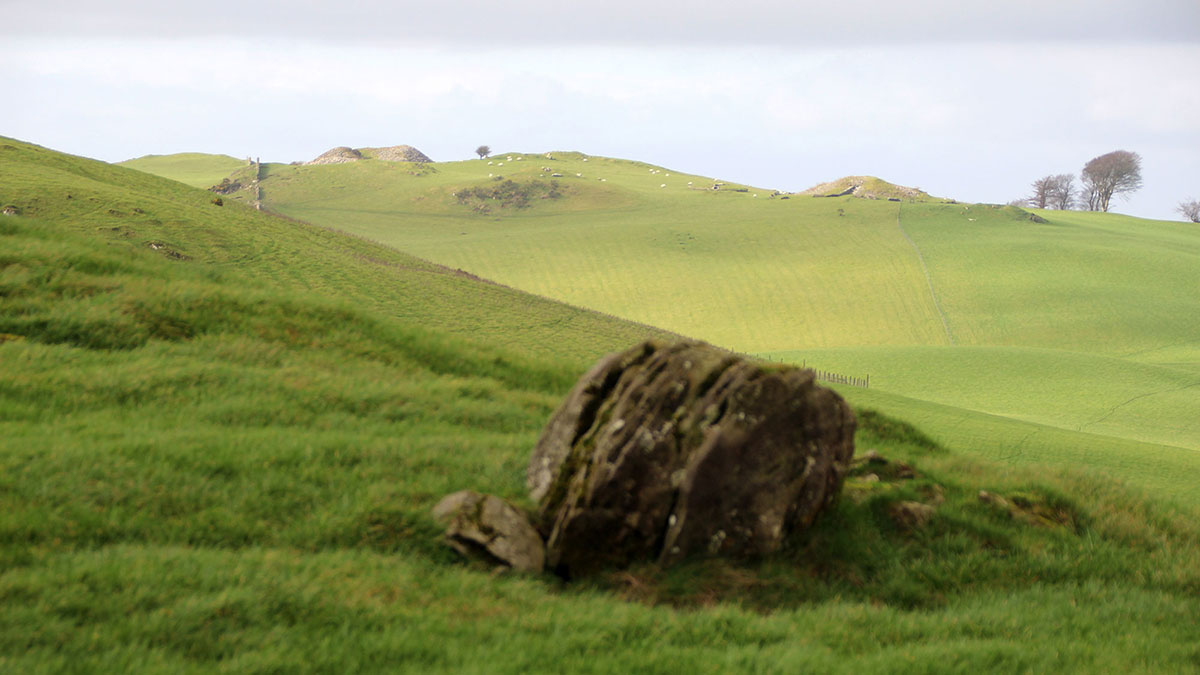
The landscape to the west of Loughcrew.
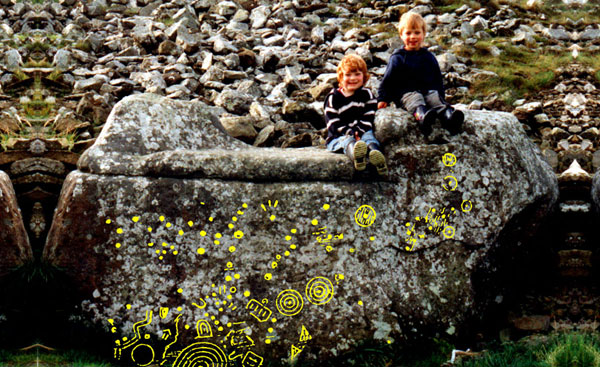
The Hag's Chair
The only surviving engraved kerbstone at Loughcrew, the Hag's Chair, is positioned on the north side of Cairn T. The engravings are very much weathered today, and not obvious
at all on the stone except for some relatively recent graffiti. The picture
above shows the kerb art highlighted using Conwell's engraving of the
Hag's Chair.
Cairn U also has several engravings
within it's chamber, including a long set of inverted nested arcs on the
backstone, which may represent a sunrise. The stones in the recesses on
either side also bear interesting compositions. There are scattered engravings
on the other monuments, which can be found by a careful search in good
light, but not a great amount remains.
The
Hag's Chair, a large horned kerbstone on the north side of Cairn T. The megalithic art from Conwell's illustration is overlaid on the stone with photoshop.
Cairnbane West
On Cairnbane West, the largest number of surviving stones are within Cairn
L, with it's unique standing stone and basin. A beautiful and dramatic design
of nested circles, cupmarks and arcs covers the slab at the rear of the
main right-hand recess. This design seems to me to have much in common with the art and basin in Knowth west in the Boyne Valley to the east. The northmost slab of the recess is covered with a complex set of orbiting bodies and seems to be a diagram depicting a cosmic event, such as the eclipse postulated by Paul Griffin.
The central motif within the right hand recess of Cairn L.
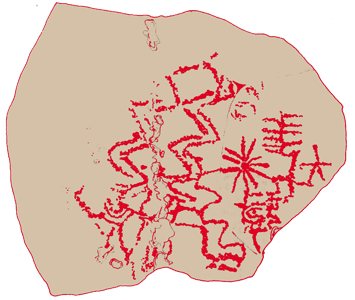
There are a number of other carvings in this chamber. Brennan believes the set of squiggles on the keystone at the back of the chamber represent the movements of the late summer full moons. Brennan
demonstrated that this engraving is illuminated by the rising sun on the
November and February cross-quater days. This stunning display of light
and shadow is illustrated on the top of this page. Aside from L, carvings
can easily be found in Cairns I H and F.
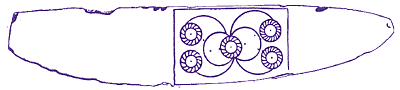
Engraved medieval bone slip from Cairn H.
Hundreds of bone slips were
discovered in Cairn H,
during Raftery's excavation in 1943, and several are now on display in
the National Museum in Dublin. They date about 3000 years after the cairns
were built. It is easy imagine the Iron Age or medieval artists at work, inspired by
the ancient engraved spirals on the walls around them. There are several ringforts, a few cashels and a fine ceremonial rath with a souterrain close by.
Engraved stone in the passageway of Cairn T on an equinox morning, as the sun is streaming into the chamber. The art comes to life in the sunlight.
The archaeologist Elizabeth Twohig has studied the art at Loughcrew using rubbings (seemingly
with the exception of the Hag's Chair), and her 1981 book, the Megalithic
Art of Western Europe is essential to anyone who wishes to locate and study all
the designs on the engraved stones.
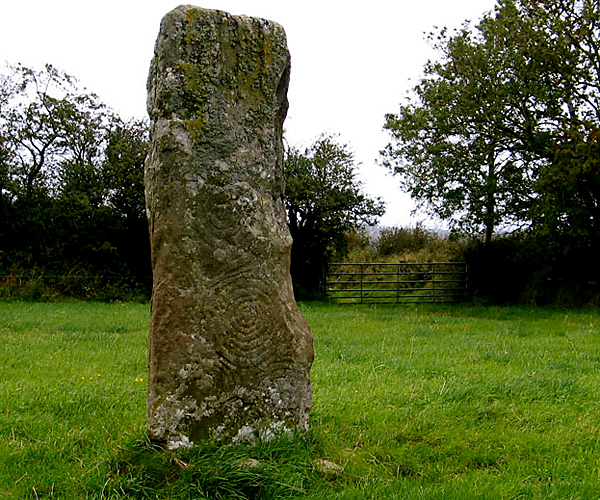
Engraved stone on Kingsmountain about 4 km east of the Loughcrew Hills. The stone is about 3 meters tall and has four large, well picked spirals.
There is more art in the area. A standing stone on the south slope of Sliabh
na Cailleach has an engraved spral on it's north surface. An engraved
slab was recently erected within the entrance on the way to Cairnbane
West. There appear to be engraved slabs near the Ballinavally stone circle
to the north of the hills. A lone slab engraved with large spirals stands
on King's Mountain a few km to the east. Finally, at least one Loughcrew
stone is on display in the National Museum in Dublin.
Equinox sunrise sunbeam illuminating the keystone at Cairn T, autumn 1996.
Researcher Michael Poynder believed that the engravings were illustrations of the earth energies that flow through these sites. Certainly the engravings are found at key locations throughout the monuments. Loughcrew is located on a line that passes through the Hill of Howth, with a large dolmen on the top, the Hill of Tara, and continure past Loughcrew to Sliabh da Ean and Knocknarea in County Sligo.
The ceiling slab of the inner recess of Cairn T at Loughcrew. This panel is illuminated by the light of the rising sun over the equinoxes twice a year, and looks glorious bathed in golden yellow light.