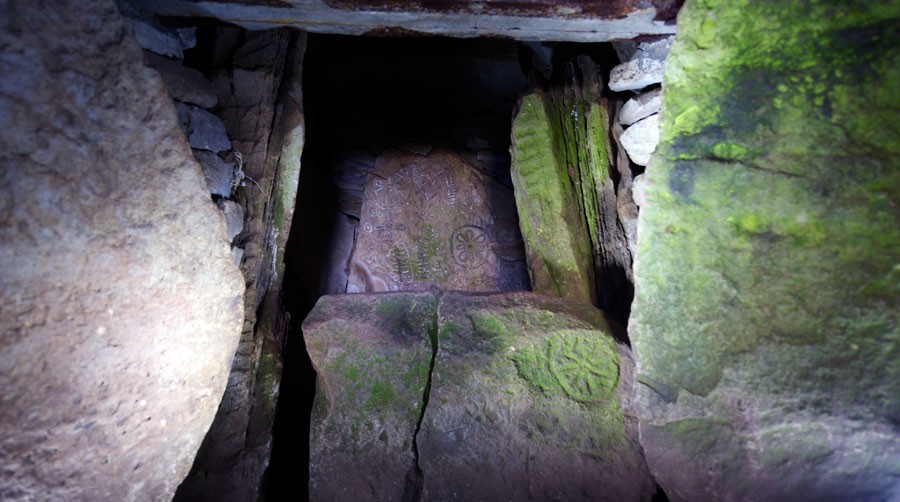
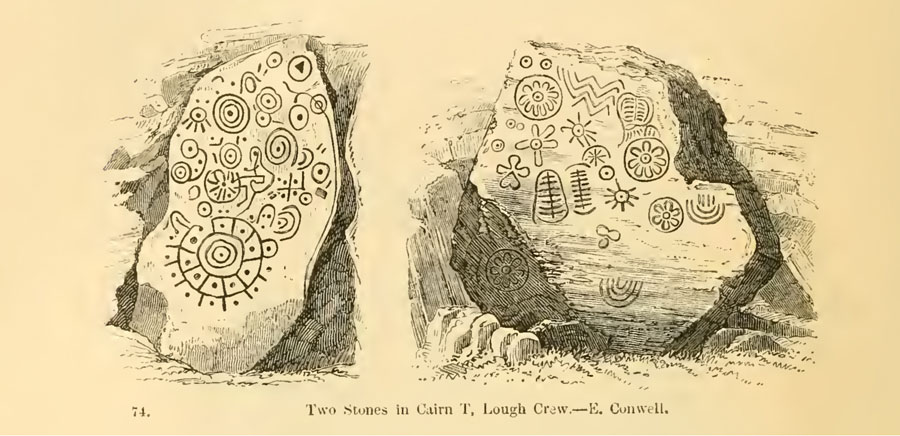
The neolithic passage-graves on the summits of the hills at Loughcrew house a wonderful collection of engraved neolithic slabs which are what appear to be numerous symbols of both the sun and the moon. At Cairn T the engravings interact with the beam of light projected by the rising sun on both the spring and autumn equinoxes. In total there are twenty-nine carved stones within the passage and chamber of Cairn T.
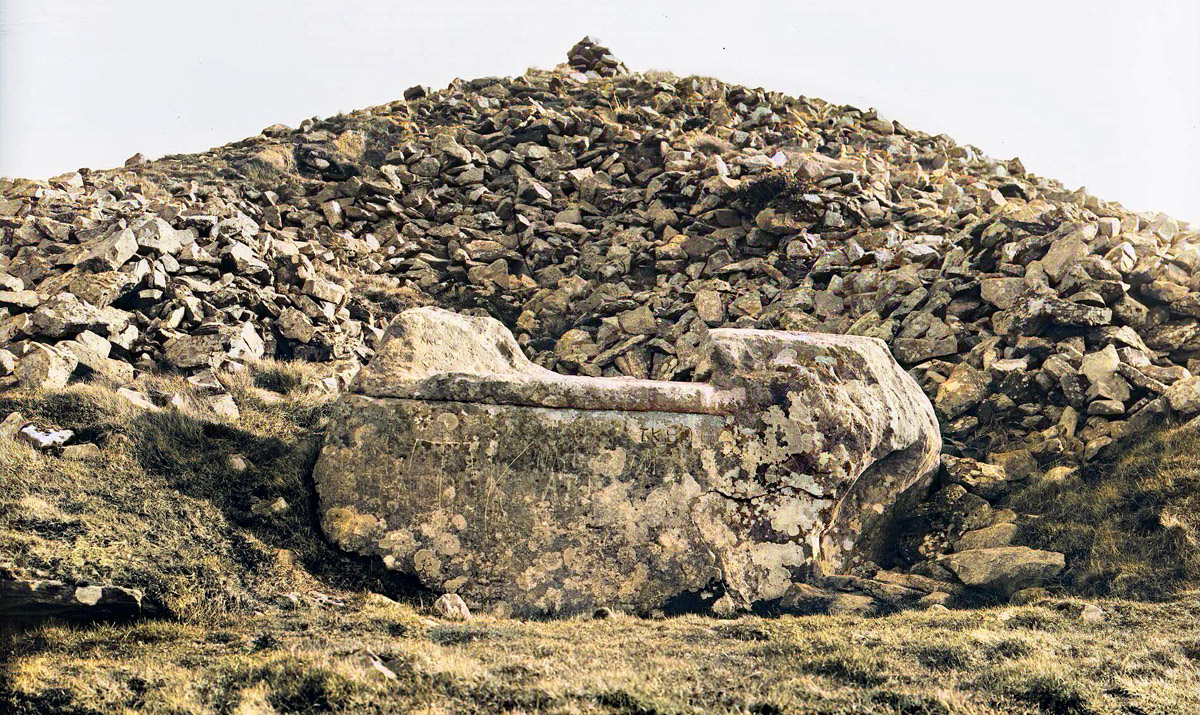
The art at Cairn T seems to be principally concerned with the rising suns and moons, and many of the engravings, including the sophisticated keystone symbols can be considered both as a symbolic language and a set of technical diagrams recording the celestial cycles. One large and elabourately engraved kerbstone, known in local folklore as the Hag's Chair is found on the notth side of the cairn.
The Hag's Chair
There is an eminence in the townland of Knocklough called Slieve Guillion, and a rude stone chair on the summit of Slieve Nacally called Cataoir na Caillige Bera, ie: Calliagh Bera's Chair. It is a large stone, about two tons weight, ornamented with a cross sunk (cut) into the seat of the chair, in which three might sit together. This hollow seems to have been made in the stone with a hammer: the cross is probably the work of a modern stonecutter. The back of the chair was broken by some human enemy to old Evlin.
John O'Donovan, 1836
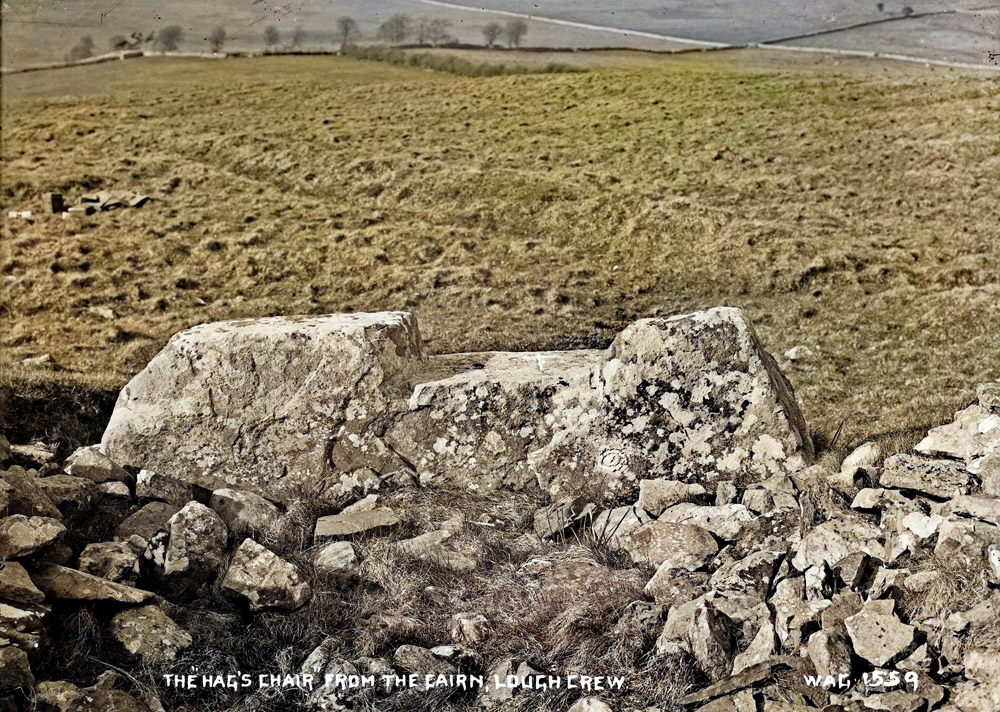
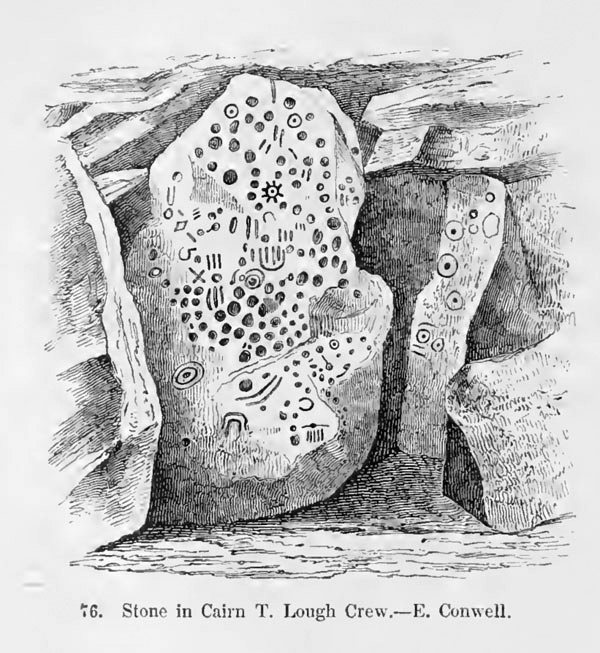
The large and elabourately engraved kerbstone known as the Hag's Chair is found on the northern edge the cairn. The large flat face is cvered with an extremely weathered set of carvings which may be images of the stars and also brings to mind the wonderful engraved ceiling slab within the right-hand recess at Newgrange. The Hag's Chair faces to the north and is the largest of the kerbstones surrounding Cairn T.
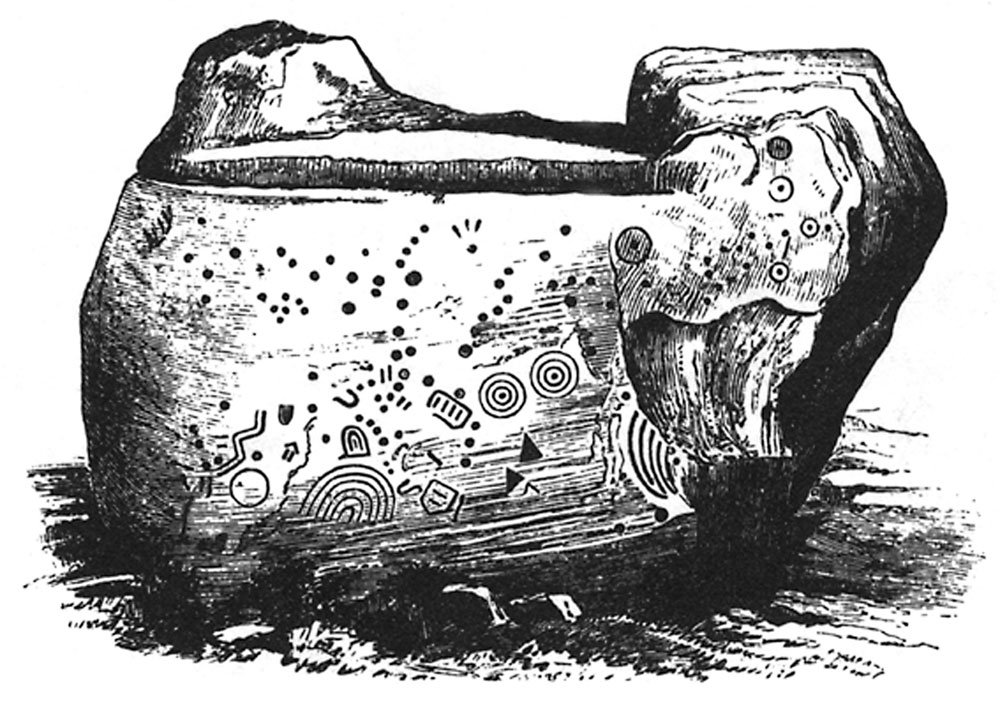
Eugene Conwell's illustration of the neolithic artwork on the Hag's Chair.
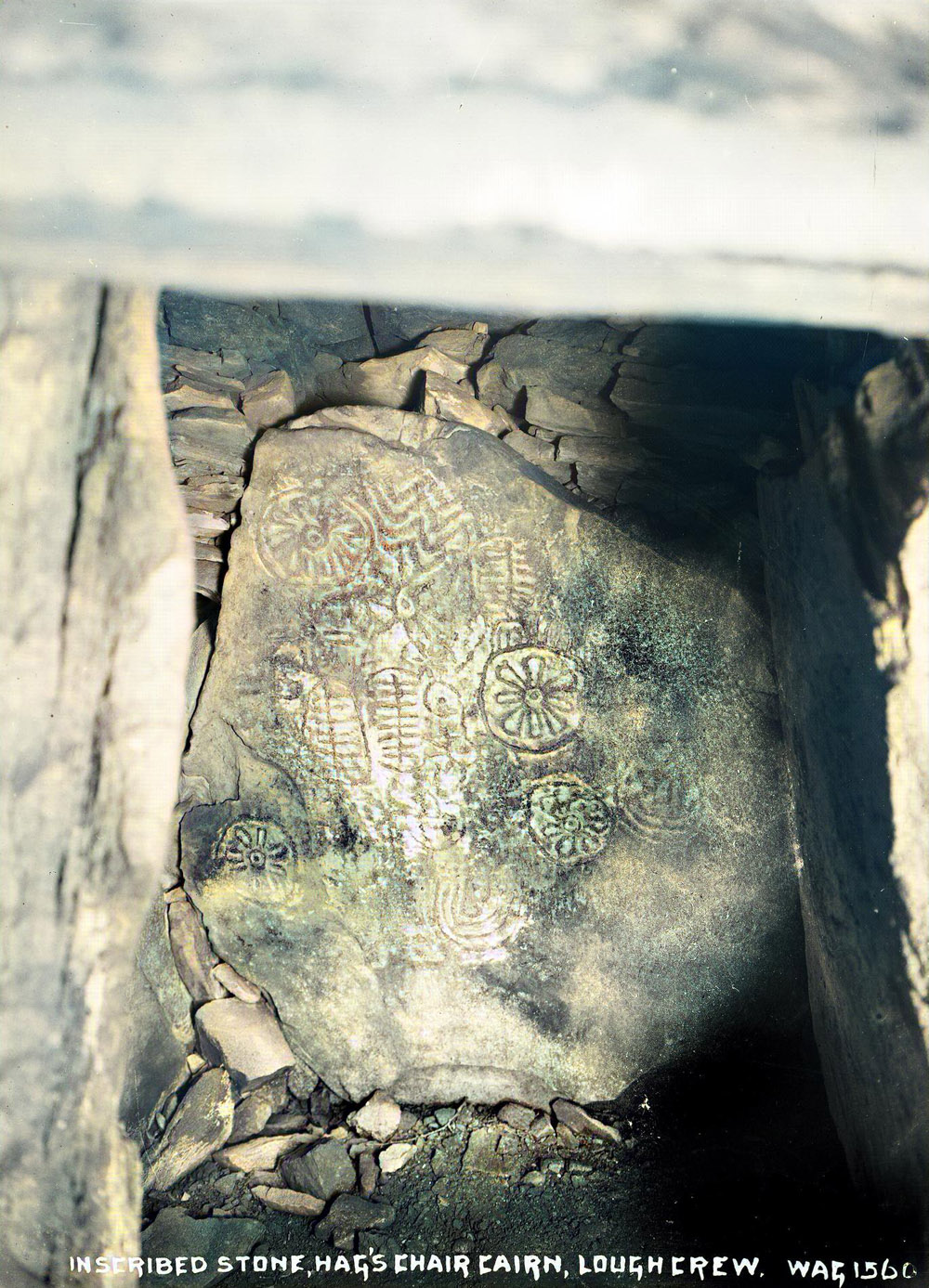
The art was recorded in an illustration by Du Noyer and published by Conwell, and the entire surface of the great slab was decorated at that time. Today the designs are not easy to see, the sandstone boulders having become extremely weathered since Conwell's time at Loughcrew. There are also carvings on the inner face of the Hag's Chair, which can be seen in illustrations by Conwell and a photograph by William Green, below.
According to local folklore a Cailleach who was named Garavogue used to sit and watch the stars and the landscape from this location.
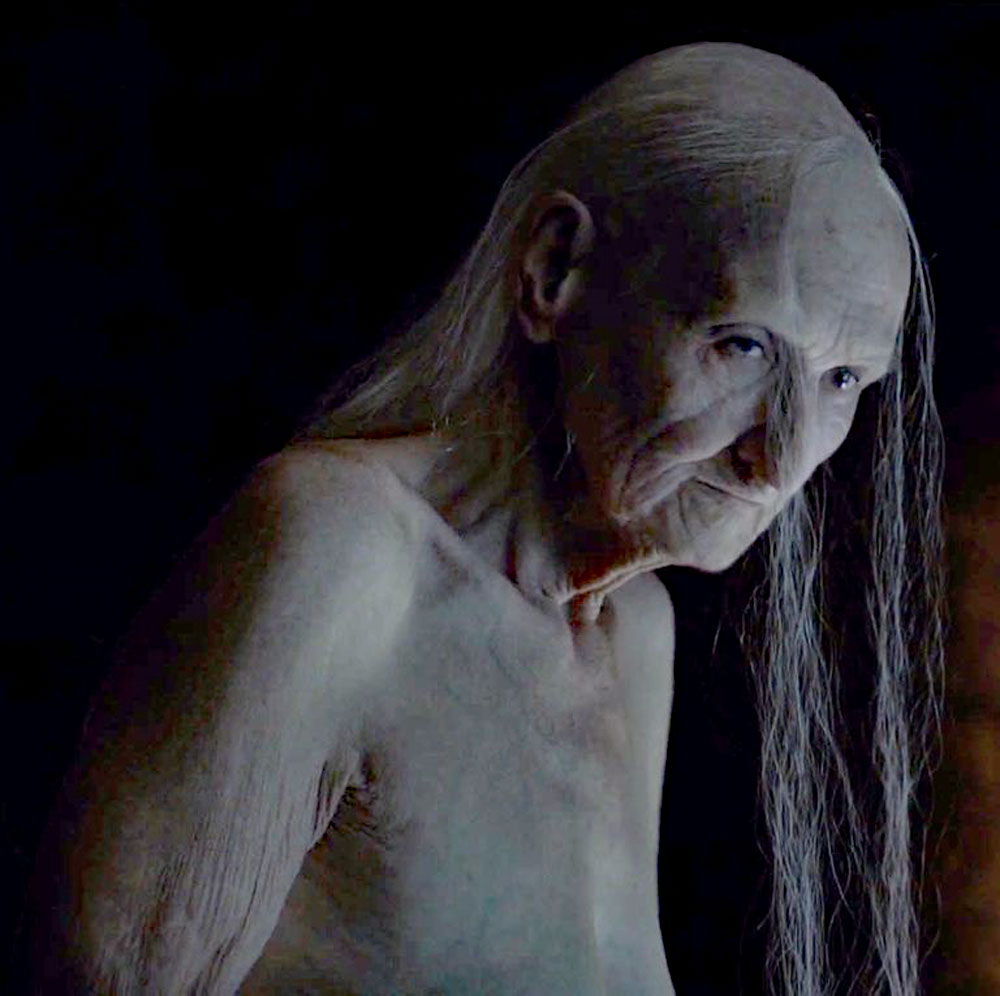
When the Red Woman, played by Carice van Houten, takes off her enchanted necklace, she is revealed to be an incredibly ancient old woman, a version of the Irish Witch, Hag, or Cailleach named Garavogue who built the monuments at Carrowmore, and lives in her house on Sliabh Da Ean. The story of the Cailleach was carried to the West Coast of America by the Ulster Poetess Ella Young, who became Professor of Celtic Mythology in Berkley, California, where her retelling of Celiti myths gained a new audience. Elle Young's Red Woman, from her story The Shining Beast is the inspiration for Mellisandre, the Red Woman in George R. R. Martin's Game of Thrones series.
The Garavogue is always remembered as the builder of the monuments, having gathered all the rocks in her white apron and transported them to the hills. The large erratic boulder which became the Hag's Chair faces due north and is positioned on the north side of the chamber. It occupies a similar position to Kerbstone 67 in relation to the chamber at Newgrange.
Neolithic art on a passage stone in Cairn T, the huge passage-grave on the summit of Sliabh na Cailleach. Illustration after Du Noyer from the Discovery of the Tomb of Ollamh Fodhla by Eugene Conwell.
Many years ago a local from Oldcastle told me a story where a great dish or basin, carved from a huge piece of quartz, and filled with cremated bone, was discovered buiried close to the Hag's Chair. The basin was reburied. A cross carved on the seat possibly dates from the Penal times when open-air masses were said to have been held here, athough such a highly visible location would be an unlikely and unsuitable place for a Penal Mass. Others say the cross was carved by surveyed from the Ordnance Survey who used the cairn as a camp during their survey here in 1836.
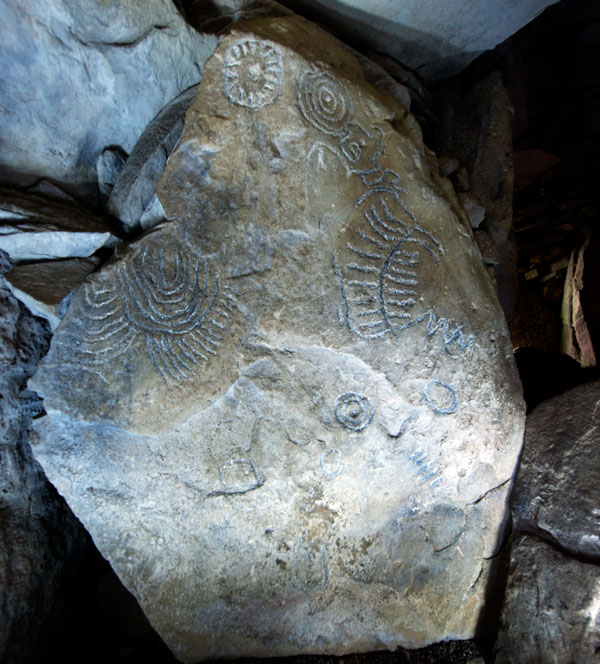
The kerbstones curve inwards coming to the mouth or entrance to Cairn T, and the decorated stones begin with the first stone on the left bearing a complex if not unique set of symbols which seem to indicate some kind of a count of cycles or orbits.
Decorated stone in the entryway to Cairn T.
This stone and its extraordinary artwork are lit up by the first rays of the glorious golden light at dawn around the equinoxes. When Conwell arrived the passage roof had collapsed, and only one lintel remained spanning the passageway, while two-thirds of the corbeled ceiling of the chamber had fallen in. He cleared lots of fallen stone from the chamber and passage, describing the engraved stones as he exposed. Many of the stones he cleared would have been corbels, and at least one flag was engraved.
The strange style of ornamentation observable on many of the chambers or cists is apparently of three kinds— punched work, chiselled work, scraped work, the first being very common, the last exceedingly rare. It is very remarkable that though the carved stones exceed one hundred in num ber, there are scarcely any decorations alike!
Here, among the earliest peoples, we have an independence and self-reliance of workmanship which a great critic has characterized as the cause of the pre-eminence of all true Christian and mediieval art and architecture.
Source: Our Ancient Monuments and the Land Around Them - Charles Philip Kains-Jackson
With Conwell's lectures and publications, Loughcrew featured in many books and archaeological guides, like the section quoted above. All commenters were puzzled by the abstract nature of the engravings. By the 1880's there were concerns for the safety of the carvings:
The tombs on the Lougherew Hills have also received attention:
these were thoroughly examined in 1865. The interesting account by Eugene Alfred Conwell, Esq., so carefully describes them, that it is
almost needless to go into further particulars.The great danger to these monuments is the exposure to the
atmosphere of the inscribed stones. A prolongation of the entrance covered by a rough arch has been thought the best way of preserving them. This is being done.
On Some Ancient Monuments, Scheduled under Sir John Lubbock's Act, 1882, by Thomas N. Deane.
The outer section of the roof was restored by the Board of Works under Deane's direction, when a concrete slab was cast over the passage, giving a measure of protection to the carvings. The stone orthostats lining each side of the passage are decorated with a range of motifs and cupmarks, and one stone bears a resemblence to the symbol on Kerbstone 67 at Newgrange, below:
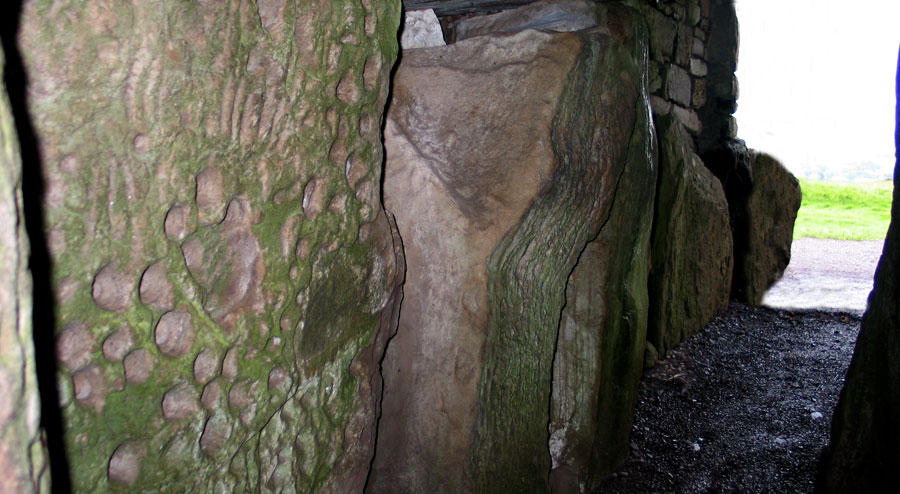
The passage of Cairn T points to about nine degrees south of east, which means the sun is well up in the sky at equinox before it can shine into the monument. The illumination of the artwork within Cairn T and the interaction of the beam of light with the subtle engraved symbols is an extraordinary testament to the skill and ingenious capibilities of our neolithic ancestors.
Looking out east along the passage of Cairn T, with the gate airbrushed out. The passage stones are carved with a variety of motifs and symbols, many of which seem to be astronomical in origin.
The Equinox Sun Stone
The octagonal chamber of Cairn T with its reconstructed corbeled roof is a classic example of an Irish cruciform-shaped passage-graves. This is among the oldest free-standing
buildings in Ireland and probably dates from about 3,500 - 3,400 BCE. There has been no scientific dating at Loughcrew, but as the monuments are smaller and the artwork cruder, the sites are considered to predate Dowth, Knowth and Newgrange.
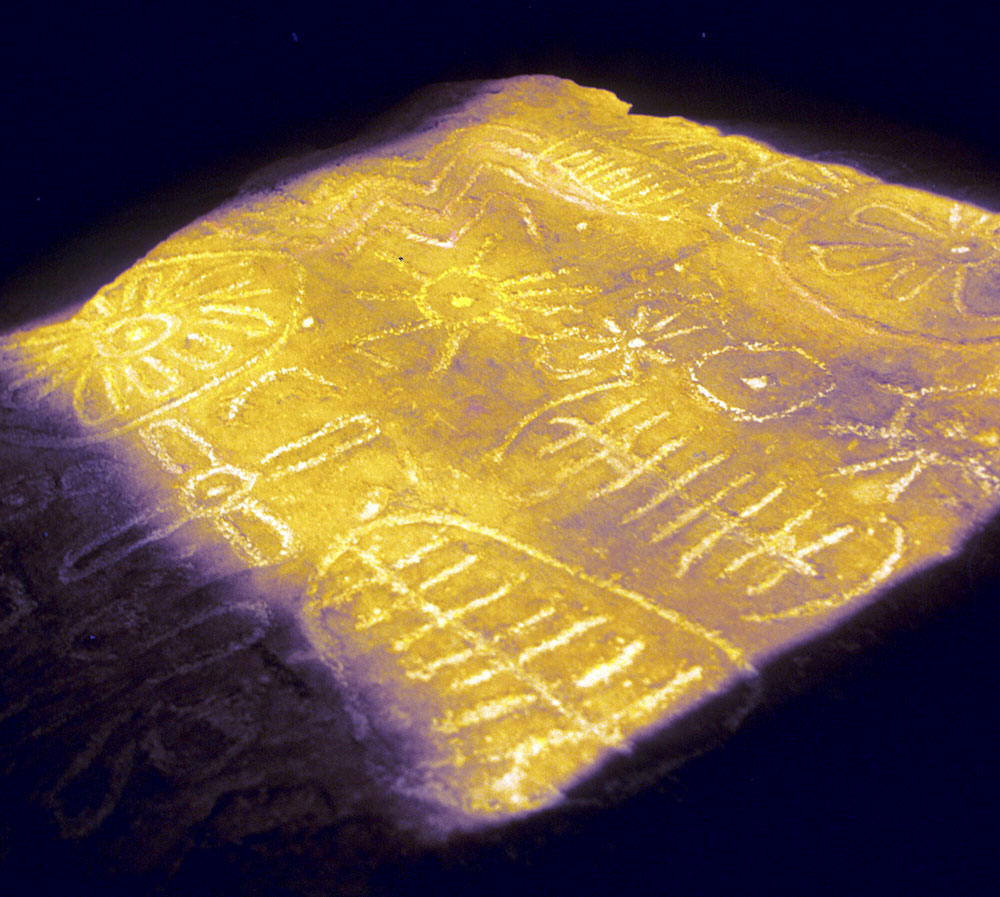
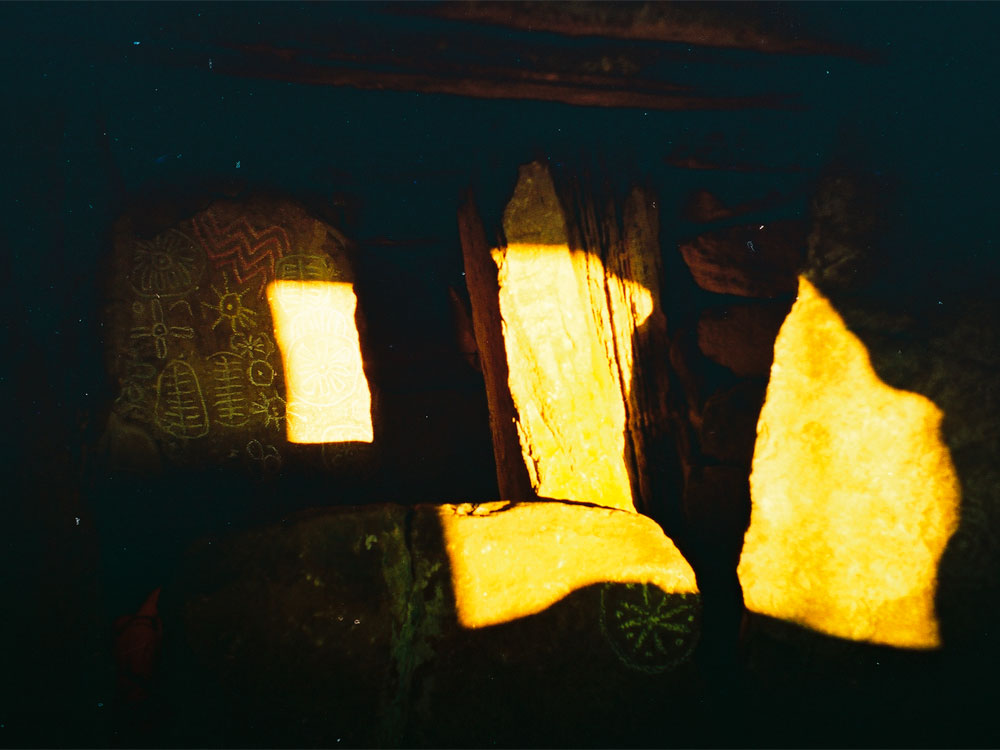
The Equinox Stone within Cairn T at the Loughcrew megalithic complex, lit up by the rays of the equinox sunrise. This important alignment was discovered by Martin Brennan and Jack Roberts in 1980.
The current best guess for the age of the Loughcrew cairns comes from the dating of a solar eclipse, which researcher Paul Griffin suggested occurred over the Loughcrew area around 3,340 BCE. Griffin believes that this event is depected in the large panel of engraving within the right-hand recess of Cairn L. Refining Griffin's observation, Canadian researcher Robin Edgar has identified a more likely candidate with a solar eclipse occurring over Loughcrew in 3,315 BCE.
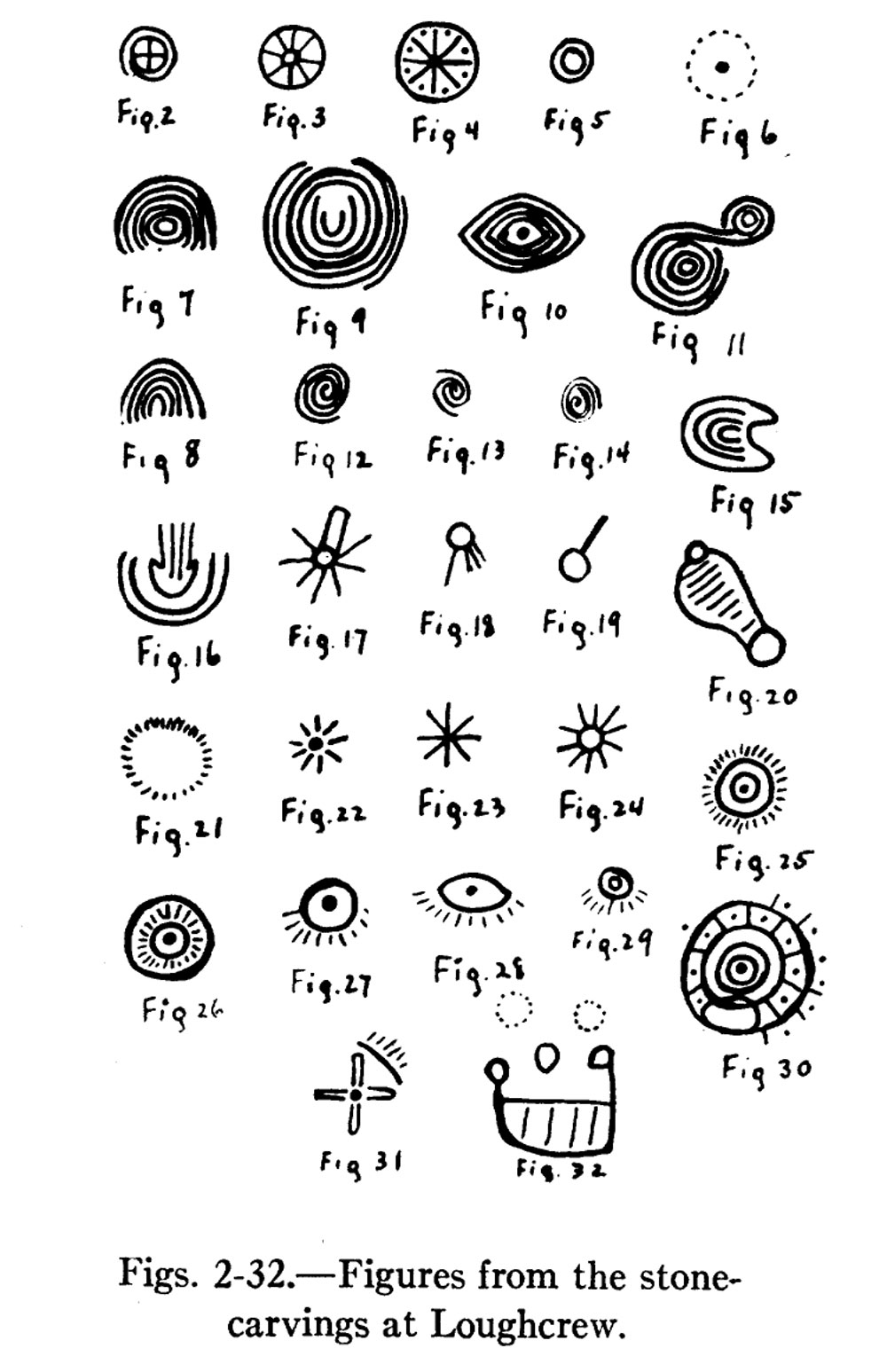
The range of symbols encountered at Loughcrew published by George Blom in his 1924 article on the engravings at Loughcrew..
This event which may have sparked off the explosion of engraved artwork at Loughcrew, which seem to record the sunrises in and around the time of the eclipse on stones in various monuments. This concern for eclipse symbolism is transferred to the next great monumnet in the developing series of Irish passage-graves, Dowth.
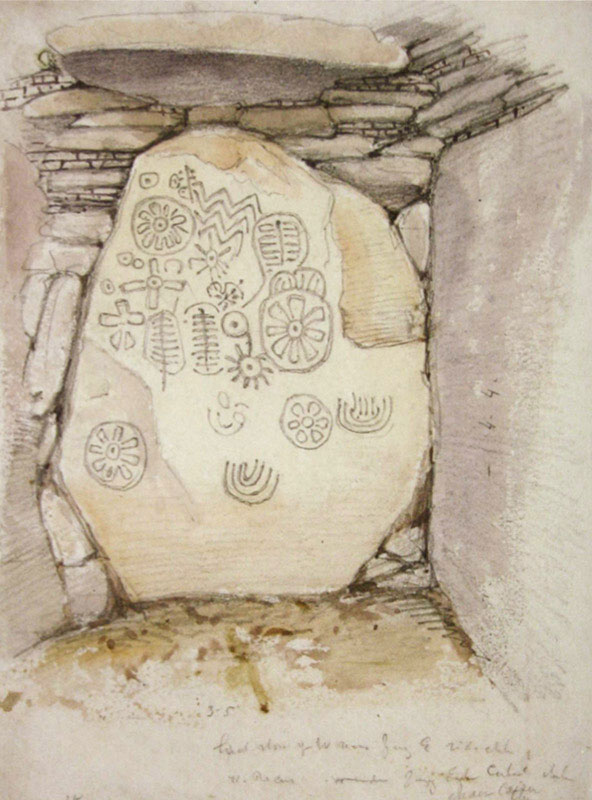
Decorated quinox Stone in Cairn T. Watercolor by George V. Du Noyer, 1866.
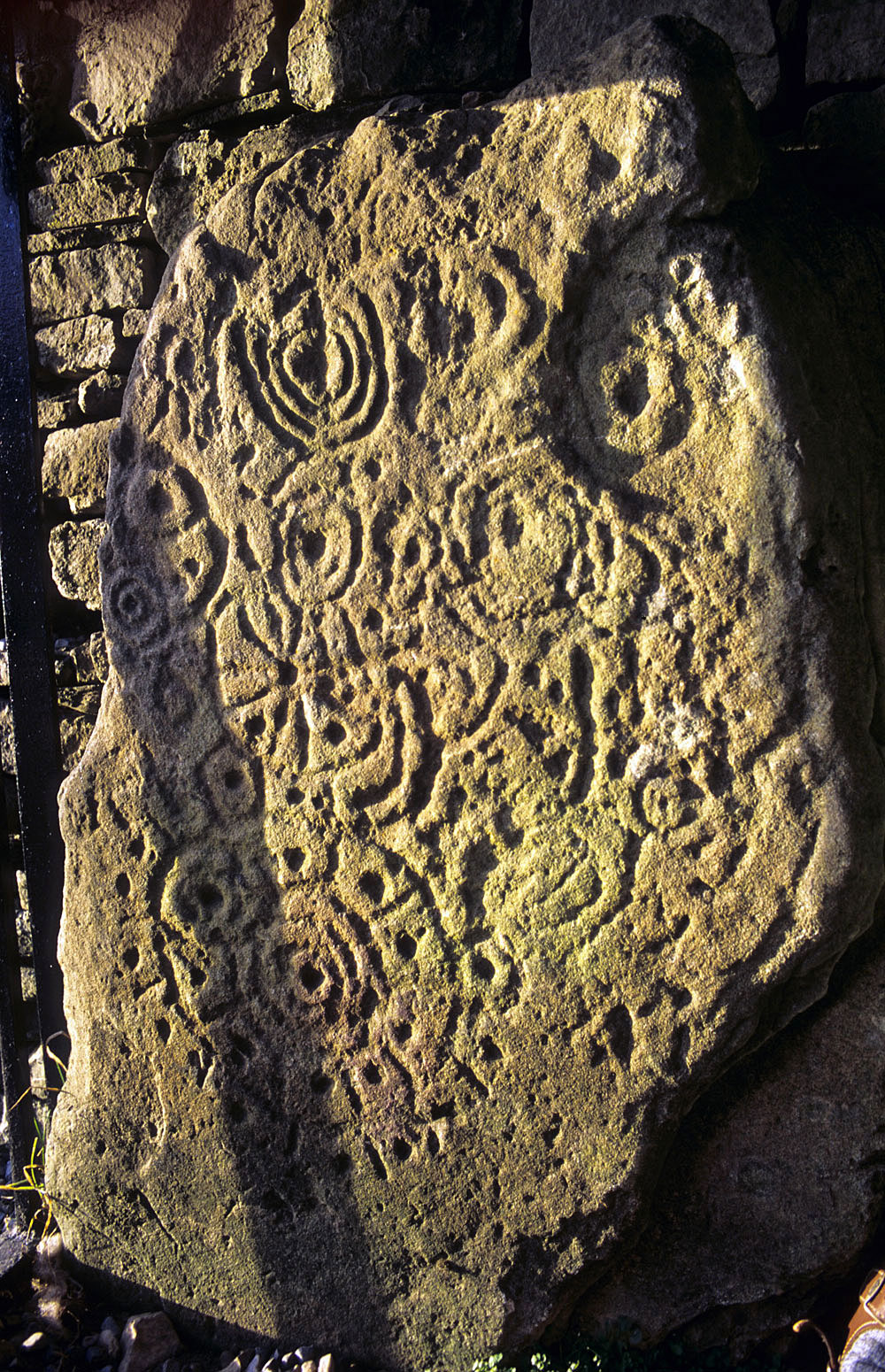
In 1980 Martin Brennan and Jack Roberts discovered that the equinox sunrises illuminated the art within Cairn T in a most spectacular fashion, with a beam of sunlight highlighting and interacting with an engraves symbol of itself. The Equinox Stone is richly carved with a series of symbols which resemble combs and flowers with several clear depections of the sun. This is the famous Loughcrew Equinox Stone, which was used in some fashion related to observation and understanding of the cycles of the sun and moon, most likely to attempt to predect solar eclipses.
The elaborately decorated Equinox Stone within the deepest recess of Cairn T on the mornings of the spring and autumn equinoxes. This important alignment, which predates the monuments in the Boyne Valley, was discovered by American archaeo-astronomer Martin Brennan and his co-researcher Jack Roberts in 1980. The beam of sunlight elegantly illuminates the carved symbol of itself, the eight-petelled flower which represents the great goddess Inanna in the near east.
Furthermore, the solar emblems engraved within Cairn T are well-known symbols in the near east, representing the great goddess Inanna. The solar and lunar symbols are placed within these amazing buildings to create an environment where symbolic reenactments of Inanna's journey to and return from the Land of the Dead could be undertaken. The pinnacle of this replication of a journey to the World of the Dead is taken to its limit at Knowth, where two passages measuring forty and thirty-six meters, with engraved symbols, inner portals and sill stone to mark important points or nodes on the journey.
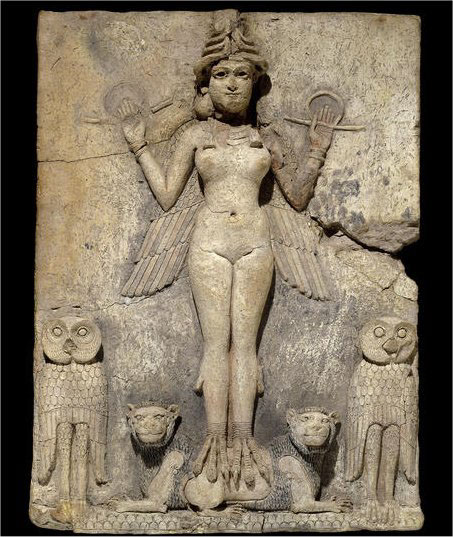
The imported goddess Inannaa, with her owl totems and her owl feet. Inanna made an epic journey into the underworld to rescue her sister. During her voyage her body was dismantled, disarticulated and de-fleshed, before being re-assembled for a form of rebirth.
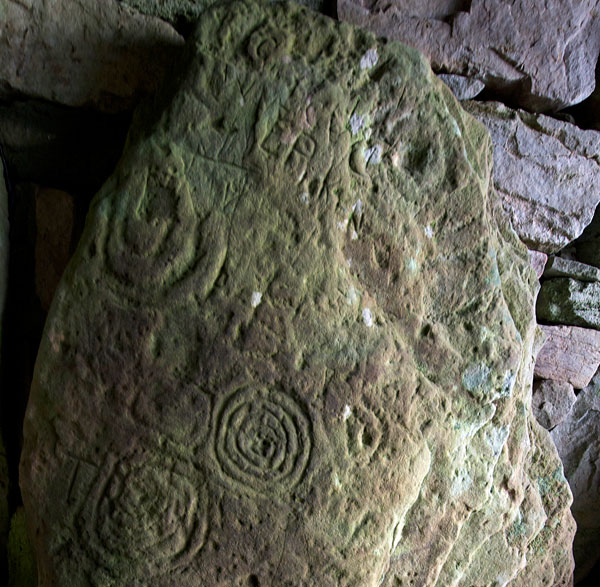
There are many small engravings on the chamber stones, in particular the west sill.
Three small cells, seperated from the central space by sillstones open
off the main chamber, to the south, west and north.