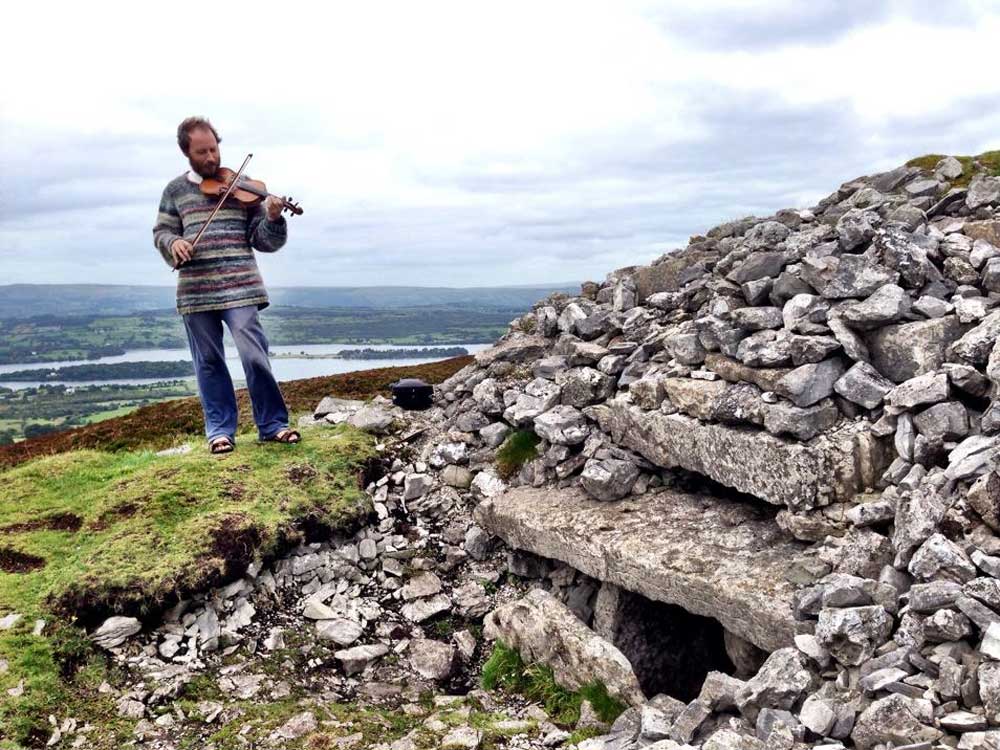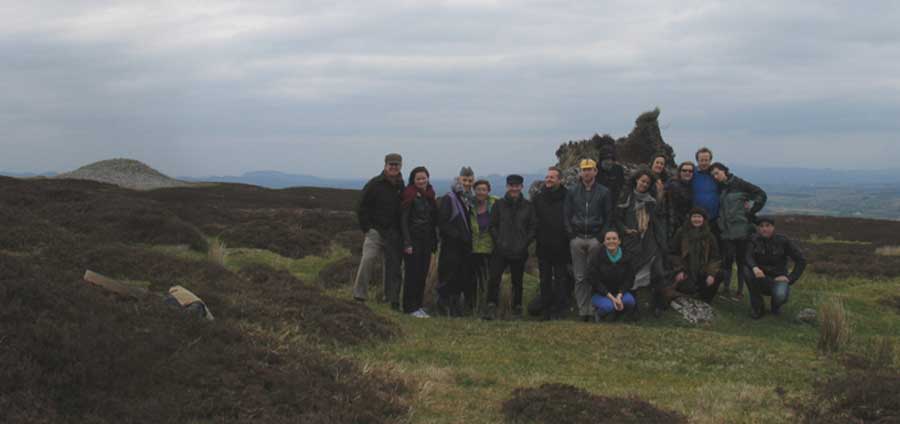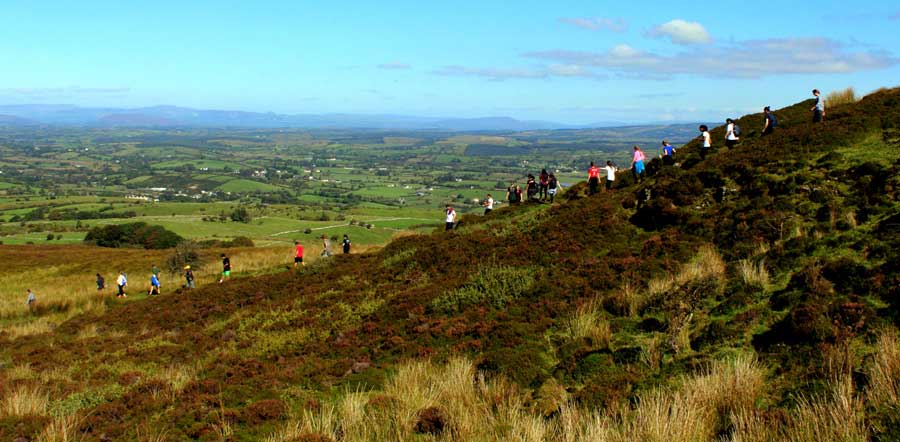
Visitor to Cairn G at Carrowkeel. Cairn G has a roofbox which is illuminated by the light of the sun each summer and by the moon each winter.


Sacred Island
Carrowkeel
Summer solstice
Doonaveeragh Village
Caves of Kesh
Kesh Cairn
Knocknarea
Carrowmore
Moytura
Newgrange
Winter Solstice
Knowth
Dowth
Loughcrew
Equinox sunrise
Samhain sunrise
Tara
Fourknocks
Croagh Patrick
Cong
Knockma
The Burren
Uisneach
Rathcroghan

 Guided Tours:

I am a Bord Fáilte qualified tour guide with an intimate knowledge of ancient Irish sites their mythology and archaeology. I have a special interest in the art and astronomical alignments of the monuments known as chambered cairns or passage graves.

General and specialist tours are offered to the major Irish sacred centres: Carrowmore, Carrowkeel, Moytura, Loughcrew and the Boyne Valley. Tours are tailored to suit the needs and interests of the individual or group. Contact me for information on dates and pricing.

I have a large collection of slides showing the sites and their alignments, and am available to give talks for schools, groups and festivals. Check out the Sacred Island web pages, or email me for more information:

E-mail: sacredisland@eircom.net
Website:
http://www.carrowkeel.com
Website:
http://www.carrowmore.com

About the Guide:

I trained as a painter and printmaker in Galway in the late 1980's. I had always been interested in Celtic design and mythology, and whilst in college I discovered two works by American researcher, Martin Brennan - The Boyne Valley Vision and The Stars and the Stones, which got me hooked on megalithic art. After graduating I set off to visit these ancient sites, which often involved jaunts with my good friend Padraig Conway in his 'Jungle Juice Jammer'.

I began to soak up the art, monuments, and landscapes, and collect the stories - folklore, legends and mythology - that often go with them. We amassed a large collectiion of rubbings of various carvings - Stone and Iron age, Early Christian cross slabs, and Sheela na Gigs. Over the last ten years or so I have visited many of the most important Irish sites and documented their alignments and artwork but there are literally thousands left to visit - Ireland has one of the biggest collections of monuments in Western Europe.

In the mid 1990's I moved to Sligo; having visited Carrowkeel several times, I felt compelled to move there. I lived at Cloghogue below Carrowkeel, near the village of Castlebaldwin for 10 years and became intimate with the sites and stories of this fabulous landscape. While living in Castlebaldwin I completed a diploma in archaeology with NUI in Galway, which involved doing a survey of the monuments.

In 2003, after borrowing a CD from a friend - it was the first album by The Bothy Band - I was completely smitten by Irish traditional music; I went and brought a fiddle and enrolled in the Drumshanbo school of music. Five years later I am still sawing away merrily every night; I have only just got over it enough to begin maintaining this website again.

Cairn K at Carrowkeel; photo from 1911.

Megalithic Heritage:

Ireland has some of the oldest and best preserved megalithic monuments in Western Europe. The country is covered with the remains of an ancient civilisation, buildings which were erected at the end of the last Ice age in the early neolithic, nearly 8000 years ago.

The oldest Irish sites - indeed some of the oldest buildings in the world - are found along the Atlantic seabord - in the Burren of Co Clare, at Cong and Knockma in Mayo and Galway, and the great sites of Carrowmore and Carrowkeel in County Sligo.

The monumental sites of the Boyne Valley and the Loughcrew Mountains belong to a later time, dating from about 4,000 - 3,000 BC; they house the largest collections of megalithic art remaining in Europe today. Many of the ancient cairns were aligned and oriented to an important date, festival or to a distant mountain or monument.

Ritual observation of the sun, moon, and other heavenly bodies was undoubtedly a fundamental part of the function of these fascinating monuments. Tours can be arranged to integrate with the ancient festival cycle; weather permitting, the visitor can experience alignments of the ancient sky-watching programme first-hand.

Mythology:

County Sligo is a treasure-trove of mythological information and folklore. Some of the most famous stories of Irish myth are set here. The Second Battle of Moytura, the centre-piece of Irish mythology took place on the ridge of Moytura on the east shore of Lough Arrow, where heroic champions such as Lugh of the Long Arm and Núada of the Silver Arm fought the mighty hosts of the Formorians led by Balor of the Evil Eye.

Sligo Town is dominated by the majestic cairn on Knocknarea, which is said to be the final resting place of the legendary Queen Maeve of Connaught. Sliabh Da Eán, the Mountain of the Two Geese south of Sligo Town, is associated with Mad Sweeney and his famous consort, the Cailleach or Hag of Beara.

Cormac Mac Art, Ireland's most illustrious High King, was born at the foot of Kesh Corran, a mountain which is said to be one of the major Sídhe, or dwellings of the Fairy Folk. Diarmuid and Grainne settled in the area north of Kesh, and lived there happily until Diarmuid set off to Benbulben for his ill-fated boar hunt. Fionn Mac Cumhal, leader of the Fianna loved to hunt the wild Sligo lands, and several of his stories are set here.

Traditional Irish music:

As mentioned above, I play the fiddle and am a huge fan of Irish Traditional music. I had not idea when I moved to Sligo that there was such a musical heritage in the northwest region. The most famous of the Irish composers and harpers, Turlough O'Carolan, was based in Ballyfarnon, about 10 miles east of where I had moved to. Carolan composed many tunes, some 250 of which survive, and several of which are still played in local sessions.

Michael Coleman, Paddy Killoran and James Morrison, three of the most famous and influental fiddle players to ever come out of Ireland, all came from the area around Ballymote. All three emigrated to the US in the 1920's & 30's, and recorded many records, which set the standard for Irish fiddle playing. The sets and tunes they put together are still played locally today.

Other famous players from the area are Michael Gorman, Martin Wynne, Lad O'Beirne and Andy McGann, all fiddlers. The famous duo, Peter Horan & Fred Finn are from Gurteen. Flute players John McKenna, Packie Duignan, Jose McDermott are all local too. Brothers Ben & Charlie Lennon are from north Leitrim, and Ben's son Maurice was the founder member of DeDannan. John Gordon from Fermanagh was another fine fiddle player. The list could go on and on. Recordings of many of these players are available.

Dolmen 13 at Carrowmore, watercolour by William Wakeman.