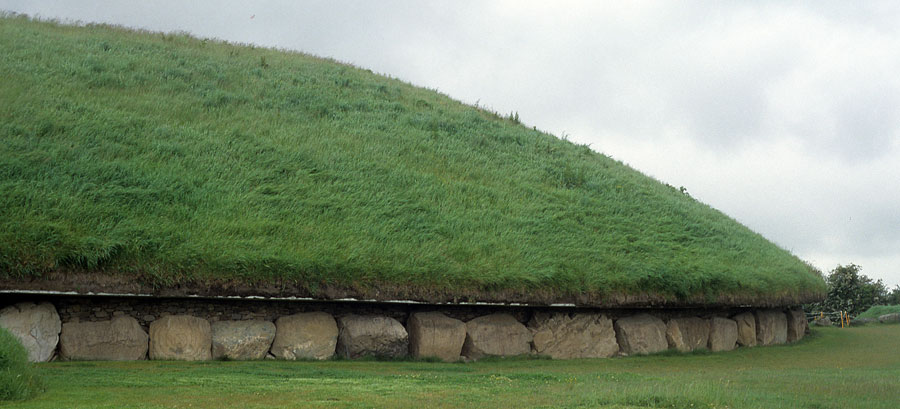
The great cairn of Knowth with its gallery of engraved kerbstones, is the
largest and most complex neolithic building in Ireland.
Knowth
Knowth is the largest passage mound in Ireland. It is a massive structure covering an acre of land on a hilltop in the Boyne Valley. In architectural conception it represents the ideas and motivations of a society which we are only just beginning to understand. That society is very far removed from us, and indeed very far removed from even the most ancient civilizations that we do know something about.
The Stars and the Stones, Martin Brennan, 1983.
Knowth is both the largest and most remarkable ancient monument in Ireland. Though Newgrange is more famous and Dowth is probably older, Knowth is a fascinating and important site with a collection of more than 400 engraved stones and
some finely carved artifcts dating from the middle to the end of the Irish neolithic. The cruciform east chamber at Knowth is the largest in Ireland, at the end of a passage forty meters long. Knowth is a UNESCO World Heritage site, managed by the Office of Public Works and access is through the Brú na Bóinne Visitor Centre.
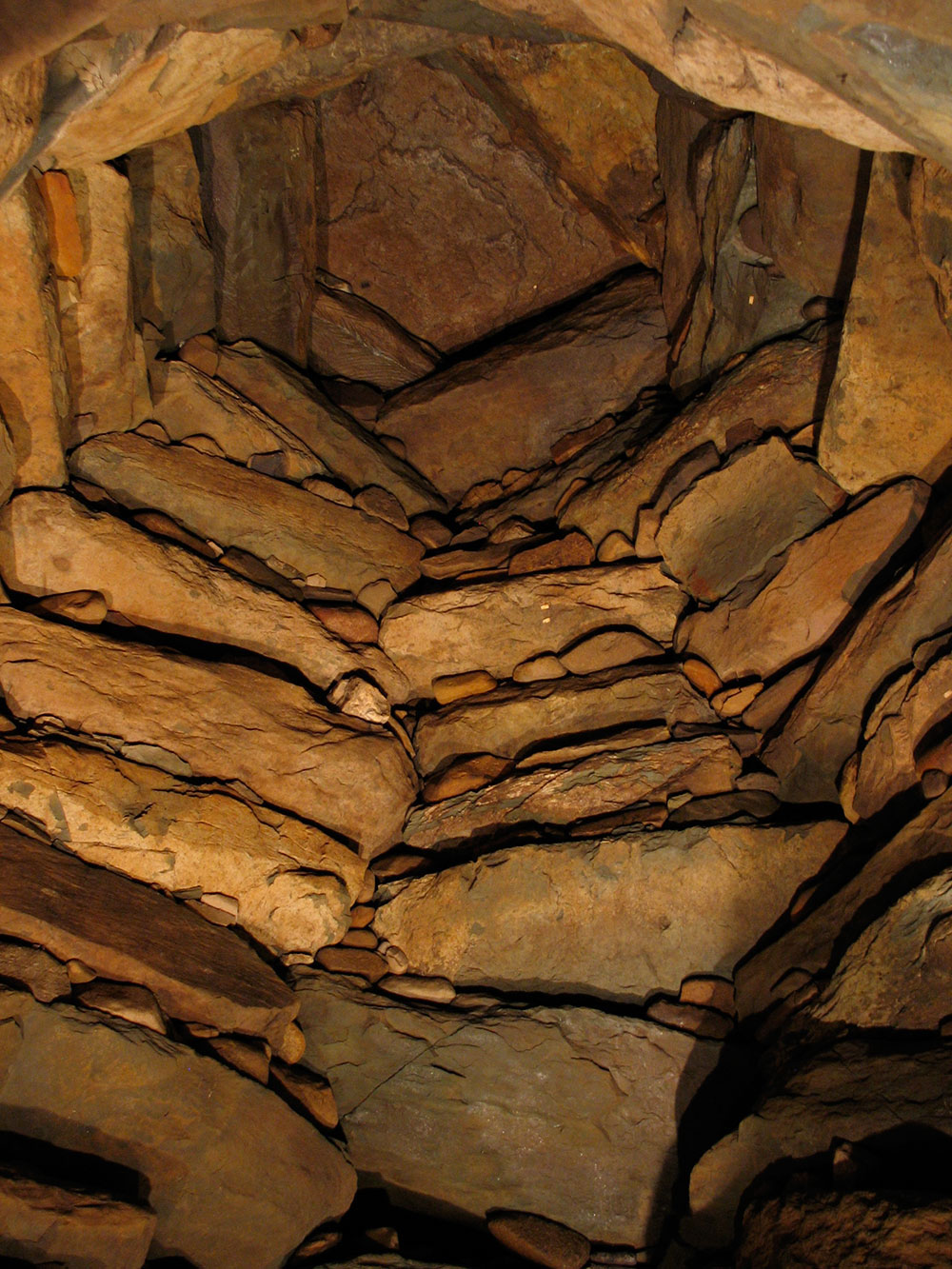
The massive vault of the corbelled ceiling in the East chamber of Knowth.
Cnoc Buí
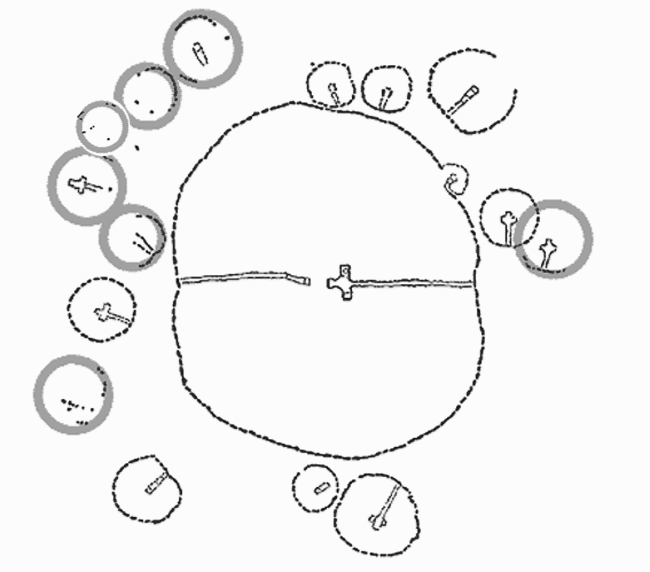
Knowth is located on a ridge two kilometers north-west of Newgrange, and is the closest of the three mega-mounds to the sacred River Boyne. The enormous main mound is 85 by 95 meters in diameter, covering more than an acre of ground, and is surrounded by at least eighteen smaller structures called Satellite monuments. The satellite mounds, several of which are as large as twenty meters in diameter, predate the colossal central cairn. The monument seems to have been in use for at least three centuries, between 3,200 and 2,900 BC.
Kerri Cleary was project coordinator for volume six in the Excavations at Knowth series, on the Neolithic archaeology of the Great Mound. She has worked as an archaeologist for over fifteen years, since completing her PhD at University College Cork in 2007. She specialises in prehistoric archaeology, particularly the Neolithic and Bronze Age of Ireland. She was one of the contributors for the recent publication, 'Knowth'.
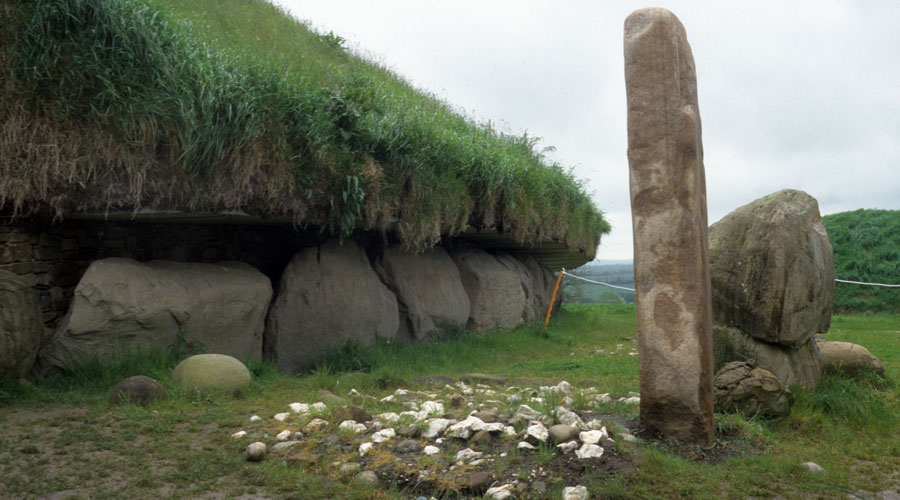
In Irish mythology Knowth is Cnoc Bui, home to the sovereignty Goddess Buí, consort of Lugh of the Long Arm. Lugh and his spouse Buí may well be represented by the pair of standing stones positioned outside the West entrance at Knowth. It would seem that each of the three huge mounds in the Boyne Valley has a symbolic role or meaning: Newgrange represents Birth, Knowth represents Marriage and Dowth represents Death. The passage-graves are symbolic ritual constructs designed to allow the living to make a symbolic journey through the passageway into the Underworld or Land of the Dead, represented by the chamber, and to return again safely to the Land of the Living.
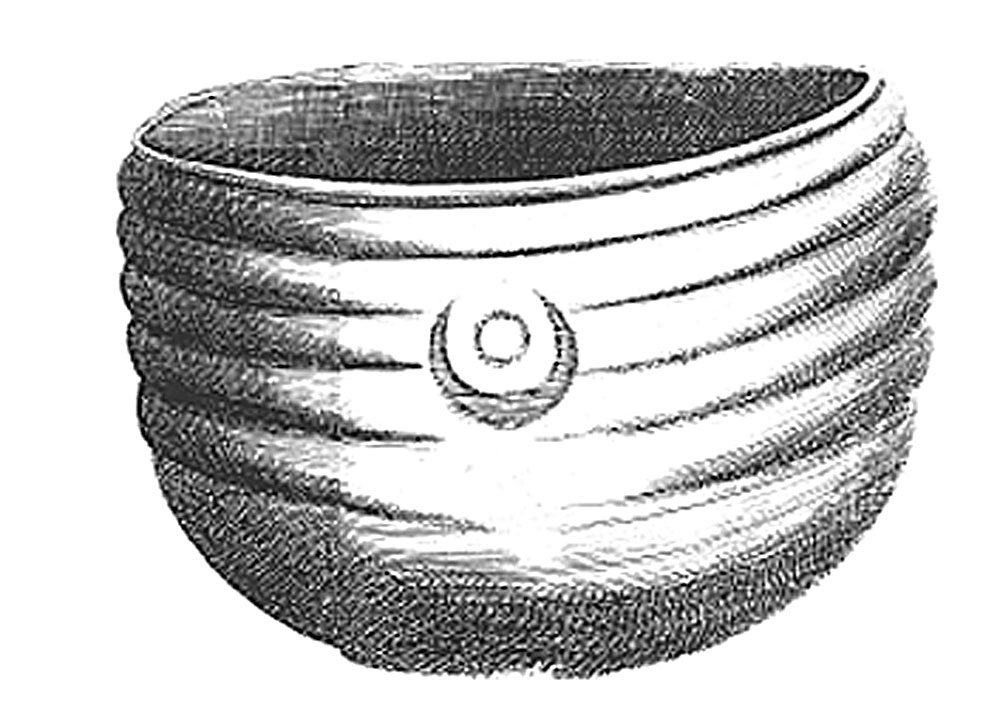
Excavations have proven Knowth to be an extremely complex site which was in continual use from the neolithic to the Norman times. The monument is first mentioned by Sir Thomas Molyneux, who visited Knowth around 1713 and published details of the monument in 1725. Molyneux found a decorated stone 'urn', most likely a basin stone, and some fragments of cremated bone in what was surely the recess of a cruciform or undifferenciated satellite monument. The basin has since been lost, and is probably in a private collection somewhere, but we have an illustration left by Molyneux. The object has solar or lunar symbolism and bands carved around the sides, much like a smaller version of the basin in the East chamber.
One of two illustrations of the stone 'urn' or basin illustrated by Molyneux in 1725.
John O'Donovan, working for the Ordanance Survey, visited the site in 1836, noting that the monument was known as Miss Nanny's moat, and that ‘attempts have been made to discover a passage into the Moat but with no success’. William Wakeman was the first to illustrate the monument, and noted that for many years the site had been used as a quarry, which probably accounts for the destruction of the satellite monuments. Sir William Wilde mentioned the monument in his Beauties of the Boyne, published in 1849, and described the Knowth as:
an abrupt, hemispherical mound, with rather a flattened top... Some enormous masses of stone, arranged in a circular manner around its base, tell us, however, that it is evidently the work of design; and some excavations made into one of its sides show that it consists of an enormous cairn of small stones, covered with rich greensward, occupying in extent of surface about an acre, and rising to a height of nearly eight feet. As far as we can judge by external appearances, although history is against us, it appears to be as yet uninvestigated.
Knowth, Newgrange and Dowth were taken into state care in the 1882, and gained some measure of protection from quarrying and other damage. George Coffey visited Knowth in 1892, and made an effort to identify the monument from literary sources:
Hence is Cnogba of the troops,
So that every host deems it famous,
From the lamentation after reaping nuts.....
Following Elcmar's daughter.
Coffey was the first to identify the presence of a satellite monument, noting several large stones on the northern side of the huge mound, forming a ‘more or less defined ellipse, of about 70 feet by 30 feet, possibly marking the site of another sepulchral monument’.
R. A. S. Macalister's trench at Knowth during his 1941 excavation.
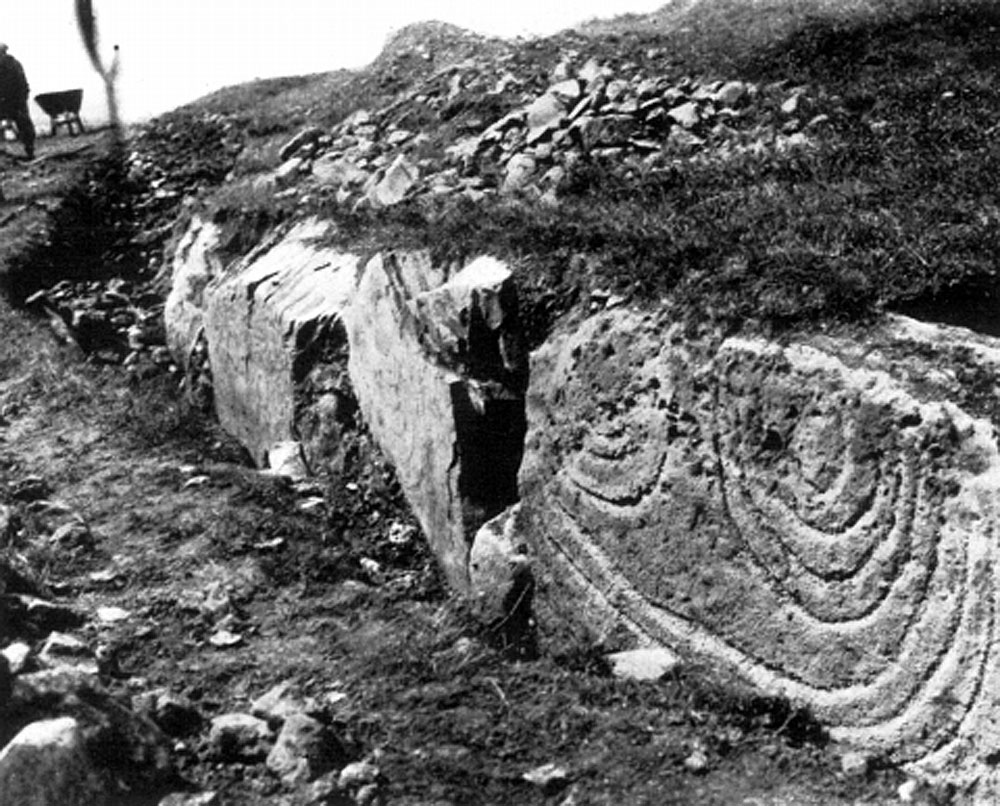
Robert Alexander Stewart Macalister, who had excavated at Carrowkeel in 1911 and Newgrange in 1928, was next to investigate Knowth in 1941. Macalister thought the stones noted by George Coffey might mark the entrance to the great mound, and obtaining permission from the landowner, he began to excavate what we now know as Satellite 14. He recognised this as a seperate monument to the great mound, 'a minor grave-monument', and turned his attention to the kerb of the great mound. He began to excavate a trench one meter wide along the base of the mound, exposing the kerbstones, intending to work his way around the base of the mound until he found the entrance. Macalister dug four trenches and uncovered fifty-eight kerbstones, forty-eight of which were ornamented, some of them very elaborately.
The East and West Passages
The original monument at Knowth was a passage-grave about fifty meters in diameter with twin chambers back to back. The first Knowth, which may have been constructed around 3,500 BC, is no longer visible. During the later neolithic, this earlier monument was subsumed into a greatly enlarged mound, and extensions were added to the two passages, changing the angle of the west passage by about 17 degrees.
When George Eogan began his excavations in 1962, there was no indication that the site was so complex. The West chamber was discovered on 11 July 1967, when the excavators were investigating a series of medieval souterrains, built long after the neolithic. Martin Colfort and George Eoghan explored the newly discovered megalithic passage, discovering that it penetrated thirty-four meters into the mound. At the end was a spectacular undifferenciated passage-grave with many lavishly engraved structural stones.
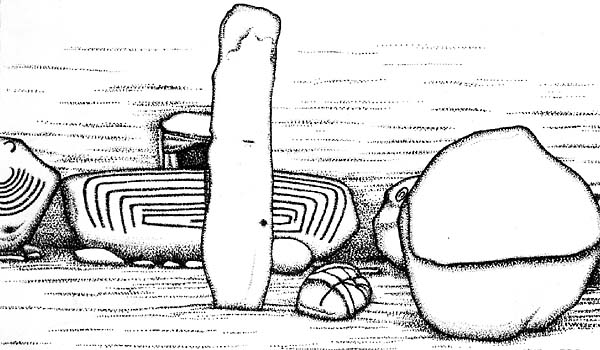
Tall twin pillars flank the north recess of the East chamber in Knowth, guarding the fabulous engraved stone basin.
The East passage and chamber was discovered on 1 August, Lugnasadh, the Feast of Lugh, 1968. The entrance was discovered while excavating a medieval souterrain, which connected to what turned out to be the longest megalithic structure in Europe, with many fine engravings on the orthostats and roofslabs. The passage ran straight for forty meters into the mound, opening into a huge cruciform chamber with a wonderful corbelled roof. Twin pillars guarded the right-hand recess, where a beautiful engraved stone basin, the finest example known in Ireland was discovered. The basin, which is 1.4 meters in diameter, is much too large to have been taken into the monument after it was constructed, so the chamber must have been built around the basin.
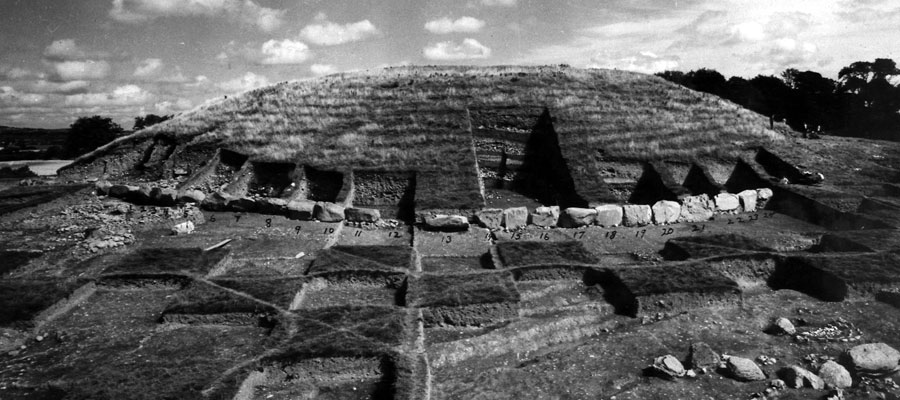
A photo of Knowth taken during excavations shows the cuttings behind various kerbstones.
The Kerbstones at Knowth
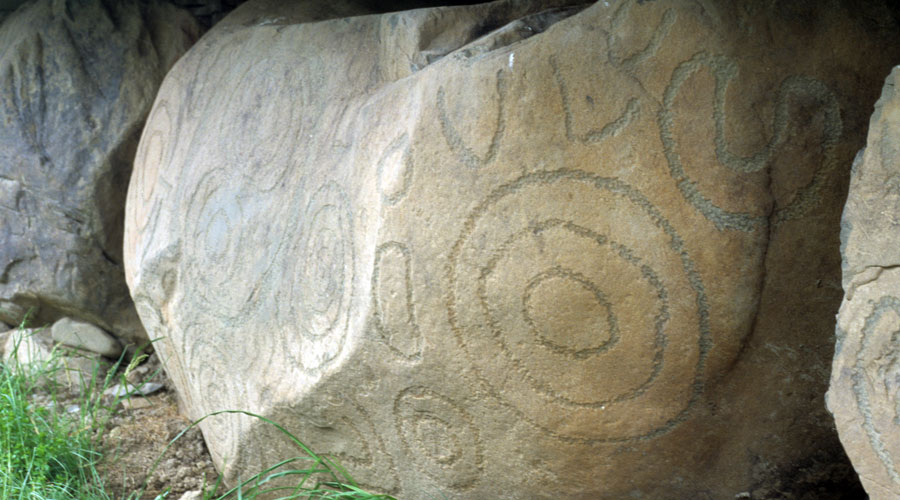
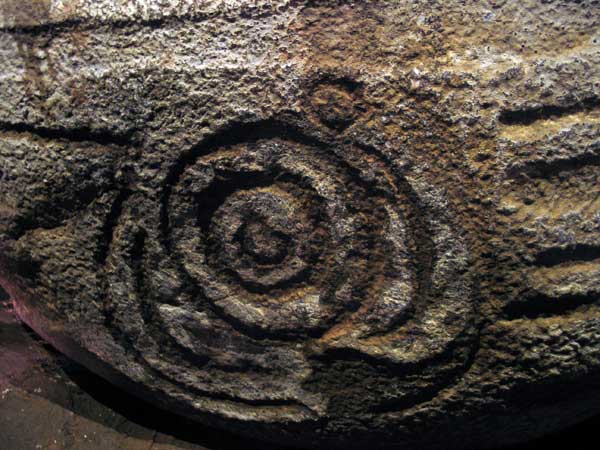
A continous ring of 127 kerbstones encircles the base of the enormous mound. Three kerbstones are missing and all but ten of the are engraved with an amazing array of abstract astronomical motifs. Carvings which may represent the moon, or eclipses of the moon and sun, predominate at Knowth.
The stones used for the kerb and chamber construction are greywackie, a fairly soft sandstone, which is easily carved. Like the stones at Newgrange and Dowth, the stones came from Clogher Head, and were dragged at
least twenty kilometers from their quarry if they were transported by land, or thirty kilometers if they were moved by water, which seems more likely. The sourcing and movement of so many stones is an astonishing feat, pointing to a wealthy and highly organised society, driven by religious motives.
One of the ninety decorated kerbstones at Knowth.
Megalithic Art
Knowth has the largest collection of megalithic art known from neolithic western
Europe, and accounts for half of the total number of engraved stones
in Ireland, and one third of all the megalithic art in Europe. Knowth's artwork is the equivalant of a huge library of stone age art, with a common theme and style running through the art. Almost all of the kerbstones encircling the large mound are engraved, many with what seem to be very obvious solar and lunar symbols.
Ninety of the 127 kerbstones are engraved, many with complex panels that seem to be attempting to reconcile the cycles of the sun and moon, and many examples appear to be counting moons. While the East and West passages, and the wonderful examples of art they contain are off limits to the public, visitors can view the ninety engraved kerbstones surrounding the mound.
The front panel of the basin in the right recess of the East chamber may be an illustration of a solar eclipse.
Canadian scientist Phillip Stooke has suggested that carvings in the end recess of the huge Eastern cruciform chamber may well be the oldest known representation of the surface of the moon. It was thought for many years that the Eastern and Western passages were aligned to the sunrises and sunsets over the equinoxes. However, when Frank Prendergast and Tom Ray surveyed the passages, they discovered that this is not the case, and both passages are some way off the equinox positions.
The original Knowth monument, before it was enlarged, had much shorter passages, and it is likely that the light of both sun and moon illuminated the backstone of this earlier phase of the monument. It is fascinating to imagine the light of the moon illuminating a map or diagram of itself.
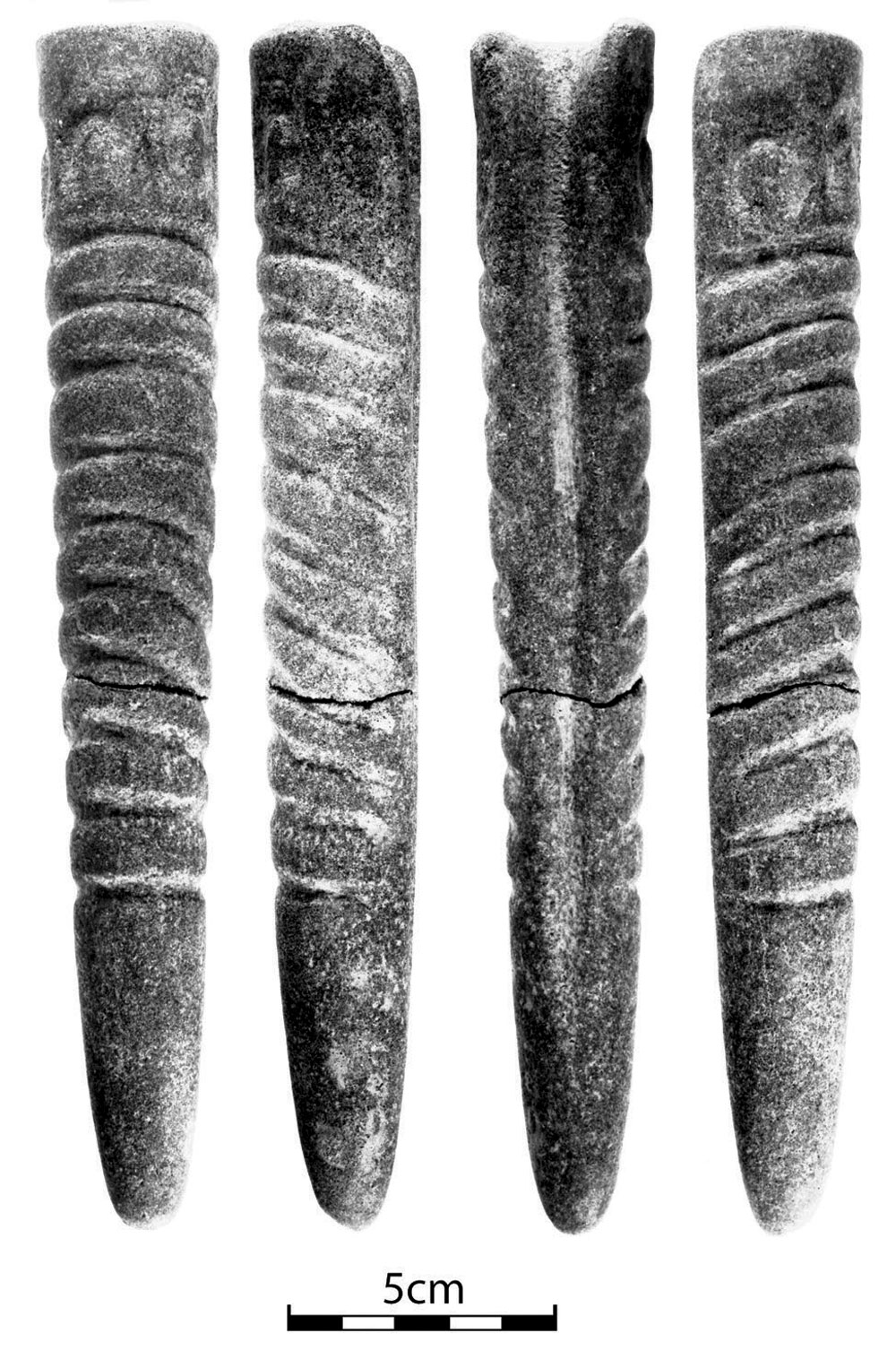
A decorated stone object found near the West entrance.
Three outstanding ritual objects were discovered during the excavations. A wonderful engraved neolithic basin stone was found in the east chamber, and a highly decorated ritual macehead, carved from a piece of Orkney flint was buried close to the basin. Both are superb examples of neolithic art. The third object was found near the Western entrance. Considered to be a stone phallus, this mysterious item is 30 centimeters long, with ten ribs and a groove carved along the shaft, and arcs or circles carved around the end.
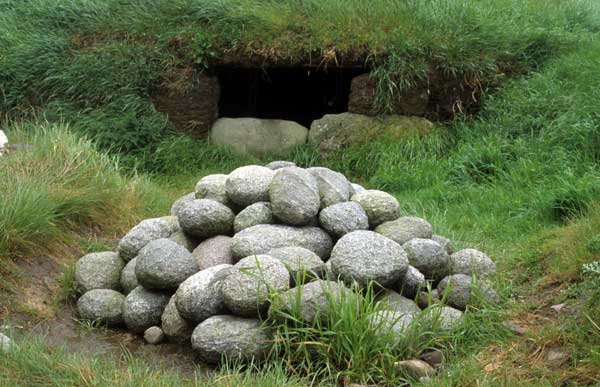
Dragon eggs: granite cobbles, brought to Knowth from the Mourne Mountains 60 km to the north of the Boyne Valley. These stones are now spread on the ground before the entrance to the east passage.
Excavations
Excavations at Knowth began in June of 1962, the same year as the Newgrange excavations, and proceeded every year until 2002, when the site was finally opened to the public. The excavations were directed by professor George Eogan and his team, who found that the site had remained in continous use from the neolithic to the middle ages, with twelve seperate sequences of use. The foundations of several neolithic houses were found under the huge mound, indicating thet the site began as a settlement. A similar scenario was found at Townleyhall, the small passage-grave excavated by Eoghan prior to his work at Knowth.
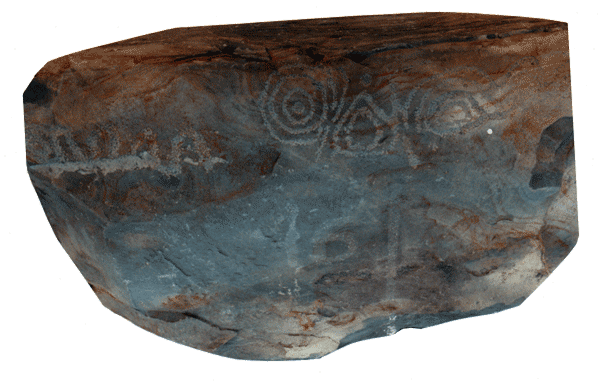
Carvings on a displaced roof corbel from the destroyed entrance to the Western passage, discovered during excavations.
Large sections of the main mound were completely removed during the excavations, and long trenches were dug along the passageways, in order to straighten the leaning passage stones. The excavators found that the structural stones of the east chamber had skewed and rotated, making the chamber and the inner section of the passage unstable. A large inner cairn of stones surrounded the two original chambers, and this was left unexplored, in case excavation would cause further destabilization. The mound was built in layers, indicating that it was constructed over many seasons. Approximately five acres of fine grass land was stripped to provide the base for the mound.
So Knowth turned out to be no less spectacular than Newgrange, and with no fewer than eighteen satellite passage tombs around it, each one a major monument in its own right, in some respects more impressive than the more famous site. As at Newgrange, George found dark granite cobbles brought from the Mountains of Mourne 60 km to the north, and white quartz stones from the Wicklow Mountains a similar distance south. At Newgrange, Michael O’Kelly believed that the quartz stones formed a vertical patterned wall flanking the entrance and reconstructed them to make a dazzling white approach to the tomb. It is an attractive idea, especially to those of us familiar with the notion of dazzling white chalk barrows in prehistoric Wessex, visible from afar. But the modern reconstruction uses cement to hold the stones in the near-vertical wall. Without cement, the thrust from the mound would have caused the collapse of the wall in no time. The white quartz must have been used in some other way.
Much of the material removed from the main was replaced with modern building materials which included concrete, styrafoam and putty. However, unlike Newgrange, attempts to waterproof the monument have failed and both inner chambers remain damp and muddy. There is no public access to these chambers, and cribbing in the West passage remains in place to support the roof. So far, six volumes detailing the excavations at Knowth have been published, and have been made available to the general public in digital versions. You can download the six volumes from the Digital Repository of Ireland website.
A plan of Knowth, showing the two passages and sixteen of the
satellite mounds. Circles show approximate size and locations. Plan
adapted from George Eogan's book, Knowth.
Materials used to build Knowth were sourced from locations far from the Boyne Valley. Round granite cobbles were collected from the shore around around the Cooley peninsula, some sixty kilometers to the north,
and the chunks of quartz found spread around the entrances came from Wicklow,
sixty kiloleters to the south. There are many stone settings, circular or oval pits lined with stones, found outside the entrances. The kerbstones and structural stones came from a quarry at Clogher Head, and were probably transported by boat. The magnificant macehead from the East chamber was carved from flint sourced in Orkney, hinting at wide connections during the neolithic. The art at Knowth has many parallels with earlier carvings from Brittany, and the carvings, particularly in the West chamber, are reminiscent of, if not directly influenced by the engravings in the chamber of Gavrinis in the Gulf of Morbihan.
Take a short guided tour of Knowth.
Guided Tours of Knowth
Access to Knowth is only possible from the Bru na Boinne visitor center across the river; shuttle busses bring visitors to and from the site. A tour of the site lasts about an hour. The passages are not open to the public; visitors are taken instead into a surreal concrete bunker built into the east side of the mound.
Twolarge standing stones outside the West Entrance. The tall thin stone is thought to be male, and the round stone female. Such pairings are quite common at sites such as Avebury.