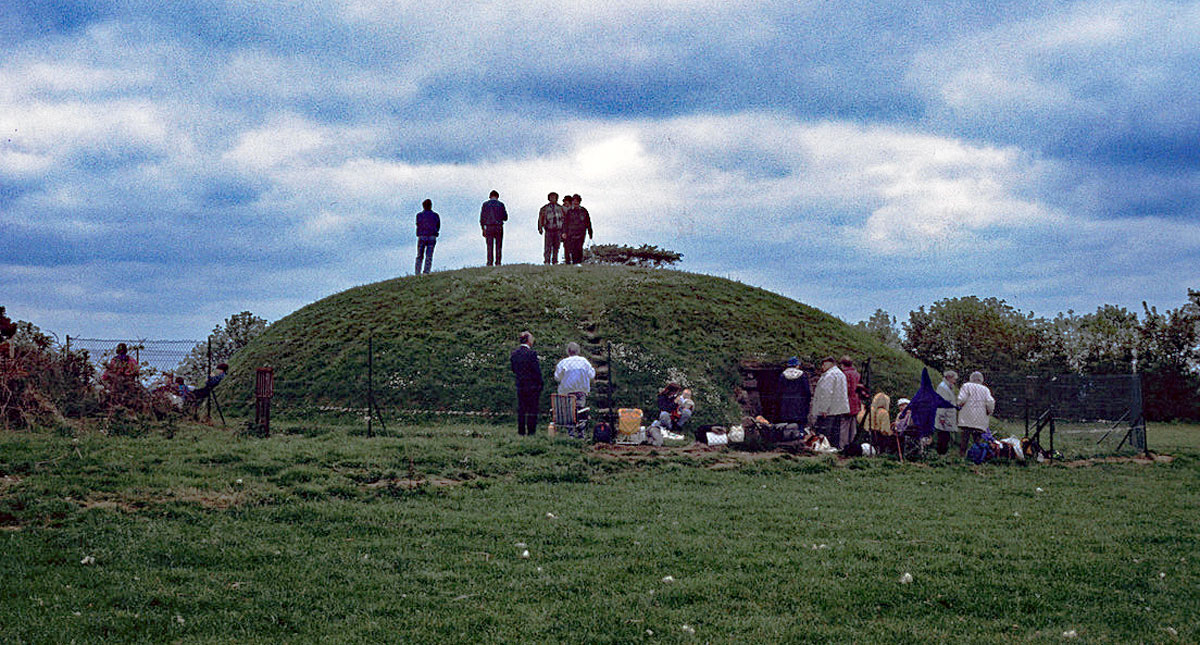
On my first trip to Fourknocks in 1994, we met up with a group of Irish dowsers who were meeting a group of Austrian dowsers at Fourknocks. The Irish group was led by Shiela Lindsay, author of the book, Time Travels of an Irish Psychic, and both groups proceeded to dowse the monument. I am glad to have been present at this fascinating moment in time.
Fourknocks Passage-grave
Fourknocks is a small and beautifully located neolithic passage-grave close to the village of Naul in north
Co. Dublin. The remains of three more monuments are located close by on the summit of the
hill, the four 'Cnocs' or 'little hills' of the name Fourknocks. The name probably means the Cold Hills in Irish. The monument is 152 meters above sea level, and has panoramic views across the surrounding landscape.
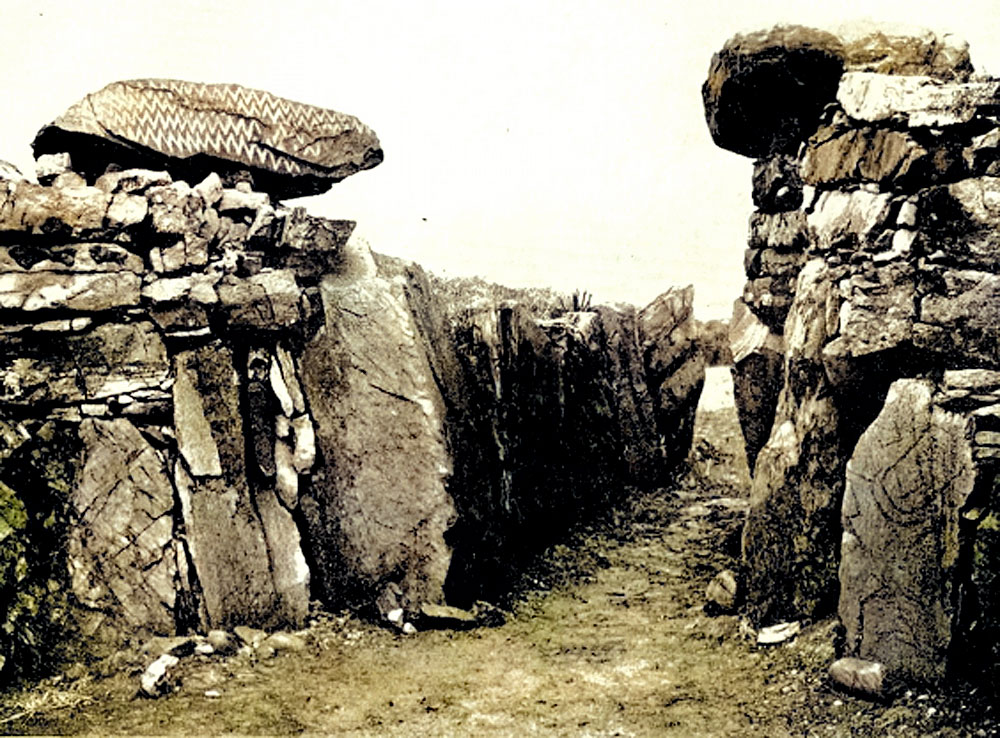
The chamber of Fourknocks, cleared after excavation in 1950.
A wide sweep of the Irish sea, just eight kilometers east of the monument, fills the eastern horizon. Sliabh Gullion and Slieve Donard in the Mountains of Mourne are visible to the north, and the hills of Loughcrew, Sliabh na Cailleach, can be seen to the northwest. Fourknocks is located about fourteen kilometers southeast of
the huge monuments in the Boyne Valley, but the sites are not intervisible with each other.
Excavations in 1950
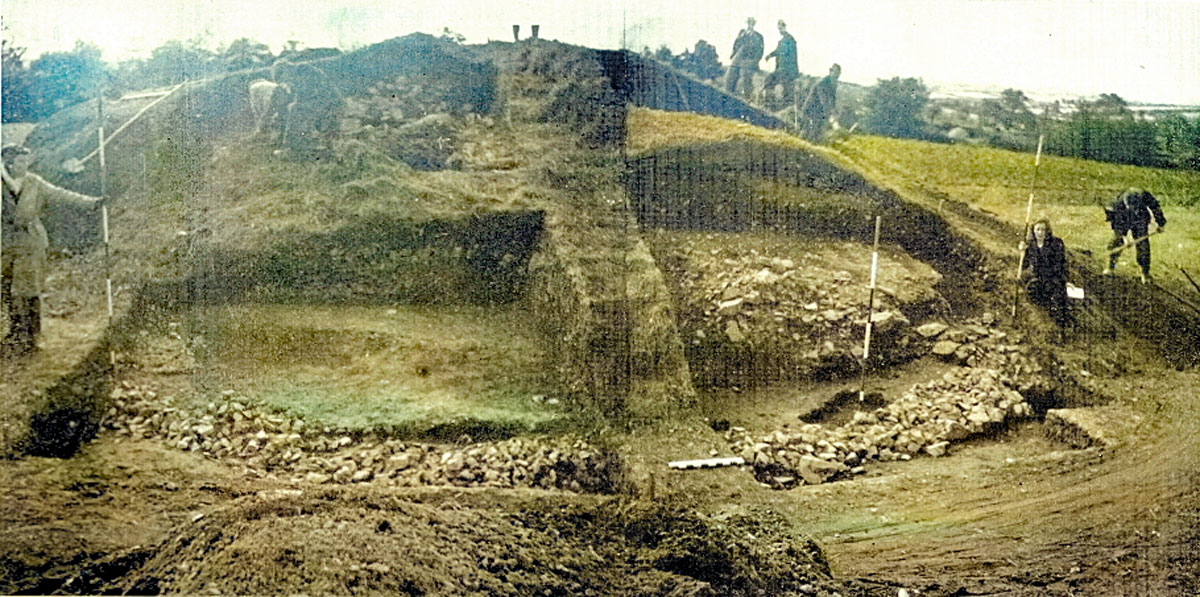
The main monument at Fourknocks was excavated by P. J. Hartnett over a period of nine weeks beginning on September 11, 1950. Harnett was invited to inspect the monument the previous year by the landowner, Patrick Maguire, who was a keen antiquarian. They noted a hollowed area in the overgrown mound, which looked as if someone had dug into the monument in the past. They found a large flat stone, which had a series of grooves carved to one side. It turned out to be a panel of megalithic art in a chevron and lozenge pattern, not unlike some corbels at Newgrange in style.
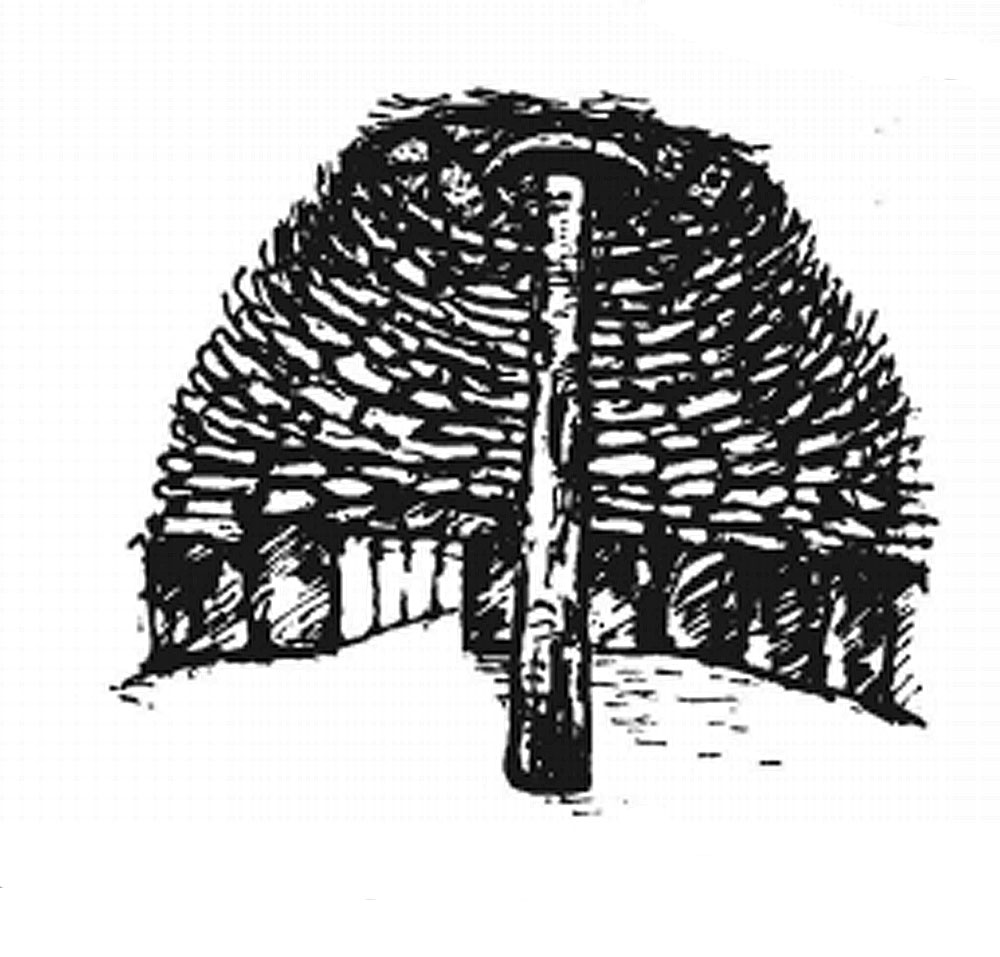
A reconstruction drawing showing how the roof may have looked during the neolithic. Image from the 1957 excavation report.
Hartnett noted that before he began to excavate, "there was nothing to indicate the presence of an elaborate megalithic structure" within the mound. The hollow are was a collapsed passage leading into a mound twenty meters in diameter and four meters high. The chamber was filled with collapsed corbels and roof debris, which were lifted out using a block and tackle. The excavator discovered–
A cruciform passage-grave covered by a circular mound of turves delimited by a low ritual kerb of drystone construction. A passage opened from the northeast on to a large pear-shaped chamber roofed, beehive fashion, by flat slabs kept in place by retentive clay, and surrounded by a slight cairn. A posthole in the centre of the roofed chamber held a stout wooden post which, if not of ritual significance, may possibly have helped support the roof.
Excavation of a passage-grave at Fourknocks, County Meath, P. J. Hartnett, 1957.
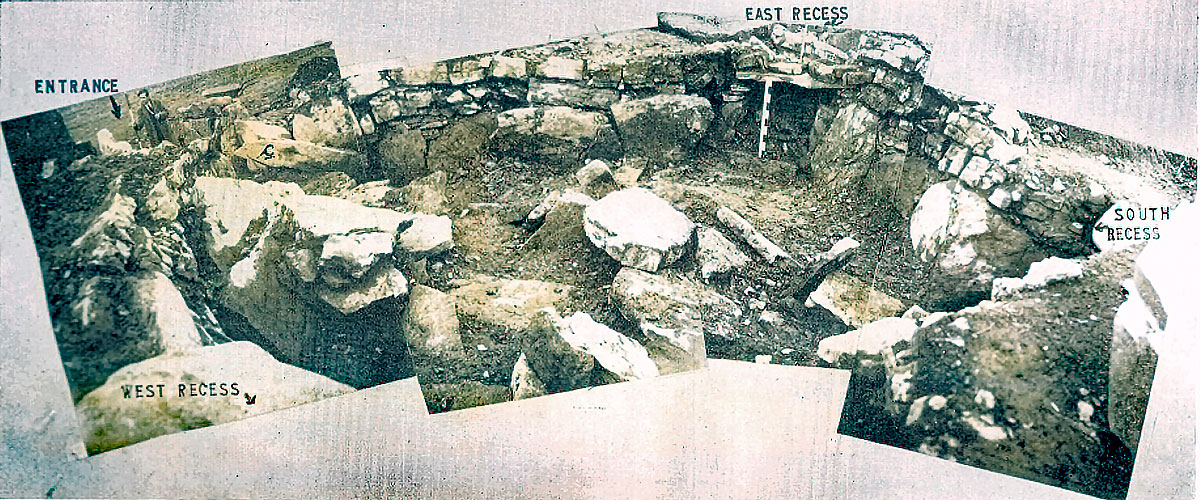
The large chamber has three recess, one each to the west, south and east, and the corbel above each entrance was covered with megalithic art. A large number of people were buried here, and Hartnett found human remains in the recesses, a mixture of cremated and unburnt bones, and a number of fragments of unburnt skulls in the chamber area.
Excavating the cairn at Fourknocks in 1950.
The Corbeled Ceiling
After the collapse of the roof, more burials were inserted into the top of the mound, and into the passage way. During the bronze age, and echoing events at the Mound of the Hostages on the Hill of Tara, a mantle of soil was added to the monument, and several burials of infants were inserted into the neolithic mound.
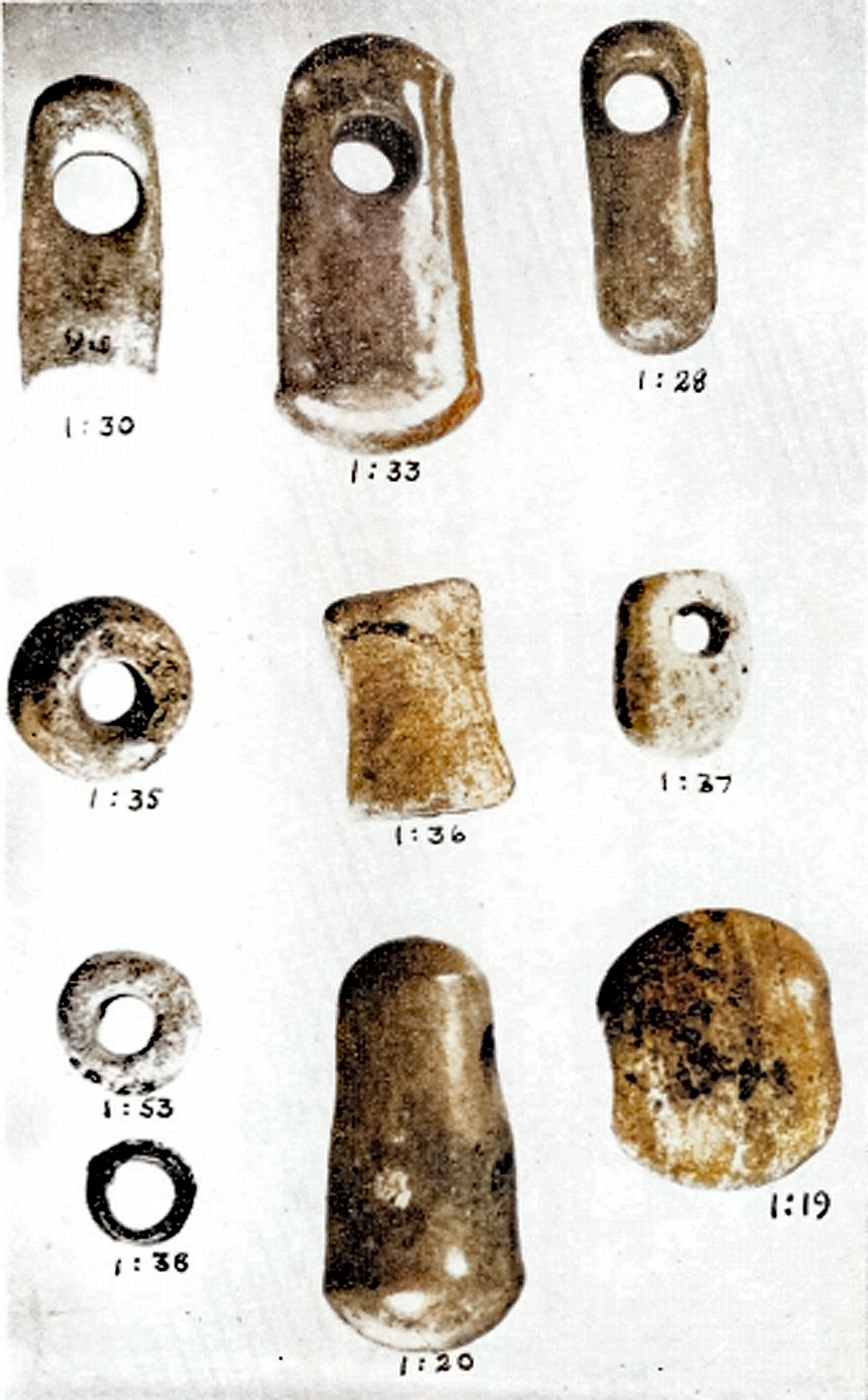
Beads and pendants found at Fourknocks.
The evidence showed that the monument had collapsed during the neolithic, possibly because the spanned area was too large and the stabilizing cairn too slight. Hartnett believed that the passage had been unroofed during the neolithic, because the passage orthostats are too slight to have carried one, and he found no roofing corbels in the passage.
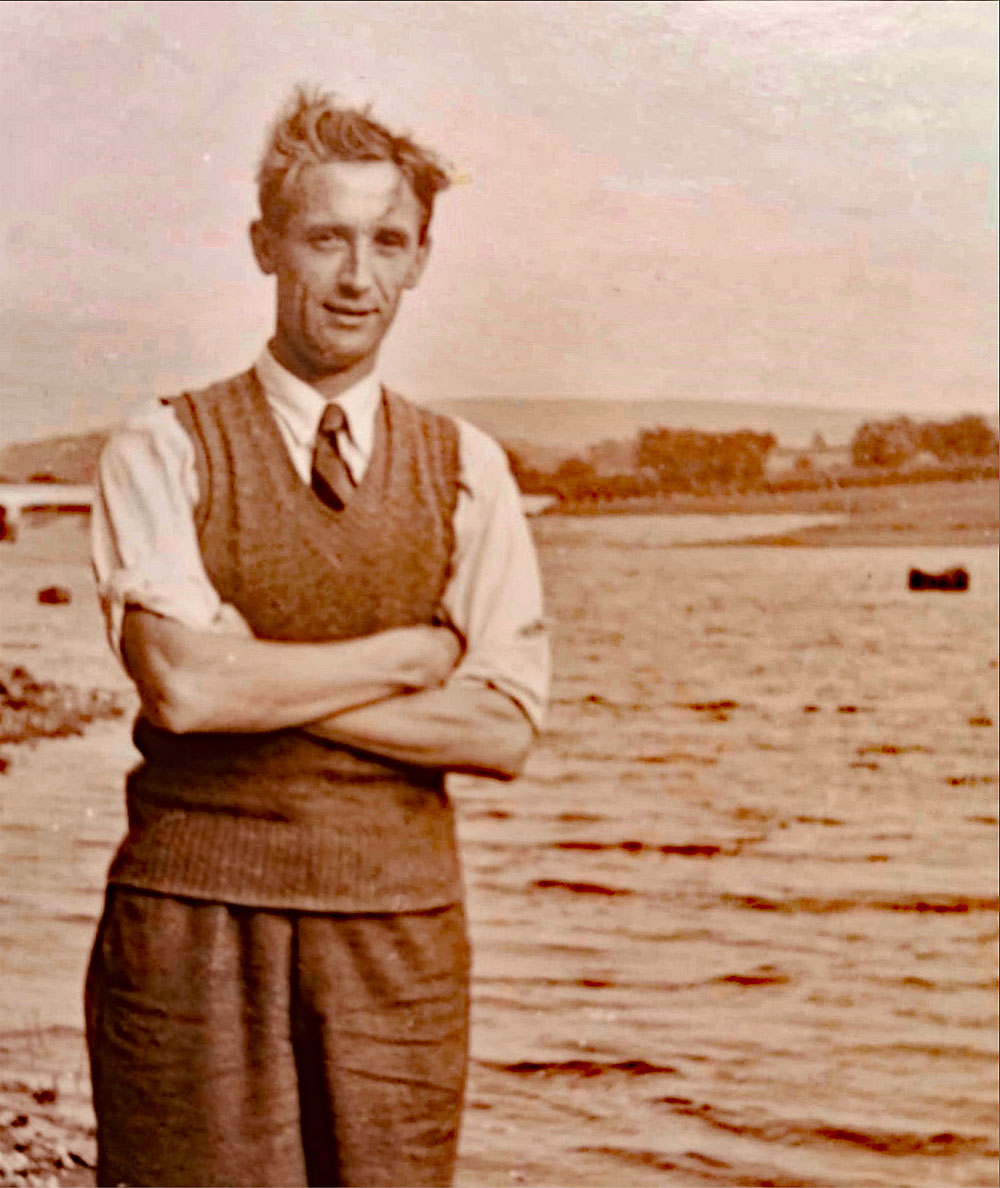
P. J. Hartnett, excavator at Fourknocks.
When the roof caved in, the corbels fell into the chamber in a jumble. They were mostly slabs of blue limestone. One large slab of sandstone discovered close to the centre of the chamber is though to be the capstone, or top corbel of the roof. When standing, the Fourknocks ceiling would have been one of the largest corbelled chambers in the neolithic world. Hartnett felt that the posthole found near the centre of the chamber held a timber beam to support the roof.
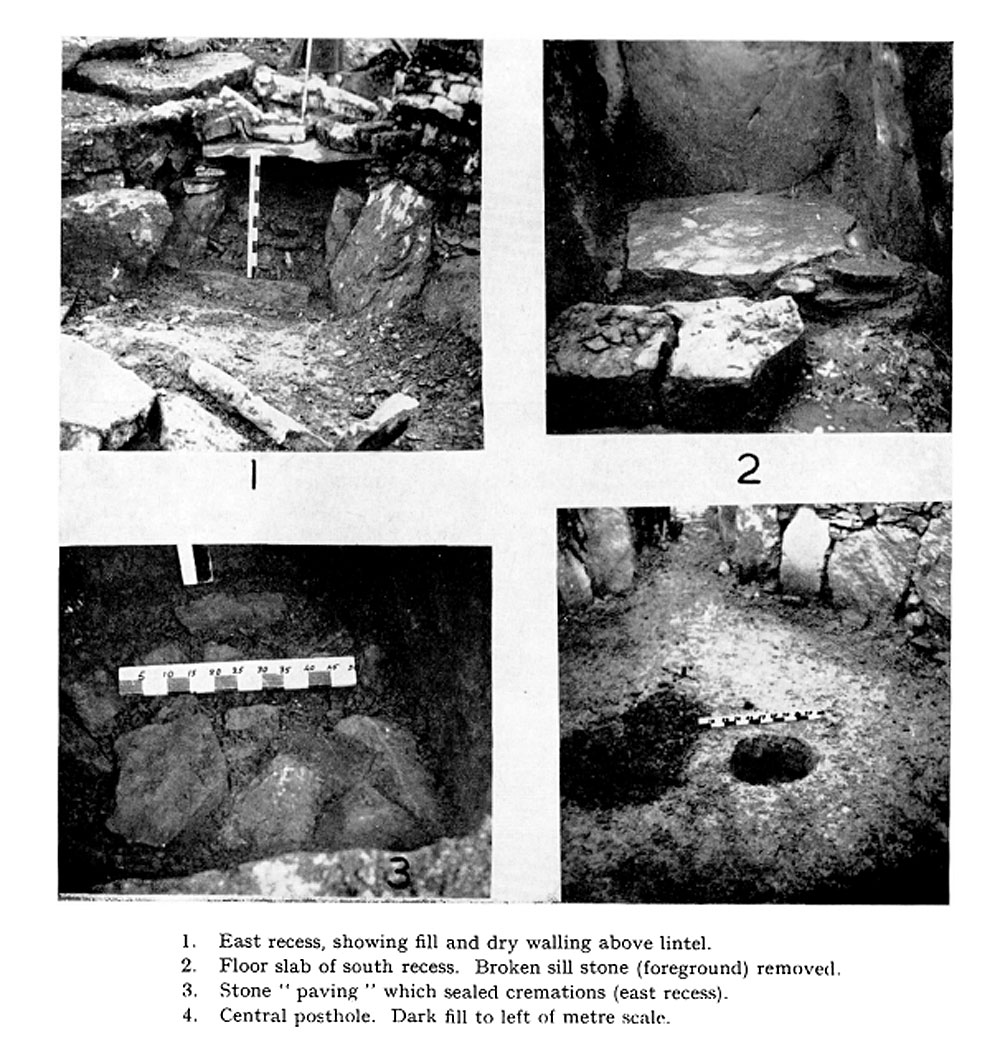
Some images from the excavation report on Fourknocks, published in 1957.
Building material must have been in scarce supply when Fourknocks was built, as the stone cairn surrounding the chamber was much slighter than the examples at Newgrange and Knowth. Soil ramps were added as baulks behind the orthostats, and clay was used to seal the outside of the chamber cairn and bind the corbels. There was no ring of kerbstones, as are usually found at passage-graves, but there was a low kerb of sandstone chunks.
Evidence for a corbeled roof, or at any rate the foundation of such a roof, was unmistakable. The outward tilting of the slabs, the stepping forward of each successive rising course, the heavy counterbalencing tailstones bedded in the mass of the mound, and the plastering of yellow clay on the backs of the stones, all suggested it. One well-preserved stretch of undoubted corbelling occurred between the east ans south recesses; this had to be removed when the collapsed filling which kept it in position was cleared away. In other sections, no doubt due to the inadequate butressing and the resilient nature of the sod mound, the orthostats as found were tilted backwards by the roof thrust and so the courses of corbelling above them had either collapsed or were distorted and not readily apparent.
Excavation of a passage-grave at Fourknocks, County Meath, P. J. Hartnett, 1957.
There are three recesses placed about the rear of the chamber, and the lintel of
each recess is elaborately engraved. The recesses were more or less intact when they were excavated. Each measures slightly more than a meter square, and each has a large slab like a basin as a base. All have a sill stone dividing the recess from the chamber. Within the recesses, a primary layer of cremated human remains mixed with fragments of skulls varied between 15 and 30 centimeters deep. A number of finds typical of this type of monument were found mixed with the bone.
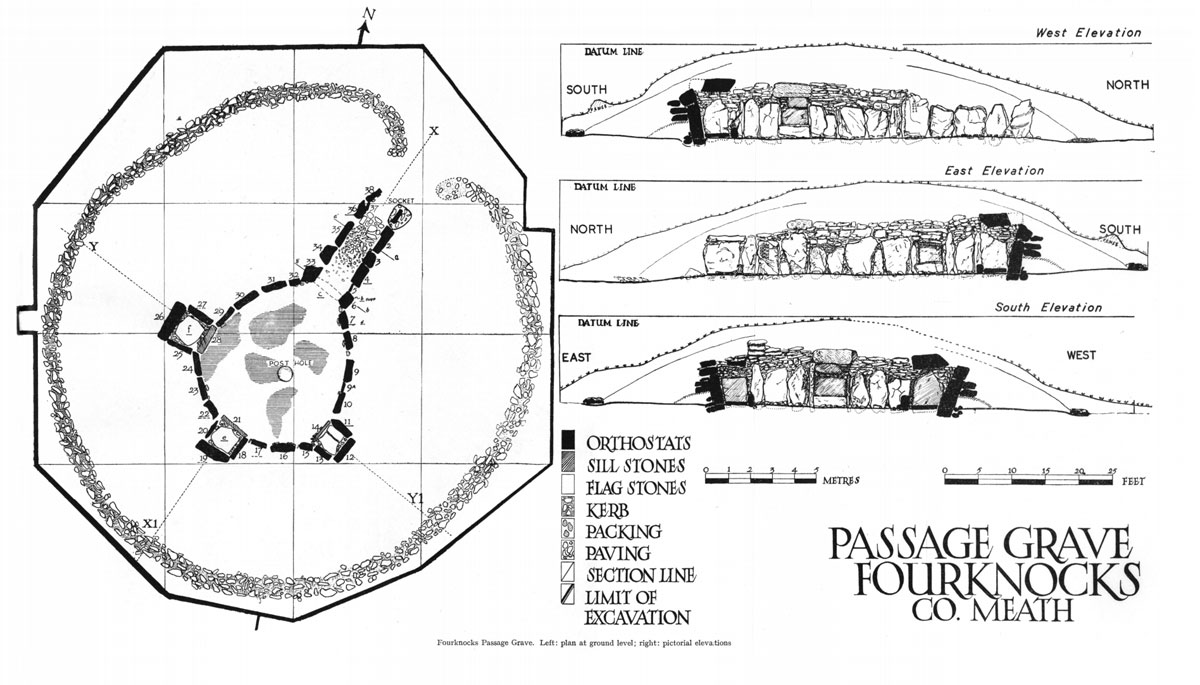
Plan and elevation of the passage-grave at Fourknocks, from the excavation report by P. J. Hartnett published in 1957.
Burials at Fourknocks
After the chamber had collapsed, burial continued in the passageway. In total, the remains of some fifty-six people were buried in the passage, chamber, and recesses at Fourknocks. It is likely that some of these individuals will be identified in future genetic archaeological research, such as the recent study which connected people buried in Listoghil at Carrowmore and at Carrowkeel in County Sligo, and Millin Bay in County Lough with an individual who was buried in Newgrange.
Over eighty per cent (in bulk) of the primary burials at Fourknocks were cremated. The unburnt bones represented fragments of human skull (mostly of children or young persons) and long bones, with a few animal bones and teeth. The animal bones, scattered thinly on the floor of the central chamber, were some of them very slightly scorched. Non-human bones are reported from several Irish and British megalithic sites and the suggestion often made that they constitute the debris of funeral feastings may, in the present case, be accepted as a reasonable interpretation. Reference to unburnt skulls is amde by Daniel and Thurnam; usually the skull of a young person as in the case of the dedicatory burial under the passage paving at Fourknocks.
Excavation of a passage-grave at Fourknocks, County Meath, P. J. Hartnett, 1957.
Hartnett found that burials were kept out of the central area and confined to the recesses and later the passageway. He speculated that the large chamber was kept free for some kind of ritual activity, noting that burning had taken place in the centre and near the west recess of the chamber.
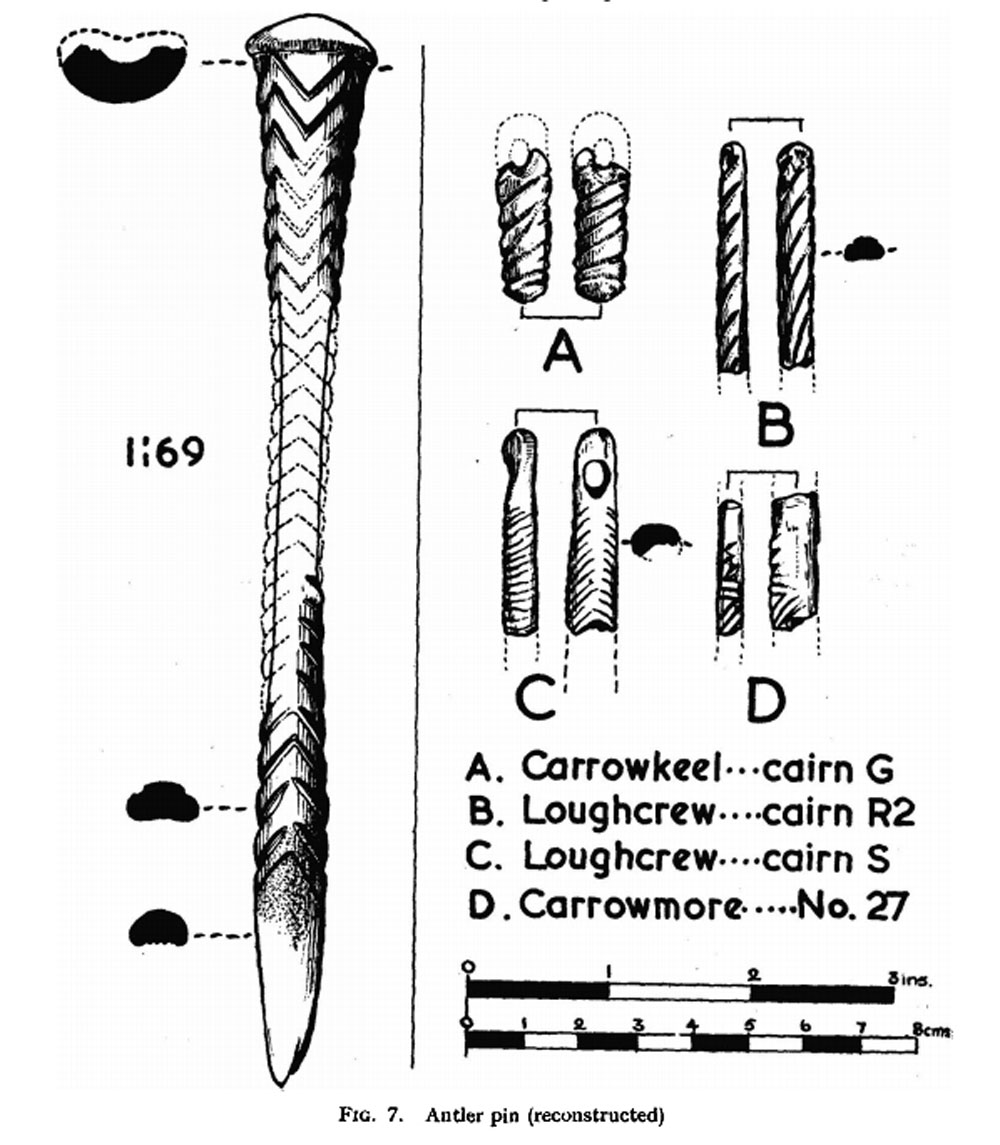
A finely carved piece of red deer antler found in Fourknocks, showing comparisons with pcarved pendants from Carrowmore, Carrowkeel and Loughcrew.
Fourknocks is closed by a modern
door, the key to which can be obtained from the nearest house. The main monument has been restored, and externally resembles the Mound of the Hostages at Tara nearby. The chamber
is entered by a short passage which is oriented to about 15° east
of north, too far north for the sun or moon to enter, and probably aligned
to the rising of a constellation.
There is a large pear-shaped chamber within the mound, the largest discovered so
far in Ireland. Normal corbelling would hardly have been able to span
this space which measures 6.5 by 5.5 meters. The posthole found at the at the centre of the chamber suggests
that a central pole and possibly a wooden and thatched roof covered the
structure. The modern reconstruction has covered the chamber with a concrete
dome, with small shafts which allow natural light to enter and illuminate the carvings.
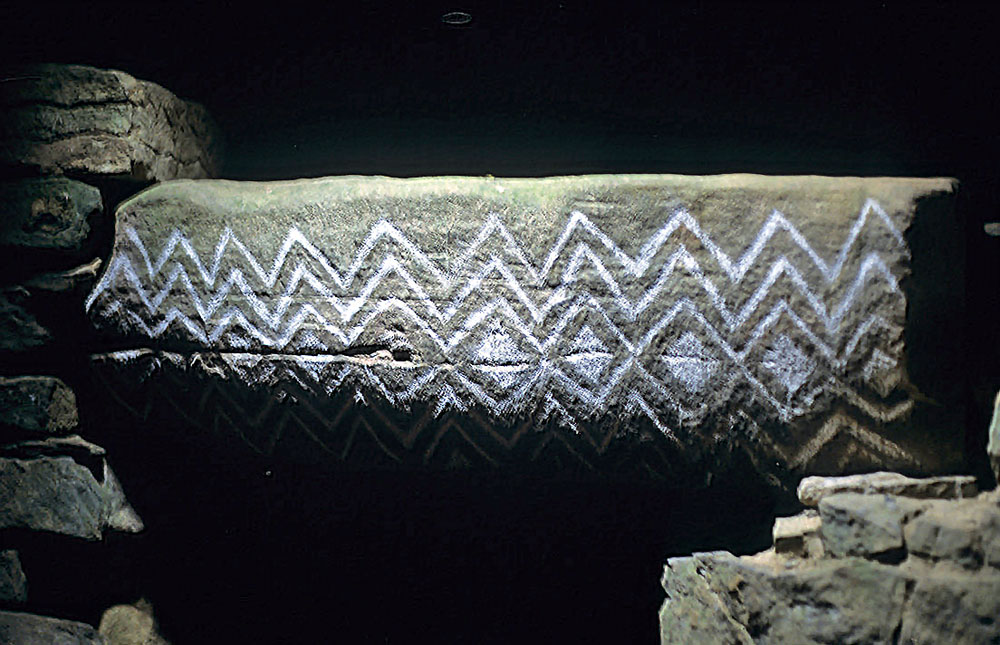
An engraved lintel above the end recess at Fourknocks.
The remaining three monuments, which are in nearby fields are quite ruined.
One has a long pit or trench which was filled with bone ash, and may have
been a cremation pit.
Megalithic Art
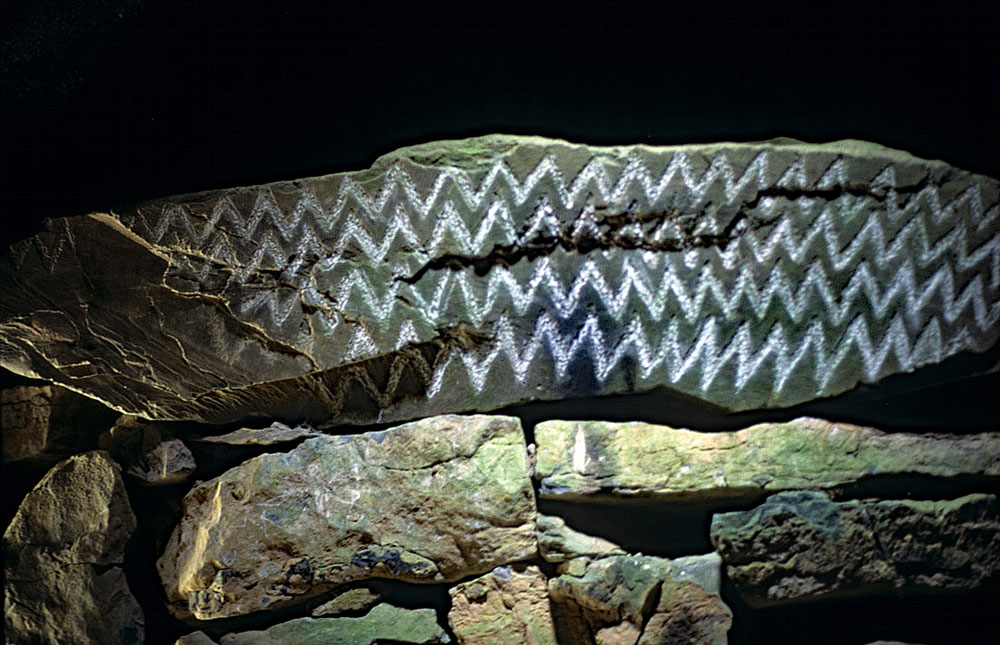
There are a number of beautiful examples of megalithic art within the chamber at Fourknocks, whcih display a uniform motif and style. The lozenge / diamond
shape was popular here, and the three lintels above the recesses are covered in variations of
the diamond and zig-zag motif. Another, larger stone seems to be a fallen lintel from above the entrance to the passage from the chamber. This stone is complete covered in zig-zag engravings and
seems quite related to the art at Newgrange. A fifth slab is composed
of circular designs, quite out of keeping with the rest of the engravings.
Megalithic art carved on a lintel at Fourknocks. This stone was positioned above the entrance to the chamber, but fell when the roof collapsed in the neolithic.
Another stone bears a series sctatched designs which some have taken as evidence of zoomorphic
art due to it's slight resemblance to a face. Directions for visiting Fourknocks: Discover Boyne Valley.
The chamber at Fourknocks during the excavation in 1950.