Dowth - The House of Darkness
Of the internal arrangement of this huge cairn little, until very recently, was known beyond the fact that there appeared here the remains of two passages in a very ruinous state and completely stopped up, neither of which however, seemed to have conducted towards a grand central chamber a sepulchral chamber of a quadrangular form, the stones of which bear a great variety of carving has been discovered upon the southern side of the mound.
William Wilde, 1848.
Dowth is thought to be the oldest of the three great cairns in the Boyne Valley. The massive cairn is the tallest of the three monuments, standing at around 15 meters above the surrounding kerbstones. The top of the massive mound is 87 meters above sea level, the highest point within the Boyne Valley with commanding fine views, especially down to Newgrange two kilometers to the east.
Article: Incest uncovered at the elite prehistoric Newgrange monument in Ireland.
Dowth is located on the west end of a long glacial ridge, with several more monuments closeby: the huge neolithic henge and the recently discovered passage-grave underneath Dowth Hall.
The Discovery and Excavation Dowth Passage Tomb with Cliodhna Ní Lionáin
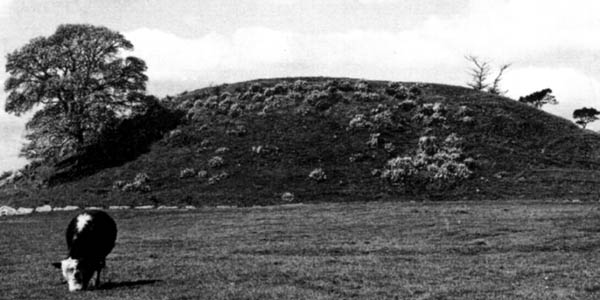
The great mound has suffered a lot of damage over the years from the various quarrying operations and rude excavations, one of which left the massive crater in the top of the mound. Like the other two huge cairns in the Boyne Valley, it dates to about 3,500 - 3,200 BC.
The entrance of Dowth faces out towards Newgrange and the horizon beyond. Dowth acts as a synchronized counterpart of Newgrange. On the day of winter solstice the sun projects its rays into Newgrange at dawn and into Dowth at sunset. The passage and chamber at Dowth are about half the size of their Newgrange counterparts, but the projected light beam is much larger, and it remains in the chamber for a longer period of time, creating an even more dramatic spectacle.
The Stars and the Stones, Martin Brennan, 1983.
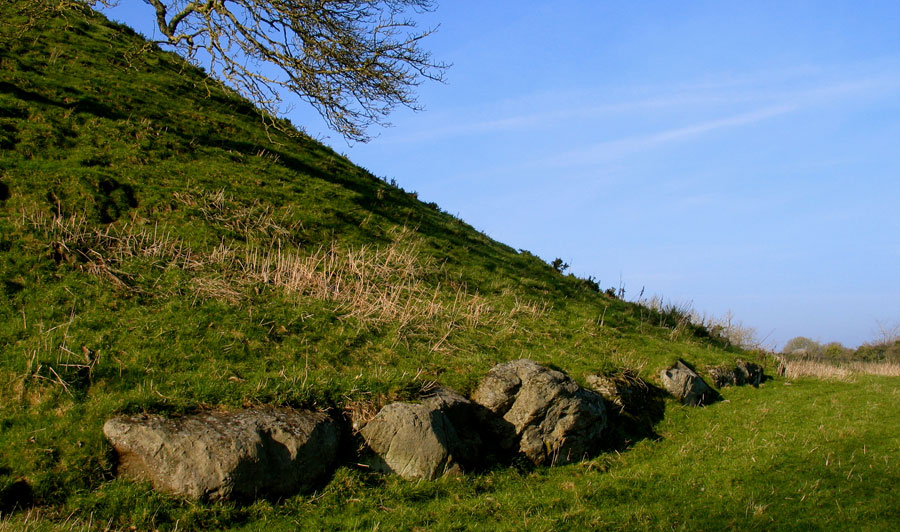
The cairn is of similar dimensions to Newgrange being about 85 meters in diameter and 15m high. The great cairn of stones is bounded by a kerb of up to one hundred greywacke boulders. At least fifteen of the kerbstones are engraved, but there may be many more carvings still buried. The site is disheveled and neglected - the mound was extensively quarried in the past and there is great crater at the center, the result of an excavation in the 1840's.
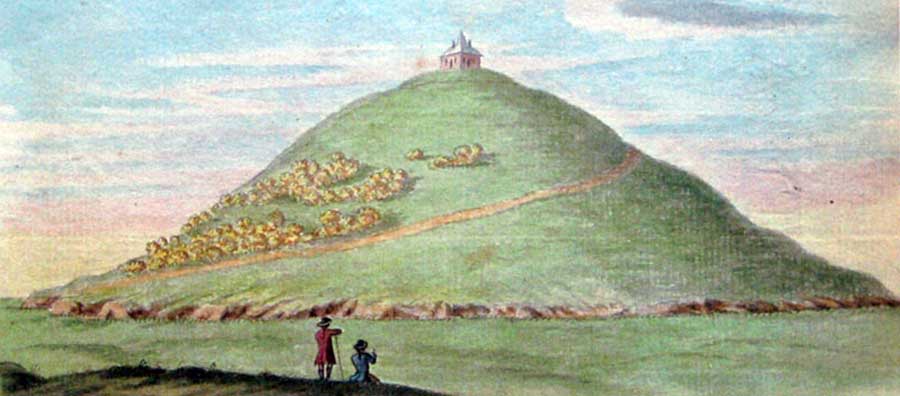
Gabriel Beranger's 1775 illustration at the top of the page shows how the cairn with nearly twice the volume of stones present today, with Lord Netterville's summer house perched at the summit. Now the kerb is covered by cairn-slip in many places, and the entrance to the north chamber is buried in the adjoining field to the west.
A fantastic virtual tour of the souterrains and neolithic passages of Dowth.
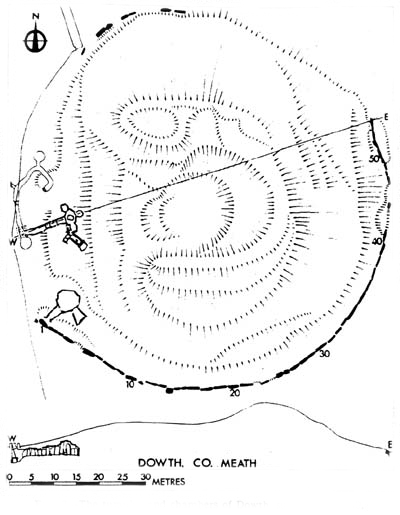
There are two chambers within the huge mound, both on the south-east side. The entrance to the northern chamber was damaged by a medieval souterrain and destroyed completely during a later renovation. Entry is through the souterrain or down a shaft that was added during Daene's restoration.
The passage leads, via three sillstones, into a cruciform chamber, with the reassembled pieces of a large broken stone basin in the middle. There is a strange annex off the right hand recess that may be the remains of an earlier phase of the monument.
The south passage is open and intact, and leads into a round chamber which was capped by a corbeled beehive roof, long since collapsed and replaced by a concrete slab. There is one large recess to the right, a strange space formed by three huge slabs laid on end. This recess has a corbeled ceiling and some unusual engravings on the now perpetually damp west stone.
The site has not been scientifically excavated in modern times, the only known 'excavation' is the 1847 dig; from Michael O'Kelly:
The excavations of 1847-8
'The investigation of Dowth was undertaken on the recommendation of the Committee of Antiquities of the Royal Irish Academy which consisted at that time of such eminent figures as George Petrie, the Rev. James H. Todd, Sir William Wilde, Sir Samuel Ferguson and Captain Larcom of the Ordnance Survey.
Mr R. H. Frith, an engineer, was given the task of directing the operations and gear was loaned by the Board of Works. A subscription list was opened by the Academy to enable the work to be carried out but was not at all well supported and as a result the first season's work had to be summarily suspended.
Just over £100 was realized and the expenses ran to a little more than that. In view of later developments it is worth mentioning that £16 was obtained from one James Elcock as compensation for damage to the mound.
The examination of the passage or passages known to exist was not the primary object of the excavation. The committee believed that Dowth must contain a chamber similar to that of Newgrange and that the center of the mound was the place to look for it since they erroneously believed that the Newgrange tomb was in the center of its mound.
Wilde tells that 'Several excursions were made to the spot, for the purpose of deciding the best means for gaining access to the interior, as, from the analogy of New Grange, it was supposed to contain a central chamber'.
It was debated whether to sink a vertical shaft from the top by means of a well-borer, or whether to tunnel horizontally from one of the sides. In the event, Frith decided to make a horizontal cutting from the west side of the mound towards the center.'
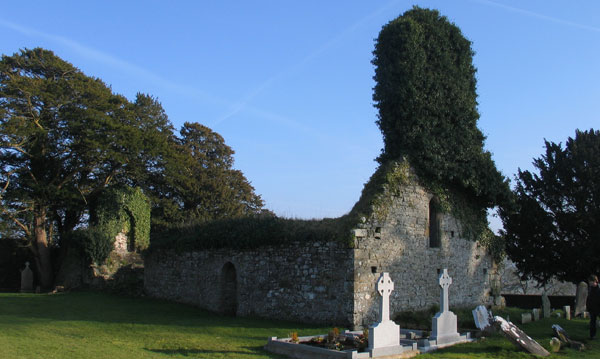
Satellite Monuments and Other Sites.
There are several more monuments nearby: two small ruined chambered mounds, Sites I and J lie to the east, just behind Dowth Hall. In the field beyond Dowth Hall is a massive neolithic enclosure, one of the largest in Ireland. Beyond that again, near the turn in the road, another chambered mound was destroyed at Cloghlea. To the south west of Dowth are three mounds in a line, two circular and one long mound in between. The long mound which may be related in form and structure to Cairn E at Carrowkeel.
Immediately beside Dowth to the east is Dowth Church and Castle which are on the grounds of Netterville Manor, which was once a part of Dowth Hall slightly further to the east. The Manor and tower house have been restored privately, and may be open to the public at some stage.
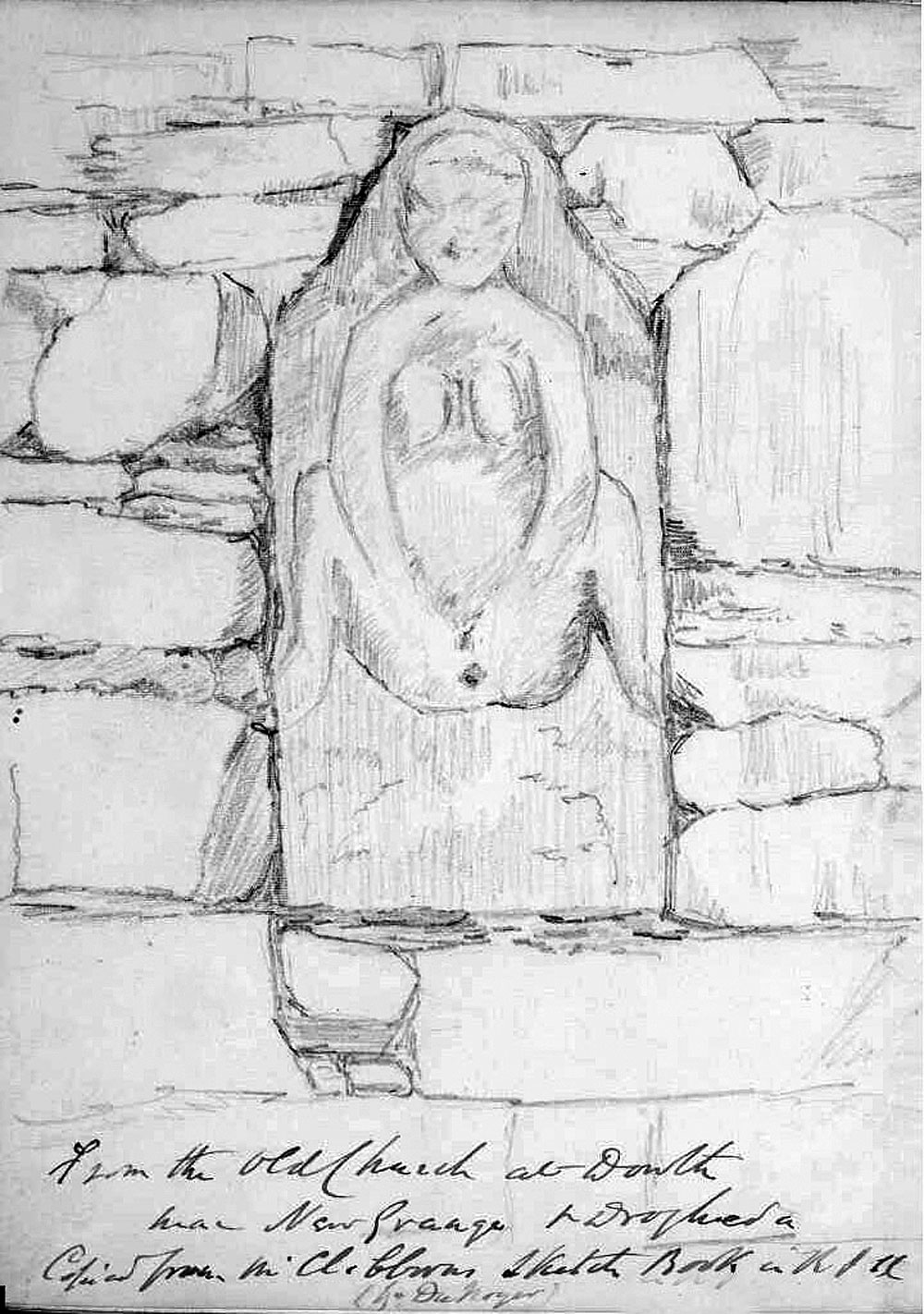
The Irish Fenian and poet John Boyle O'Reilly was born at Dowth Castle in 1844. O'Reilly was arrested in 1866 and transported to Australia for life in 1867. Escaping, he made his way to America where he edited the Boston newspaper The Pilot. After his death in 1890, a memorial to John Boyle O'Reilly was erected in the graveyard behind the Dowth church. The memorial covers the Dowth Sheela-na-gig a mysterious early medieval carving.