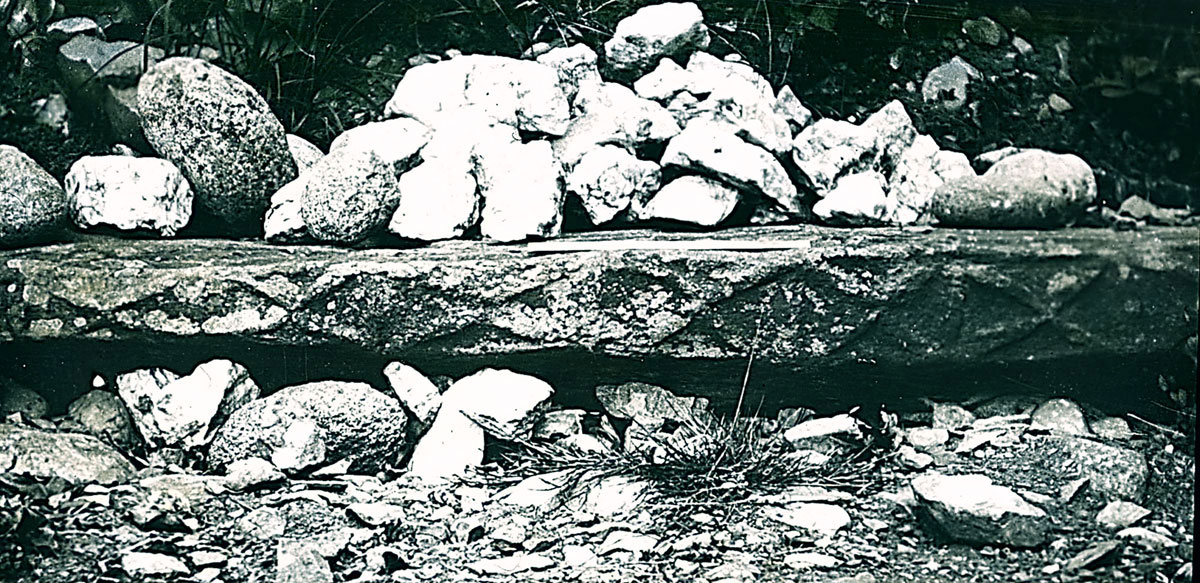
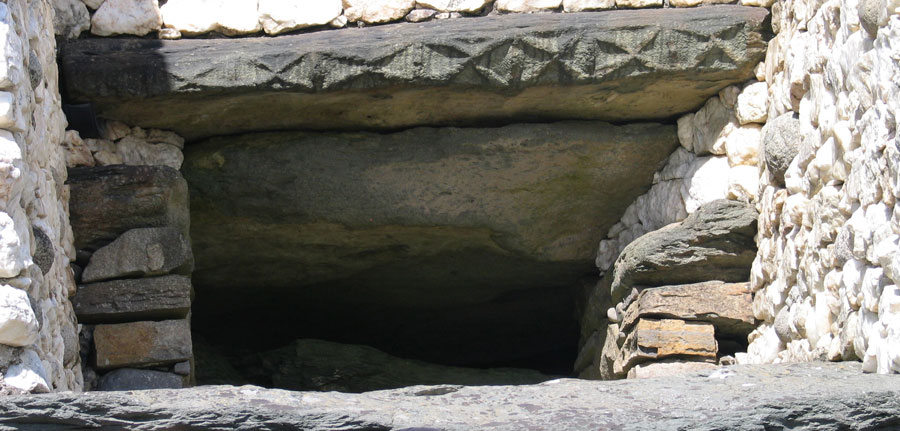
A very early photograph of the Roof-box, or 'false-lintol' from long before the mound was excavated. Chunks of quartz and granite cobbles are piled up on top of the carved lintel. In ancient times, two
quartz slabs were used to close the roof-box aperture when it was not in
use.
The Winter Solstice
It is well known that very many of the megalithic monuments of the Newgrange type scattered over Europe, especially from the Carnac centre of Brittany to the Tara-Boyne centre of Ireland, have one thing in common, an astronomical arrangement like the Great Pyramid, and an entrance facing one of the points of the solstice, usually either the winter solstice, which is common or the summer solstice.
The Fairy Faith in Celtic Countries, W. Y. Evans-Wentz, 1911.
The most famous feature of Newgrange in modern times is the orientation of the passage and chamber to the winter
solstice sunrise. This effect is achieved using a special aperture above the entrance to the passage, which Michael O'Kelly called the Roof-box.
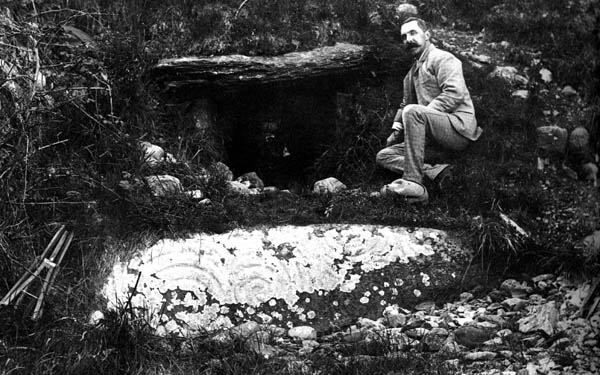
Newgrange, possibly an inspection the monument before it came into state care and was tidied up by the Board of Works. The photo, probably from about 1890, shows Newgrange caretaker Bob Hickey in the passage.
The idea that the monument might have a solar alignment dates back at least to Charles Vallancey, who suggested that Newgrange was a Cave of the Sun, a monument with a designed to observe a designated astronomical alignmnent. Bob and Ann Hickey, who worked as guides at Newgrange from 1890 onwards were aware of a solar orientation at Newgrange. The sunbeam was first mentioned in print by George Russell, the poet better known as AEON, who may have been informed about the event by the Hickeys. Russell described the interior of Newgrange illuminated by the sun in his 1897 poem, A Dream of Aengus Og.
And even as he spoke, a light began to glow and to pervade the cave, and to obliterate the stone walls and the antique hieroglyphics engraved thereon, and to melt the earthen floor into itself like a fiery sun suddenly uprisen within the world, and there was everywhere a wandering ecstasy of sound: Light and sound were one; light had a voice, and the music hung glittering in the air.
That Newgrange was oriented to the winter solstice sunrise was noted by the astronomer Sir Norman Lockyer in 1906 and again in 1909. American anthropologist W. Y. Evans-Wentz noted that the passage was aligned to the mid-winter solstice in his Fairy Faith in Celtic Countries, published in 1911. Evans-Wentz was friends with both William Butler Yeats and AEON.
The False Lintol.
The decorated stone above the Entrance had been known since about 1845, and was referred to by antiquarian researchers as the 'false lintol'.
This stone, of which we can only perceive the edge, is five feet eight inches long; its sculpture, both in design and execution, far exceeds any of the rude carvings which are figured, apparently at random, upon the stones found within the cave and as it never could have been intended to be concealed from view, it is most probable that it decorates the entrance into some other chamber, which further examination may yet disclose.
The largest of the Egyptian pyramids contains several chambers, superincumbent upon the great sepulchral vault in which the sarcophagus was placed. This sculptured stone is of the same composition—a micaceous slate—as the great spirally carved slab beneath, and is not found at all in this neighbourhood; nor, indeed, are any of the great stones of the passage or the chamber of a rock found in the vicinity, while the small broken stones, which form the great bulk of the mound, were evidently gathered around.
The Beauties of the Boyne, Sir William Wilde, 1848.
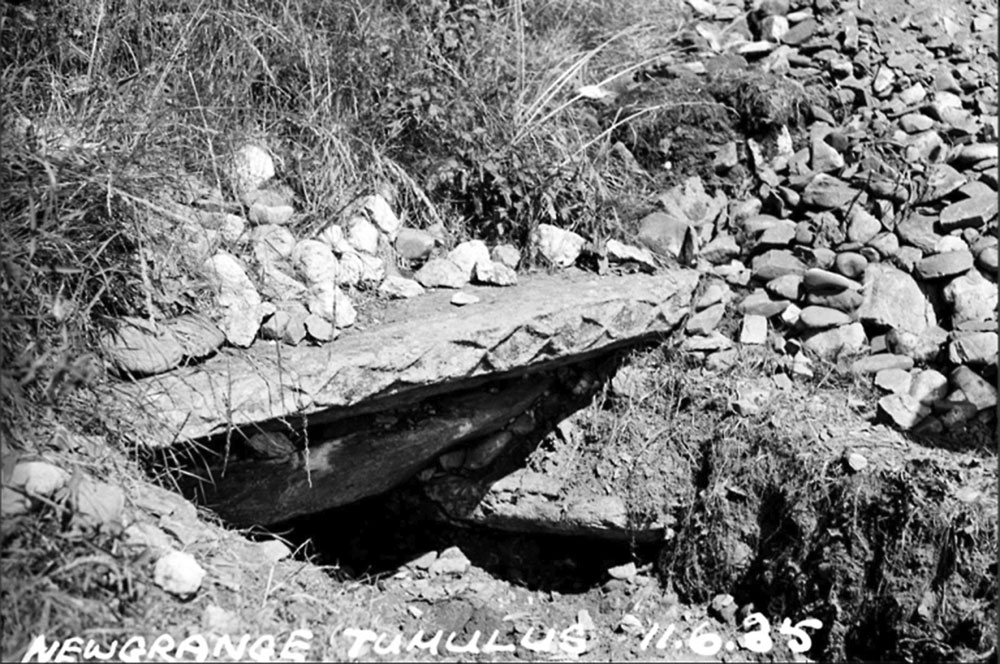
The Newgrange roof-box in 1935, a few years after R. A. S. Macalister had attempted to open the structure.
Sir William tells us that the Entrance stone, uncovered in 1699 during Campbell's quarrying, had become obscured again, covered by cairn-slip and loose stones. Around 1845 a local gentleman cleared away the loose stones, re-exposing the Entrance stone and bringing to light the False Lintol. It seems that it was also during this clean-up that the blocking stone—the door of Newgrange, was uncovered.
Several attempts were made to lift the stone, which was suspected to lead into an unopened chamber. The quality of the carvings on the edge of the lintol attracted much attention: a set of eight rectangular sections, each with a cross inside. The last recorded attempt to open the hidden entrance lintol was made by R. A. S. Macalister in 1928.
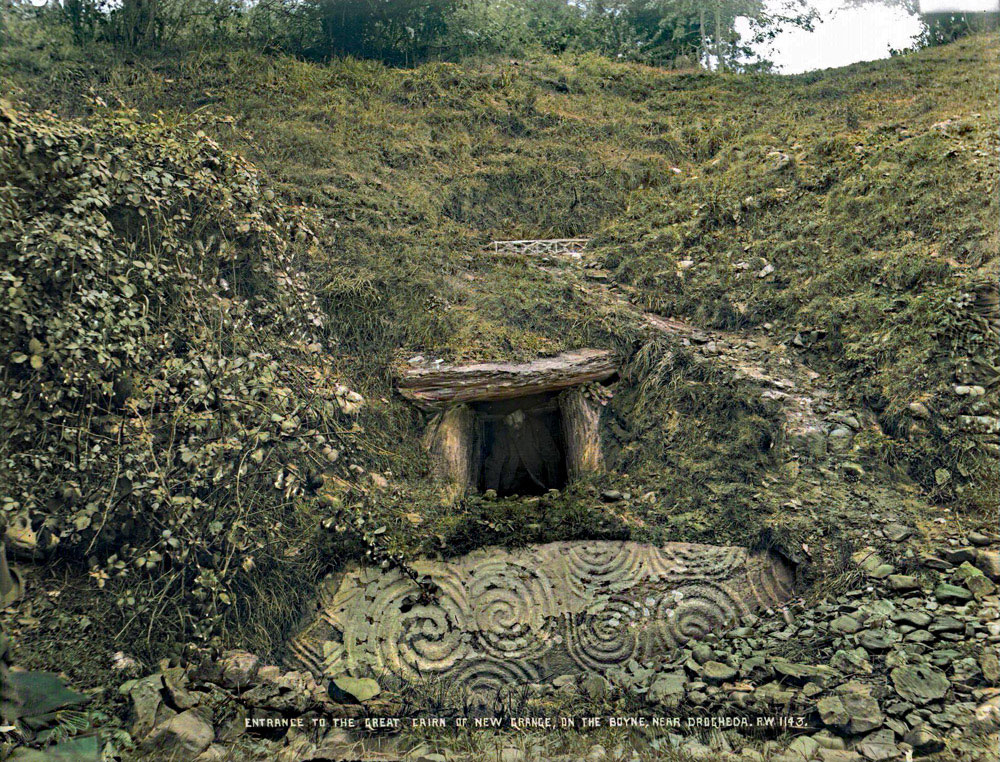
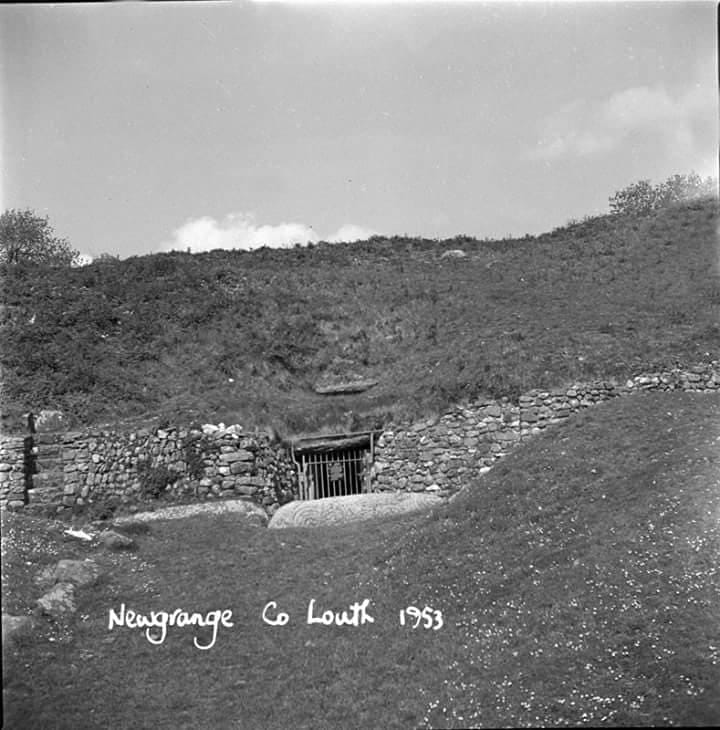
The Newgrange roof-box in 1953, seven years before Michael O'Kelly began to excavate the monument. Note the steep set of steps to the left, to allow visitors to climb the mound and examine the False Lintol.
Michael O'Kelly rebuilds the Roof-box.
O'Kelly had re-discovered and cleared out the roof-box by 1963, the second season of excavation, discovering a mysterious quartz block which had been used to close the space beneath the lintol.
As O'Kelly's team of restorers removed the grass and weeds from the mound, they came across a curious rectangular slit above the door. It was half-closed by a square block of crystallized quartz, apparently designed to work as a shutter. There were scratches on the quartz: clearly it had often been slid to and fro, providing a narrow entrance to the tomb above the main door, which was firmly sealed with a five ton slab of stone.
But what was the slit for? It was too small and too far from the ground to be an entrance for people. Professor O'Kelly remembered a local tradition which said that' the sun always shone into the tomb at Midsummer. Perhaps the 'roofbox', as it came to be known, was designed to admit the summer sun to the tomb without the entrance stone having to be moved. 'But it was quite obvious to us that it couldn't happen at Midsummer because of the position of the sun' says O'Kelly. 'So if the sun was to shine in at all, the only possibility would be in Midwinter.'
Arthur C Clarke's Mysterious World, Simon Walfare & John Fairley, 1980.
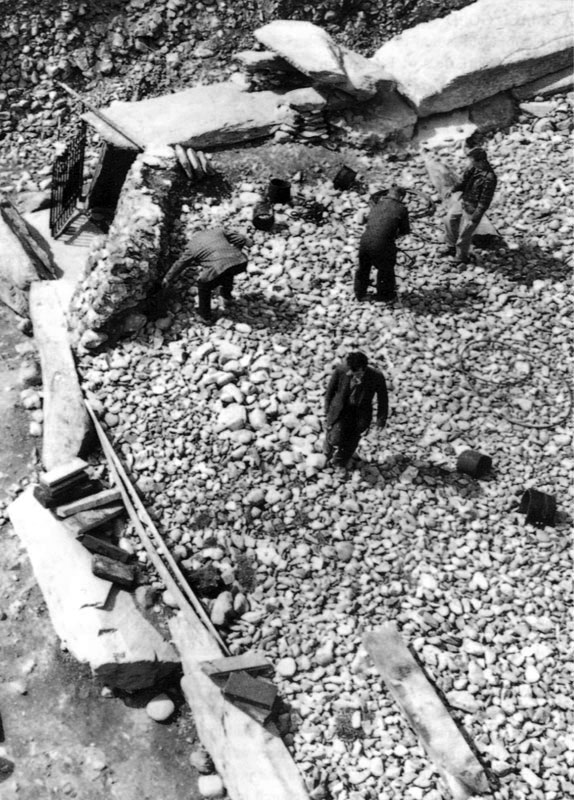
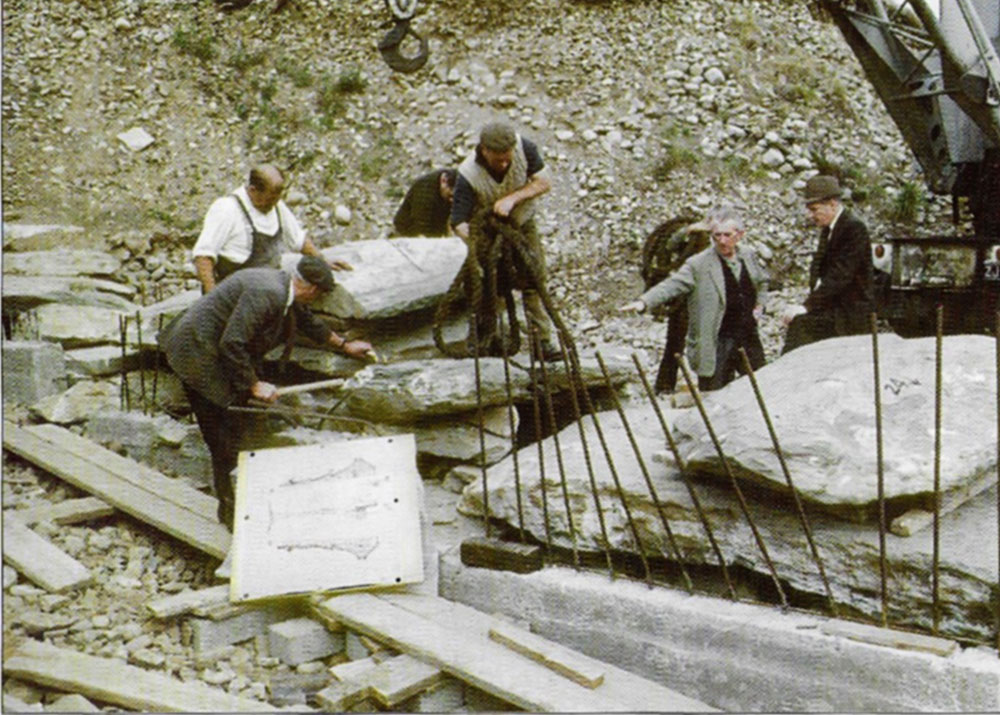
Workmen during the excavations at Newgrange, shortly before the roof-box structure was dismantled. Note the kerbstone which has fallen forwards due to cairn collapse.
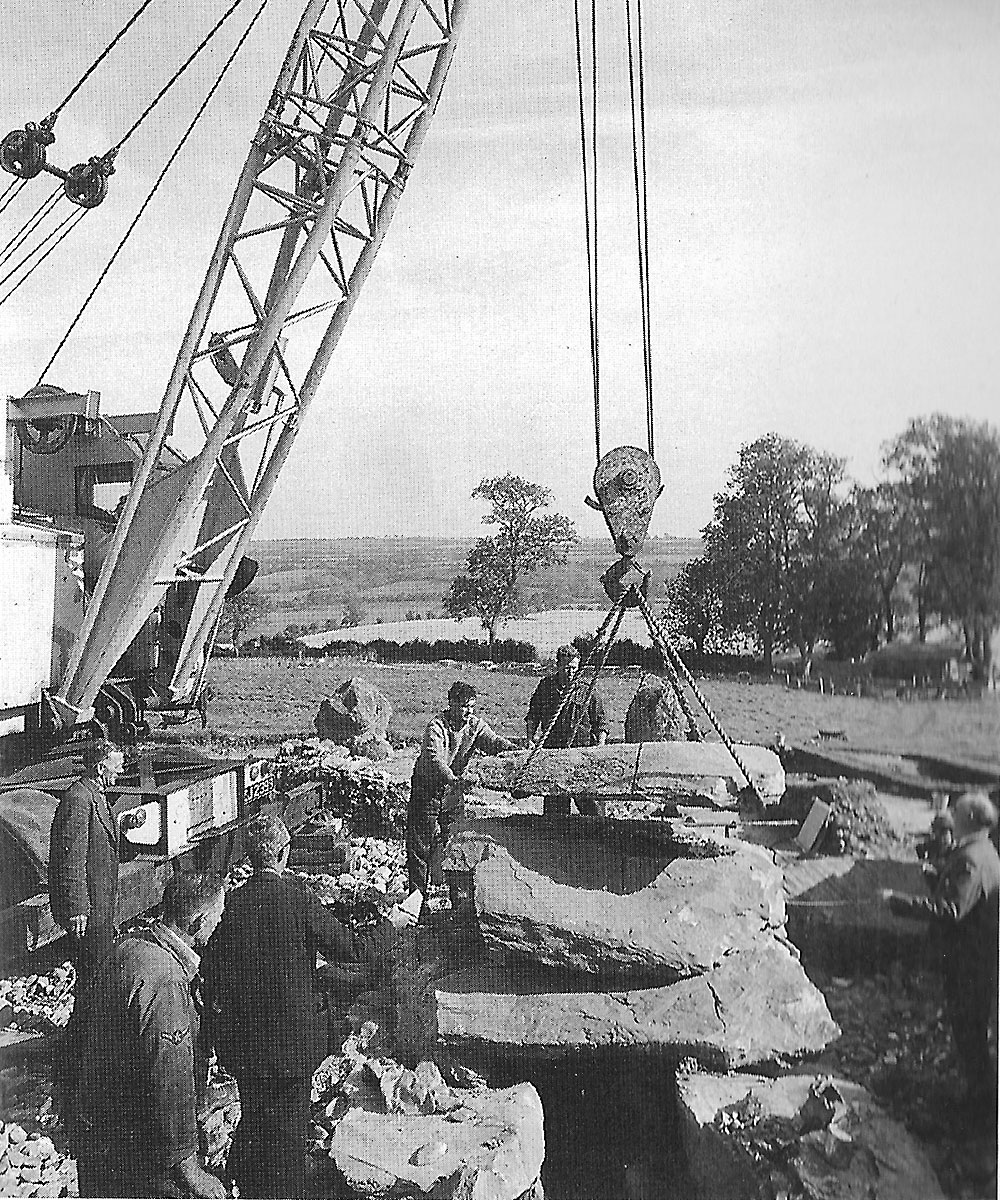
The passage and chamber were excavated during the 1967 season. To straighten the passage orthostats in order to provide easier access to the chamber, O'Kelly had dug a large trench into the mound and removed all the roofing corbels from the passage. The roof-box was dismantled completely and removed to achieve this.
O'Kelly and a team of workmen removing the 'False Lintol' above the roof-box at Newgrange to facilitate the straightening of the passage stones underneath.
O'Kelly had surely heard many accounts of the sun lighting up the chamber at midwinter, from locals such as Anne Hickey, who frequently visited the dig, and visitors to the site during the excavations who had read Lockyer, Evans-Wentz or AEON.
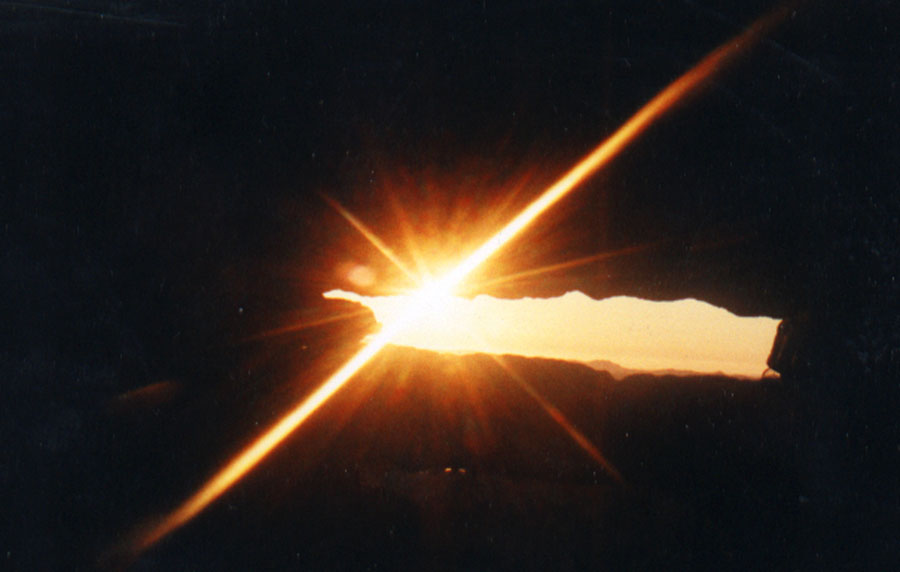
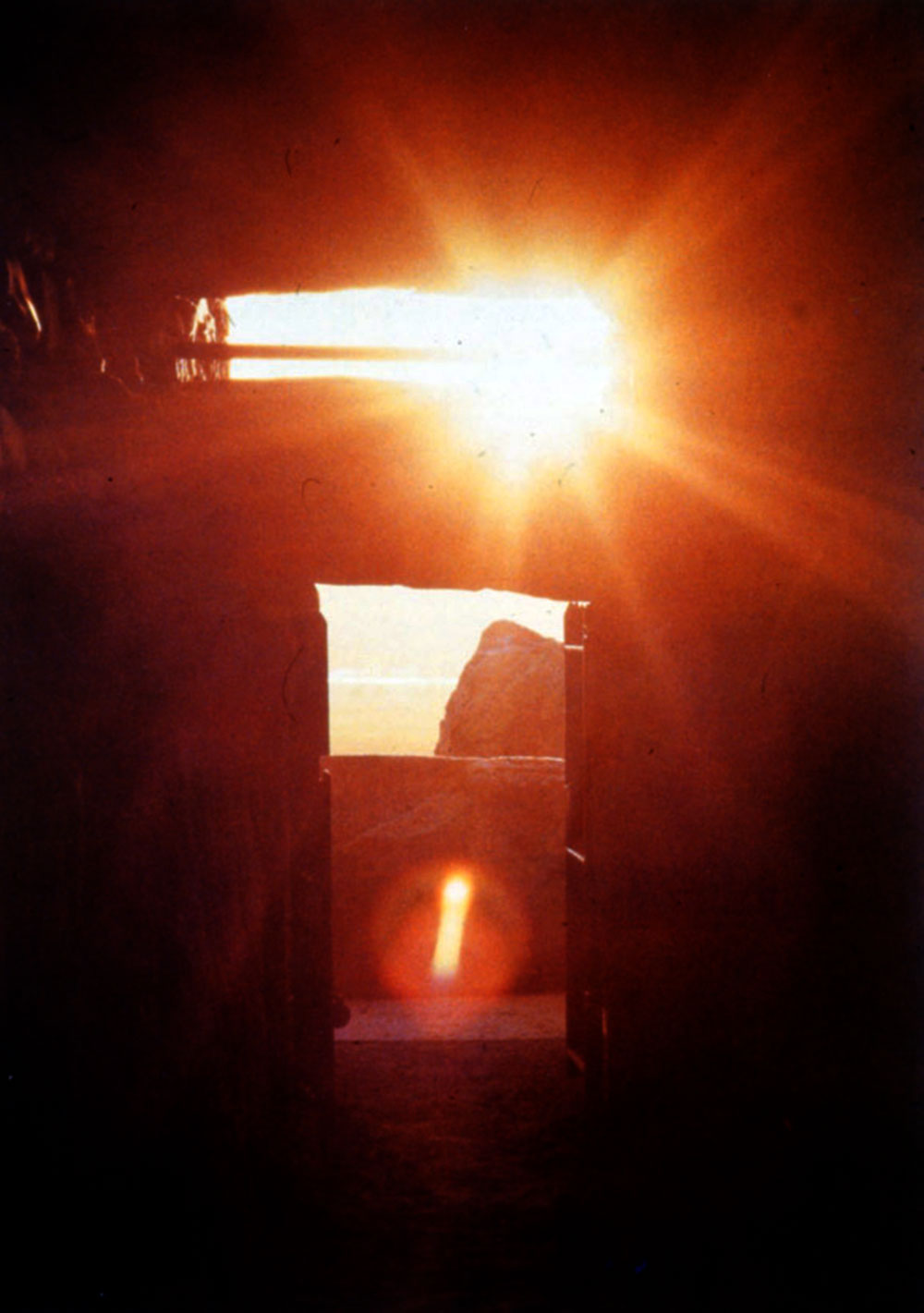
The other roof-box: the dramatic entry of the sun into Cairn G at Carrowkeel near the summer solstice. The distant hill of Doomore can be seen through the roofbox. This photograph was taken by myself in 1997.
Return of the Sun
Once the passage-stones had been straightened, O'Kelly and his workmen re-built the entry and roof-box structure. The straightening process meant that the restored roof-box was now positioned at a higher altitude than it had been before the excavation. O'Kelly was keen to test out the solar alignment theory and first witnessed the sunrise from within the chamber on the winter solstice in 1967.
Another tradition, but a much more modern one or at least one more familiar in modern times, had been mentioned to us by many visitors particularly in the early stages of the excavations when we were working almost totally in the dark as far as factual information was concerned. This was to the effect that a belief existed in the neighbourhood that the rising sun, at some unspecified time, used to light up the three-spiral stone in the end recess.
No one could be found who had witnessed this but it continued to be mentioned and we assumed that some confusion existed between Newgrange and the midsummer phenomenon at Stonehenge. Since Newgrange faces south-east it was clear that no such comparison was valid but when we began to think about it, we realized that it might be worth while to investigate the winter solstice when the sun rises in that quarter. We first did so in 1967.
Newgrange. Archaeology, art and legend, Michael J. O’Kelly, 1982.
Michael O'Kelly and the Office of Public Works workmen re-assembling the dismantled roof-box at Newgrange.
O'Kelly next got to witness the event again at midwinter in 1969 and left a record of his experience:
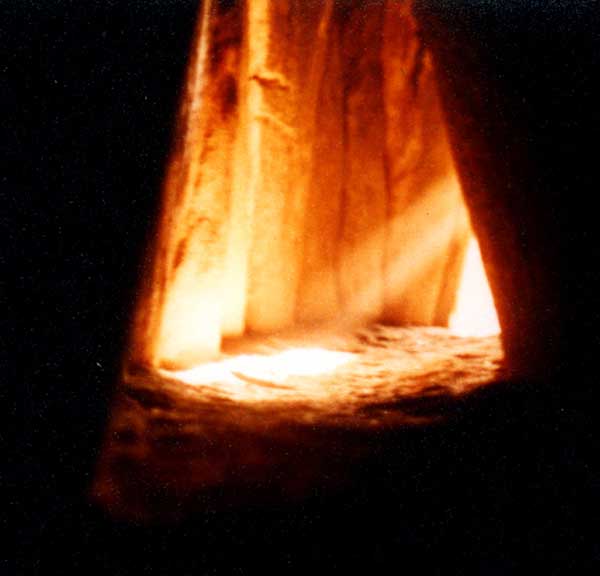
At exactly 8.54 hours GMT the top edge of the ball of the sun appeared above the local horizon and at 8.58 hours, the first pencil of direct sunlight shone through the roof-box and along the passage to reach across the tomb chamber floor as far as the front edge of the basin stone in the end recess.
As the thin line of light widened to a 17 cm-band and swung across the chamber floor, the tomb was dramatically illuminated and various details of the side and end recesses could be clearly seen in the light reflected from the floor. At 9.09 hours, the 17 cm-band of light began to narrow again and at exactly 9.15 hours, the direct beam was cut off from the tomb.
For 17 minutes, therefore, at sunrise on the shortest day of the year, direct sunlight can enter Newgrange, not through the doorway, but through the specially contrived slit that lies under the roof-box at the outer end of the passage roof.
Newgrange. Archaeology, art and legend, Michael J. O’Kelly, 1982.
The entrance of Newgrange faces to the south-east and as the sun rises over the days around December
21st, its rays enter the newly reconstructed roof-box and enter the chamber. The suns rays penetrate twenty meters along the passageway into the cairn to illuminate the chamber deep within the monument.
The Newgrange passage was built in two or possibly even three stages, during enhancements or enlargements of the monument. The roof-box seems to be the latest feature, the entire end of the passageway being an extension of an older entrance. As the passage slopes gently up hill,
the floor of the chamber within the mound is at the same level as the roof-box. These advances and lengthenings of the passage correspond to sircular settings or revetments of boulders which seem to have marked and contained enlargements of the cairn in the neolithic.
From observation of the way in which the front part of the passage had been constructed it was clear that it had been erected as a free-standing structure independent of the main cairn mass and of the remainder of the tomb.
Newgrange. Archaeology, art and legend, Michael J. O’Kelly, 1982.
The positioning of the Newgrange roof-box allows
the sun to enter deep within the cave or womb, and the event can occurs on a maximum of twenty-two days over the mid-winter, or about eleven days on either side of the solstice proper. O'Kelly remained fascinated by the solstice alignment for the rest of his life:
I think that the people who built Newgrange built not just a tomb but a house of the dead, a house in which the spirits of special people were going to live for a very long time. To ensure this, the builders took special precautions to make sure the tomb stayed completely dry, as it is to this day. Sand was brought from the shore near the mouth of the Boyne ten miles away, and packed into the joints of the great roof stones along with putty made from burnt soil. And to make absolutely sure that there would be no possibility of rainwater percolating through, they cut grooves in the roof slabs to channel it away. If the place was merely designed to get rid of dead bones, there would be no point in doing all this.
Solstice Morning
On solstice mornings given a clear sky, as the sun clears the horizon,
it's rays flood into the roof-box and flash up the passage, penetrating
almost to the end of the cruciform chamber. The beam of light is quite
narrow, and stays in the chamber for approximately seventeen minutes, before
moving out and down the passage again. The light is so strong and bright
that it illuminates the whole chamber, and the capstone, six meters above
the floor can be seen. The engraved art is thrown into high relief.
I was lucky enough to witness the Newgrange alignment in 1997, an unforgettable experience.
During the excavation a quartz block was found in the roof-box; this was
one of two used to close the skylight in ancient times when complete darkness
was required in the chamber. It must have been well used, since it's opening
and closing had worn a groove on the slab it sat on. A large flat slab was used to seal the entrance to the mound; this was found lying flat behind the Entrance Stone, worn smooth by many years of people
stepping on it as they entered the cairn. Today the door slab stands bolted
in place to the right of the entrance.
The Carrowkeel Roofbox
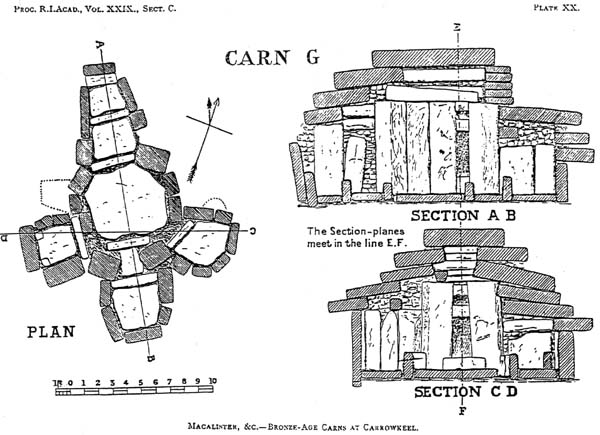
The only other roof-box currently known is the example found over the entrance of Cairn G at Carrowkeel in County Sligo, which was constructed three to four hundred years earlier and may be the prototype for the more famous Newgrange structure. The Carrowkeel example, lacking a long passageway like Newgrange, allows the sun to enter the chamber for several weeks on either side of midsummer.
For many years people had to book a place to enter the chamber and witness
the winter solstice sunbeam, and the waiting list grew ridiculously long. However, in recent years visitors are asked to fill out a card for a lottery draw when they purchase a ticket in the Visitor Centre.
A limited number of lucky people get to enter the chamber and witness the light display, should the sunrise be clear and cloudless. As the sun can shine into the chamber for a number of days on either
side of the shortest day, there is no harm turning up at Newgrange close to the solstice:
Winter solstice clelbrations at Newgrange in 2017.
The display that takes place outside the entrance to the mound is quite spectacular.
The quartz wall lights up with a bright yellow golden color, which could
surely be seen from many miles away. Martin Brennan was the first to note
that the standing stones near the entrance cast shadows on the kerbstones.
The roof-box at Newgrange, a specially contrived aperture over the entrance which allows the rays of the rising midwinter sun to enter the passage and reach the chamber of this great neolithic mound.