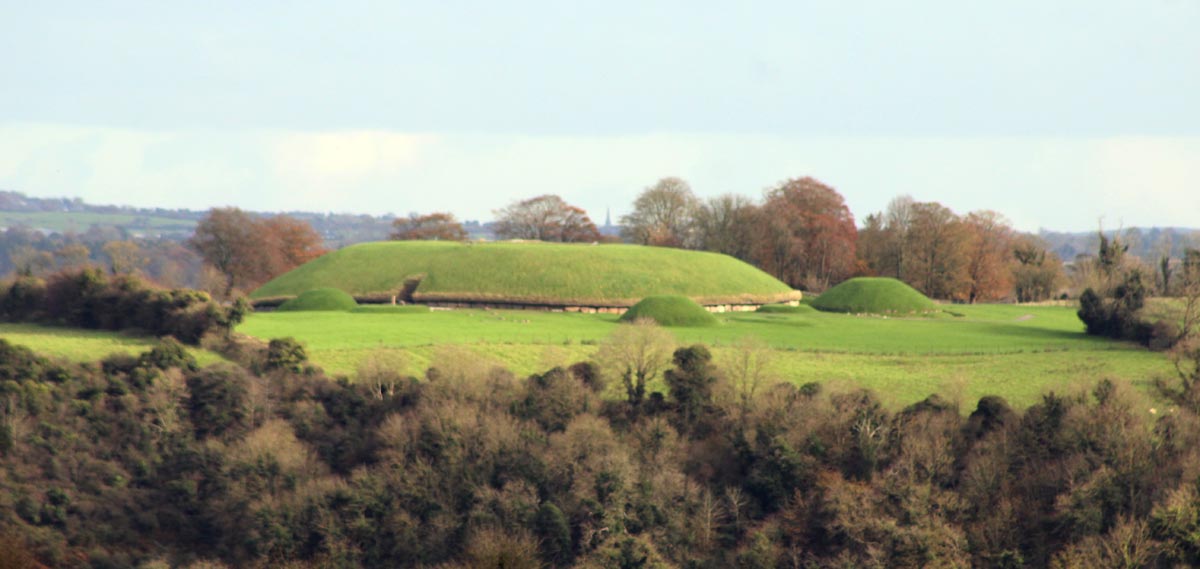
The East and West passages of the huge neolithic mound appear superficially to be aligned to the equinox sunrise and sunset, with one opening towards the east, the other to the west. However, apart from the work of Martin Brennan in the 1970's and early 1980's, and Philip Stooke in the 1990's and discussions on internet forums, little concern was shown for any possible alignments at Knowth during renovations.
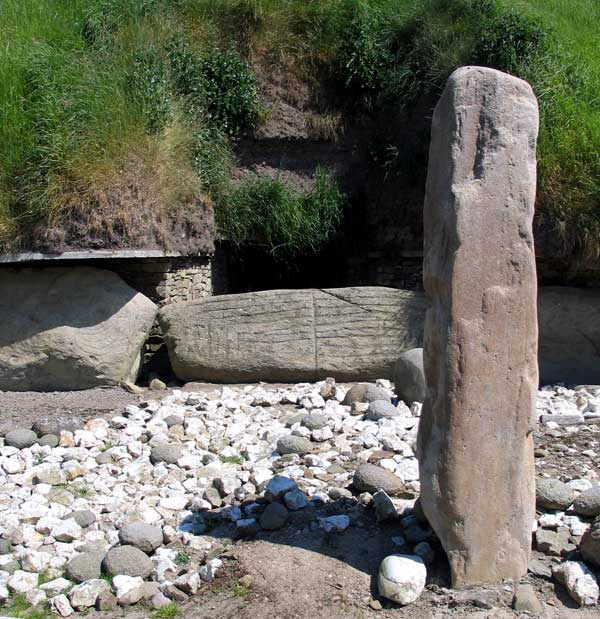
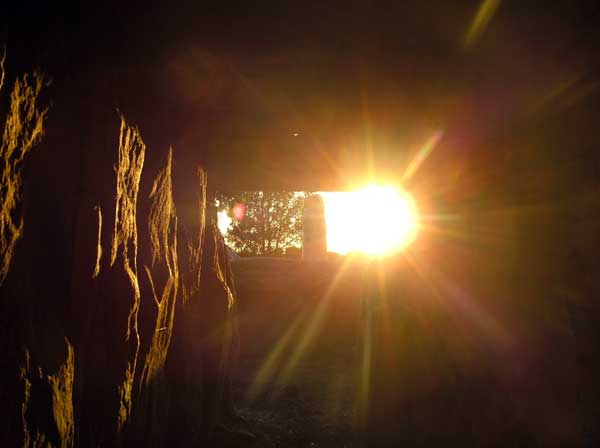
The West Entrance stone at Knowth. Over the equinox sunsets, the standing stone casts a shadow, which lines up with the groove on the entrance stone.
This was quite surprising, given the obvious interest in neolithic astronomy demonstrated at Newgrange, just two kilometers from Knowth. Martin Brennan suggested that the East and West passages may have been aligned to the equinox sunrises and sunsets; however Brennan felt that Knowth was a lunar site.
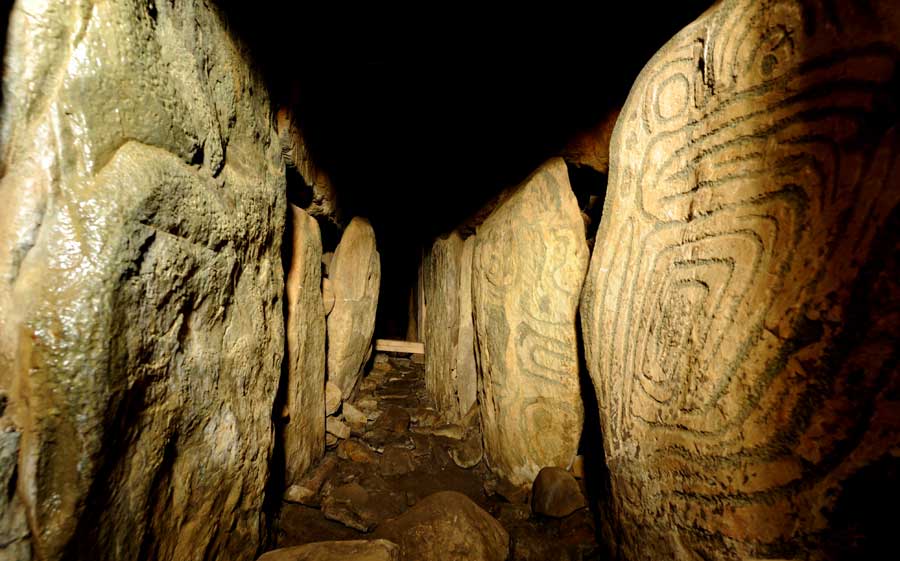
The great passage mound of Knowth, also in Meath, contains two rock-lined passages, one facing east, the other west. Brennan observed the setting sun shine into the western passage on September 13, 1980. Attempting to observe sunrise on the following day, he found that the view of the rising sun from the eastern passage would be blocked by trees and the current level of the ground. Nevertheless, it seems likely that the eastern passage was also originally intended to be penetrated by light from the rising sun and moon. Although solar alignments have been described at many Neolithic sites in Western Europe, less attention has been paid to lunar alignments, despite the fact that at certain times the moon can rise or set at any location on the horizon which may be occupied by the sun.
Neolithic Lunar Maps at Knowth, Dr. Philip Stooke.
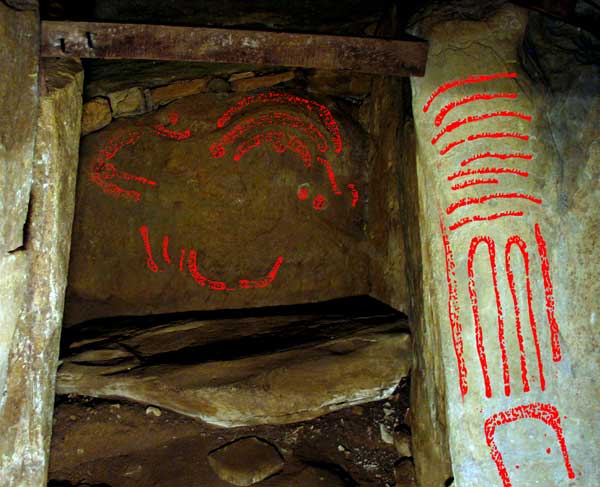
The end recess of the East chamber at Knowth; the photo is looking west. Canadian researcher Philip Stooke has suggested that the engravings (highlighted, center) may well be the oldest known diagram of the moon.
Both of the Knowth passage entrances were damaged when a ditch fortification was dug around the base of the mound, inside the kerbstones. As a consequence, the entrances to both passages were reconstructed by George Eogan. Both passages have elaborately carved Entrance stones, which were found in position, and both entrances have neolithic standing stones outside them. These pillar stones, one to the east and two at the west, cast shadows which interact with their respective entrance stones around the equinoxes. Both Entrance stones have vertical marks engraved on them, in a similar fashion to the Entrance stone and Kerbstones 52 at Newgrange.
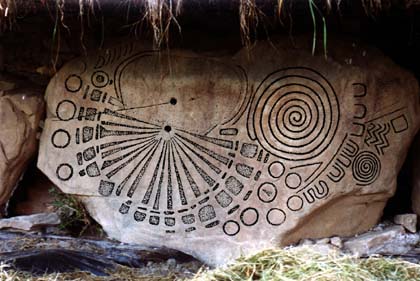
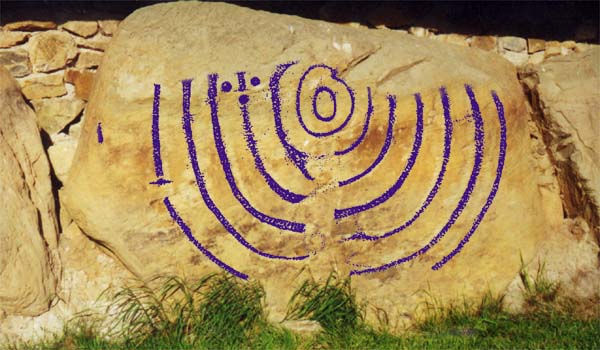
Calendar or sundial kerbstone at Knowth with art by Martin Brennan superimposed.
Frank Prendergast and Tom Ray
While Martin Brennan was the first to suggest the possible equinox alignments at Knowth in his book, the Stars and the Stones, published in 1983, the idea was popularised by George Eogan, the chief excavator in his 1986 book on Knowth. The huge monument had been undergoing excavations since 1962, making it difficult to get an exact measurement of the orientation of the passages.
At Knowth, however, the orientation of Tomb 1 suggests
that there could have been two ceremonies at different times, the vernal equinox on 20th
or 21st March and the autumnal equinox on 21st or 22nd September.
Knowth, George Eoghan, 1986.
The confusion about alignments and orientations at Knowth arose in part because archaeologists do not always use true north when giving ground plans of monuments. George Eoghan's plans tended to use magnetic north, a position which can drift and change over time. To clear up the confusion, Eoghan invited Tom Ray, who had already surveyed Newgrange, and Frank Prendergast to survey the passages. The survey was undertaken in 1997, when the capstones had been removed from both passages during the excavations.
Martin Brennan's illustration of a kerbstone with lunar symbols.
The East pasage is oriented to 83°—an azimuth 7° north of due east, which means the sun could have shone into that passage one week after the spring equinox and one week before the autumn equinox. The long extension of the west passage is oriented to 258°—12° south of due west. This means that the setting sun could have shone into this passage twelve days before the spring equinox sunset and twelve days after the autumn equinox.
The west passage has a 'kink' about
three-quarters of the way in, which is thought to be the remaining section of an earlier chamber
which was altered and realigned during the construction of the great mound. This inner chamber is oriented almost due west, which means it would almost certainly have had an equinox sunset alignment
Kerbstone at Knowth with the engraving overlaid with one of Martin Brennan's drawings. Many of the engravings at Knowth suggest orbits.
Knowth has a wealth of what can only be described as lunar symbolism, and many of the engravings seem to be counts and observations of lunar cycles. There are eighteen satellite monuments surrounding the main cairn at Knowth, a number which is suggestive of the lunar cycle, which takes 18.6 years to complete.
The eighteen satellite mounds at Knowth, as well as the many lunar emblems carved on the kerbstones suggest the 18.6 year lunar cycle was of great interest to the neolithic people at Knowth. Cairn G at Carrowkeel in County Sligo, the only other Irish passage-grave with a roof-box apart from the famous example at Newgrange, seems specifically designed to moniter the longer lunar cycles. American researcher Martin Brennan believed that many of the kerbstones at Knowth functioned as calendars for counting and marking lunar cycles.
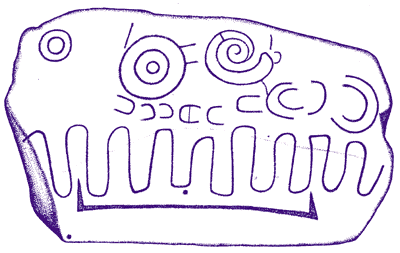
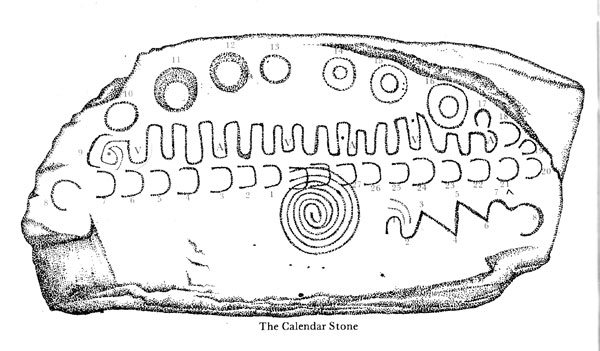
Martin Brennan's Lunar Calendar stone, SW 22.
Calendrical engravings
Any genuine system of time reckoning must admit of numerical treatment, and it must consist of divisions and subdivisions of an proximately equal length. Compositions such as SW 22 draw on the simplest laws of written numerals, ordering and grouping.
The age-old problem of calendar making is in harmonizing the solar and lunar cycles. The basic formula for a solar-lunar calendar is 12 lunar months = 1 solar year. In practice, 12 lunar months are 355 days, falling short of a solar year of 365 days by about 10 days. After 2 1\2 years this amounts to nearly a full month. In other words, after 30 months, a month must be added to bring the lunar and solar cycles into harmony. 1n order to harmonize this with the seasons, two 31-month cycles or 5 solar years of 62 months need to be used.
If the year is divided into two parts, let us say a light half and a dark half determined by the equinoxes, each 31-month period will consist of 5 seasons, and the 5-year period will contain 10 seasons which will begin and end at
the same equinox from which they start. This essentially was the basis of the ancient Celtic calendar, and a similar system is outlined above in a chart of the wavy line on SW 22. Each turn of the wavy line represents one month, or a complete circuit of the distinct but related pattern of crescent and circle repeat units which are closely matched to the phases of the moon.
The count moves to 31 and reverses back to 62, keeping in pace writh the equinoxes. Crescents transform into circles as they approach the full moon when they become double circles. The eighth phase or quarter moon is represented differently, as is the seventeenth phase. The twenty-seventh or last visible phase begins to disappear into the spiral, which obscures the invisible phases.
The same imagery is echoed on SW23, where crescents appear to emerge from a spiral, and wavy lines total 12. A similar device on the lower right-hand corner of SW22 is ambiguous and could have many applications.
The Stars and the Stones, Martin Brennan, 1983.
The Satellite Mounds
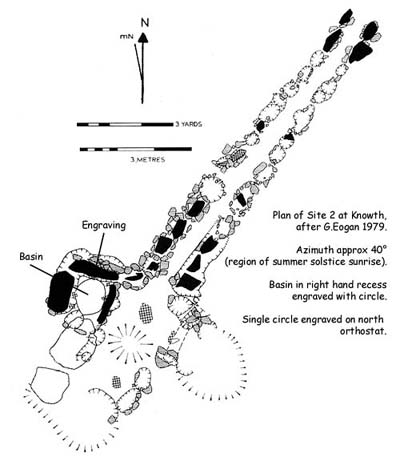
The satellites at Knowth, which are older than the huge main monument, are aligned to different phases of the moon, and were used over a lengthly period of time before the main mound was extended. Site 2 and Site 4 both appear to be aligned to summer sunrises rises and extreme moon rises, and Site 2 has specific solar and lunar engravings in the right-hand
recess.
Plan of Site 2 at Knowth. The monument is oriented to the northeast, approximately the region of the summer solstice sunrise and winter solstice full moon rising positions. The passage and chamber measure thirteen meters in length, and the chamber is cruciform in shape.
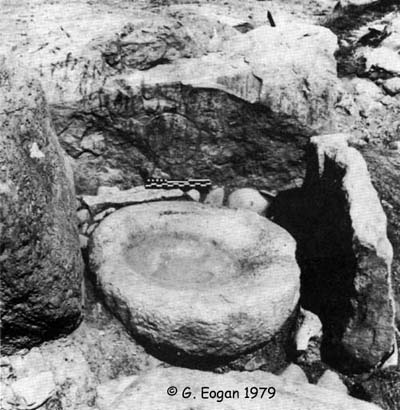
The excavators found a basin in the right-hand recess of the chamber. There is a picked line around the inside of the rim, and the basin looks as though it was designed to hold liquid and not ashes. The orthostat on the north side of the basin has a circle engraved on it which looks to be a fairly obvious rising sun or full moon.
Right-hand recess with basin and circular engraving.
The concept built tnto Knowth would seem to be that at key times during the neolithic, at
least twice if not four or eight times during the 18.6 year lunar cycle, the East and West chambers were lit by both the sun and moon at the same time.
With this piece of the jigsaw in place, we can now see the following picture in outline: Lug and Buí are man and wife; Buí resides at Cnogba, and the ‘cave’ of Cnogba is also an entrance to Emain Ablach, with which Lug is associated; Lug has as Otherworld consort a personage described as the Sovereignty of Ireland; access to that personage is gained at Cnogba. It is a reasonable extrapolation from all of this that Buí is another name for the personage known as the Sovereignty of Ireland. It remains to consider whether this extrapolation finds support in what we know of Buí from other texts.
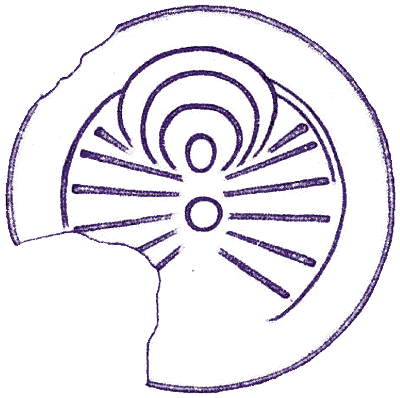
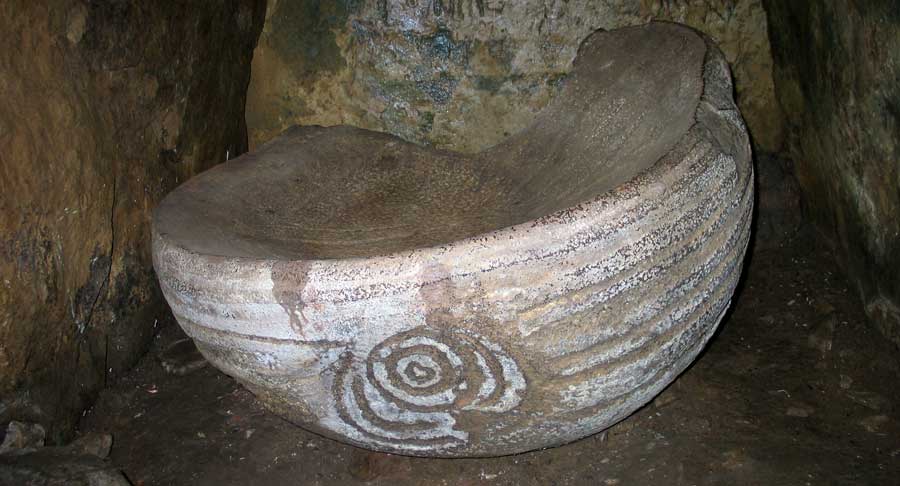
The marriage of the Sun and the Moon is indeed be a feat which would match the size, scale, cosmic grandeur and design of the complex arrangement of monuments Knowth. In Irish mythology, Knowth—Cnogba—is the home of Buí, the Cailleach and Sovereignty Goddess of ancient Ireland. This proposed grand double alignment, the cosmic dance and sacred marriage of the Sun and Moon at Knowth, specifically fits with the design carved within the great basin stone from the East chamber.
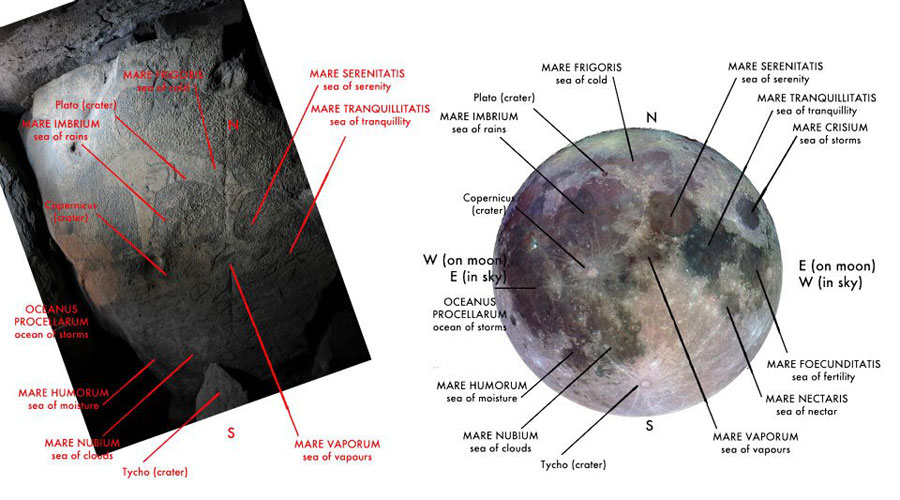
The possibility that lunar alignments were observed and recorded at Knowth is supported by research from Canadian astronomer Philip Stooke, who has identified the engravings on the keystone of the East chamber as the oldest map of the moon so far discovered.
Brennan's experience, described in his 1983 book The Stars and the Stones, suggested that these Irish Neolithic sites might have had some connection with the moon as well as the sun. I have identified another connection, previously overlooked by Brennan and others working at Knowth. If moonlight were to shine on the back stone of the eastern passage at Knowth, it would illuminate a map of the moon itself, the world's oldest known depiction of the lunar maria.
The carved stone which forms the end wall of the eastern passage was called Orthostat 47 by George Eogan, who excavated Knowth in the 1960s. The design has three sections, superficially similar but oriented differently. The right-hand section appears to be nothing less than a map of the lunar maria, as becomes clear when it is compared with a naked-eye map of the moon. At least a dozen points of correspondence are immediately obvious.
Neolithic Lunar Maps at Knowth, Dr. Philip Stooke.
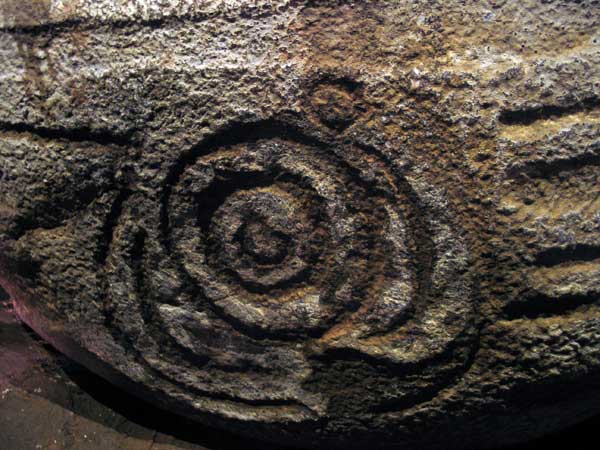
Carving on the front of the great basin in the East Chamber.
This carving on the front of the great basin may represent the orbit of a heavenly body, perhaps the Earth travelling around the Sun. It also resembles the fine carving in the right hand recess of Cairn L at Loughcrew. There are seven deep grooves running around the outside of the basin.
Sadly, the modern restoration work at Knowth means we have to guess what was going on here in the neolithic. The damaged entrance to the East passage at Knowth may well have had a roofbox structure similar to Newgrange. The East passage of Knowth is alleged to be oriented to the third great passage-grave in the Boyne Valley at Dowth.
The huge carved neolithic basin-stone, located within the right-hand recess of the East chamber at Knowth. This beautiful object is much too large to have been brought into the monument after construction, which means that the chamber was built around the basin.