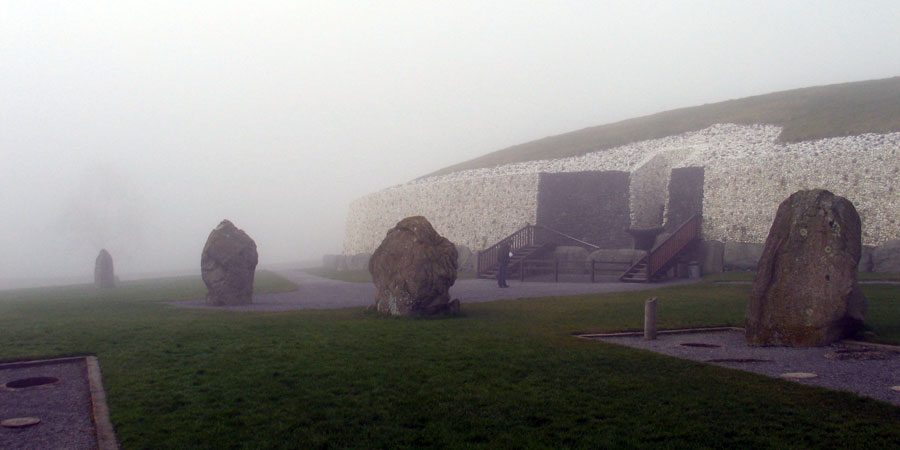
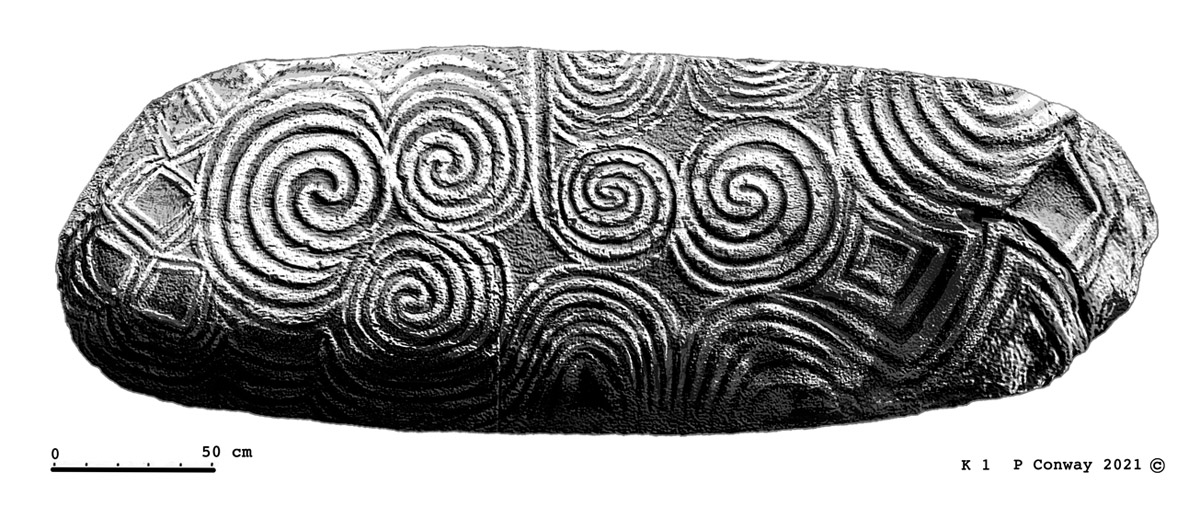
The reconstructed entrance to Newgrange
in the eerie early morning mist that rolls up from the River Boyne. Four
of the stones of the Great Circle are visible,
as are several of the post holes from the later neolithic timber henge beside Newgrange.
The Mythology of Newgrange
New Grange
The golden hill where long-forgotten kings
Keep lonely watch upon their feasting-floor
Is silent now, — the Dagda’s harp no more
Makes sun and moon move to its murmurous strings;
And never in the leafy star-led Springs
Will Caer and Aengus haunt the river shore,
For deep beneath an ogham-carven door
Dust dulls the dew-white wonder of their wings.
Yet one may linger loving the lost dream–
The magic of the heart that cannot die,
Although the Rood Destroy the quicken rods;
To him through earth and air and hollow stream
Wild music winds, as two swans wheeling cry
Above the cromlech of the vanished gods
Thomas Samuel Jones, Jr (1882-1932)
Newgrange is Ireland's most famous megalithic monument, and has fascinated people since it was first entered in modern times in 1699, the large number of visitors attested by the plentiful graffiti. In 1897 George Russell, the mystic, poet, and prominent Gaelic Revivalist, visited Newgrange in the compamy of his fellow mystic, William Butler Yeats. Russell left an account of the impression the monument made on him in A Dream of Angus Og:
'As he spoke, he paused before a great mound grown over with trees, and around it silver clear in the moonlight were immense stones piled, the remains of an original circle, and there was a dark, low, narrow entrance leading therein. "This was my palace. In days past many a one plucked ere the purple flower of magic and the fruit of the tree of life..."
And even as he spoke, a light began to glow and to pervade the cave, and to obliterate the stone walls and the antique hieroglyphics engraven thereon, and to melt the earthen floor into itself like a fiery sun suddenly uprisen within the world, and there was everywhere a wandering ecstasy of sound: light and sound were one; light had a voice, and the music hung glittering in the air....
"I am Aengus; men call me the Young. I am the sunlight in the heart, the moonlight in the mind; I am the light at the end of every dream, the voice for ever calling to come away; I am desire beyond joy or tears. Come with me, come with me: I will make you immortal; for my palace opens into the Gardens of the Sun, and there are the fire-fountains which quench the heart's desire in rapture."'
AEON, A Dream of Angus Og, 1897.
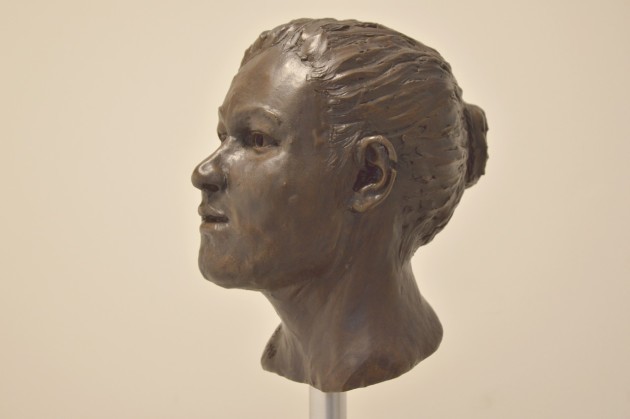
The story of the original owners of Newgrange was lost in Ireland's misty pre-history up until recently with the arrival of Ancient DNA, beginning with the analysis of the genetics of the Ballynahatty woman, a neolithic farmer, by Lara Cassidy, in 2015. We now know that our Irish neolithic farmers are neolithic colonists who's ancestors left Anatolia with a herd of cattle, and migrated west along the northern coast of the Mediterranean, around the coast of Spain and up into Brittany.
These first farmers begin arriving in in the north-west around 4,150 BC, where they build the first causewayed enclosure in these islands at Magheraboy near Carrowmore in County Sligo.
The neolithic activities of ritualizing landscapes that begins at Carrowmore culminates with the massive monuments in the Boyne Valley almost a thousand years later. Newgrange is the famous place in medieval Irish mythology, and is mentioned
many times in various texts and a nnals. It seems to have been a more famous location than the huge mounds of Knowth and Dowth, though Newgrange escaped the raiding and plundering by the Norsemen the other two monuments suffered which is described in the Annals
of the Four Masters.
The mythological stories we have today come from medieval manuscripts compiled
by Irish monks and scholars a thousand years ago. The myths were though to be the remnants of the iron age religious or spiritual beliefs, though it seems that a bronze age memory of neolithic beliefs and events may be the records of true origin stories.
A Miraculous Child is Born
The first mythological owner of the Mansion on the Boyne was a
druid named Elcmar, the husband of the Boann, the Goddess of the River Boyne.
The Dagda, a chief figure or leader among the Tuatha Dé Danann, sends Elcmar away on an errand, and while he is absent the Dagda seduces and mates with Boann, who becomes pregnant. So that Elcmar will not discover their affair, the Dagda, who has great powers, causes the sun to remain at standstill for nine months so that outside Newgrange only a day passed, and the divine child, who incarnates on the winter solstice in the great chamber-cave, is born on the same day he is conceived.
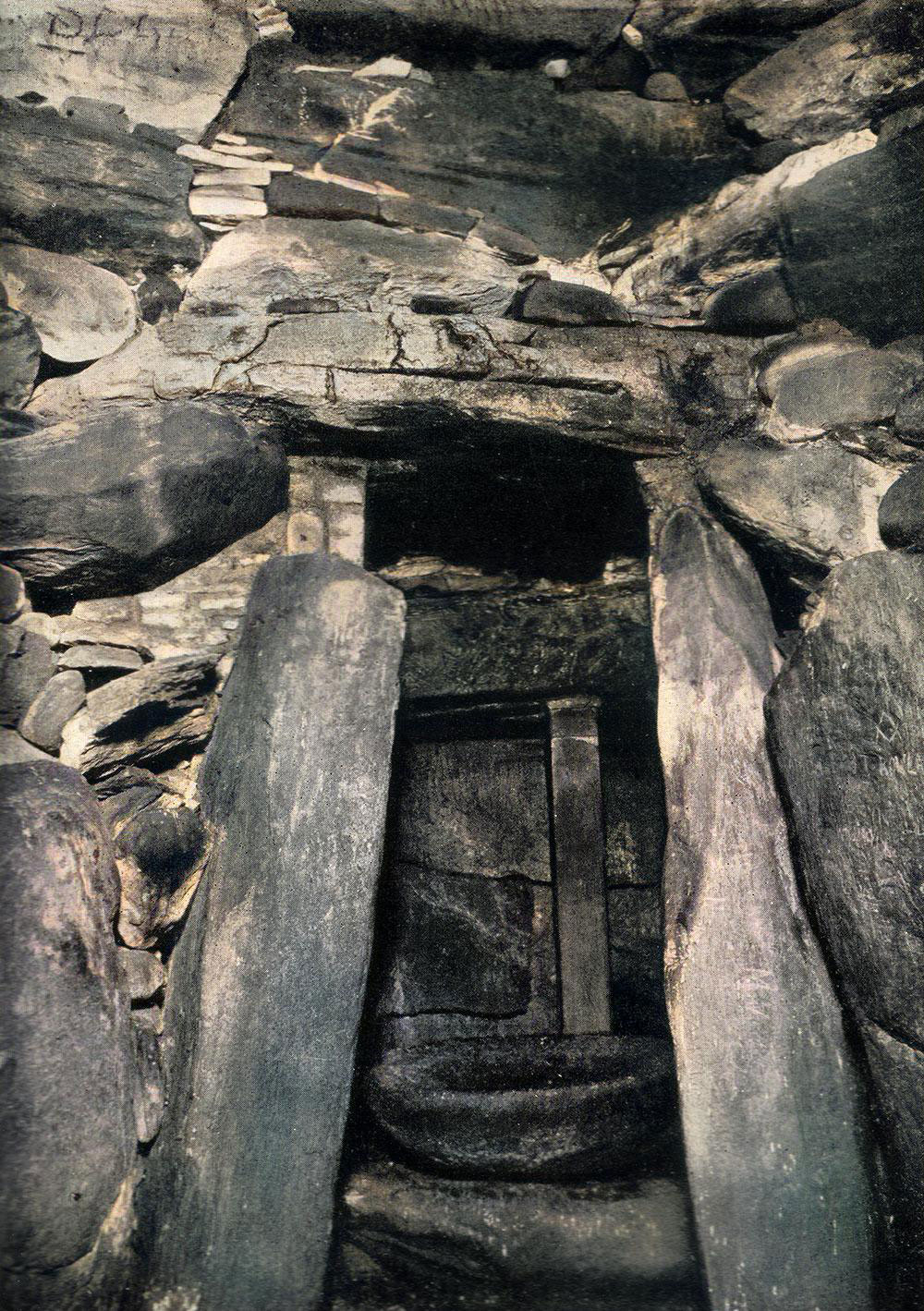
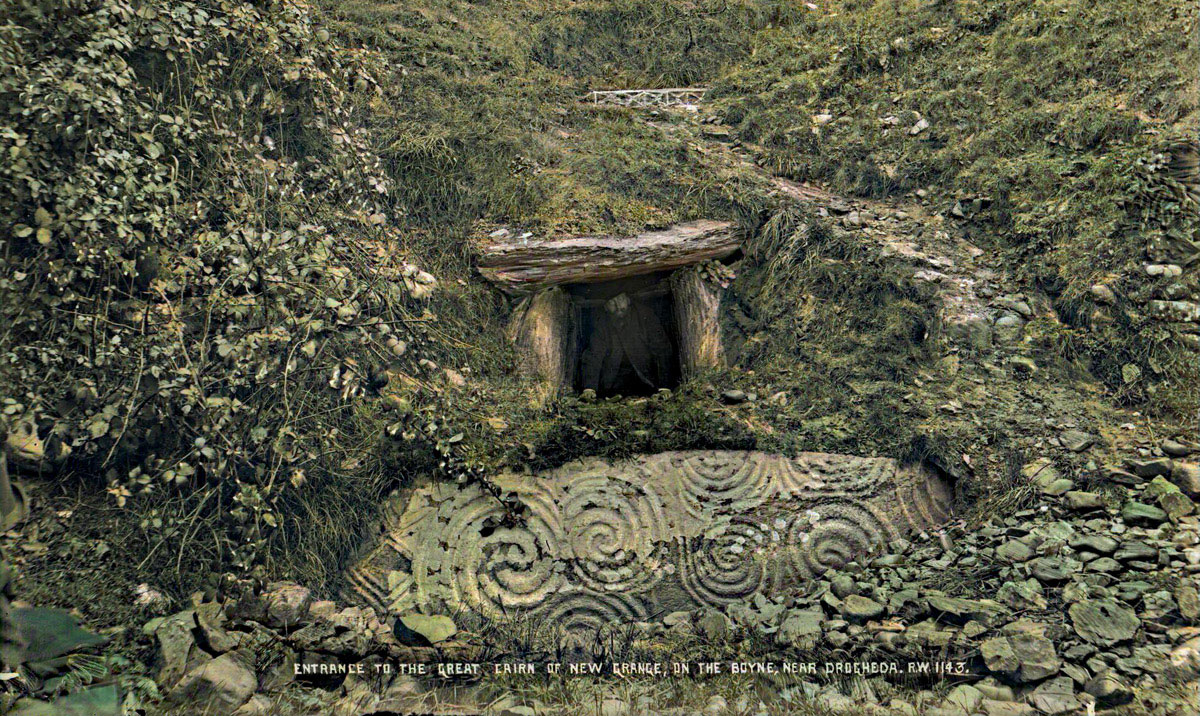
An early photograph of the chamber at Newgrange. Note the graffiti masonic symbol on the stone to the right.
Anthropologists and folklore have long pointed out that neolithic chambers represent wombs, and here were have the myth of the incredible birth taking place as the chamber - womb is fertilized by the light of the rising sun. Potent cosmological and religious symbolism which originates ultimately in the near-east, and is still in use today, these symbols being at the foundations of the Christian religion.
When Edward Lhuyd visited Newgrange in 1699, he interviewed a local gentleman named Cormack O'Neill who told Lhuyd about a 'vulgar legend about some strange operation at that town in the time of Heathenism'. Lhuyd was in contact with the Galway historian Roderick O'Flaherty, who was the first person to link the site of Newgrange with the mythological Brugh na Boinne. The 'vulgar legend' was the story of the affair between Boann and the Dagda. While Michael and Clare O'Kelly were researching their book on Newgrange, they found that the memory of the story was still retained in the locality.
The Dagda,
a feisty, earthy god desired the beautiful Boann and he sent Elcmar was
away on an errand. Then the Dagda appeared and courted Boann, and they slept together and conceived a child. So that her husband would
not know about their affair, the Dagda, a marvelous magician, caused
nine months to pass in one day, or the sun to stand still for nine months,
and so Aongus Og, the Young God was born on the same day that he was conceived:
Elcmar of the Brug had a wife whose name was Eithne, and another name for her was Boand. The Dagda desired her in carnal union. The woman would have yielded to the Dagda had it not been for fear of Elcmar, so great was his power. Thereupon the Dagda sent Elcmar away on a journey to Bres son of Elatha in Mag Inis, and the Dagda worked great spells upon Elcmar as he set out, that he might not return betimes [that is, early] and he dispelled the darkness of night for him, and he kept hunger and thirst from him.
He sent him on long errands, so that nine months went by as one day, for he had said that he would return home again between day and night. Meanwhile the Dagda went in unto Elcmar's wife, and she bore him a son, even Aengus, and the woman was whole of her sickness when Elcmar returned, and he perceived not her offence, that is, that she had lain with the Dagda.
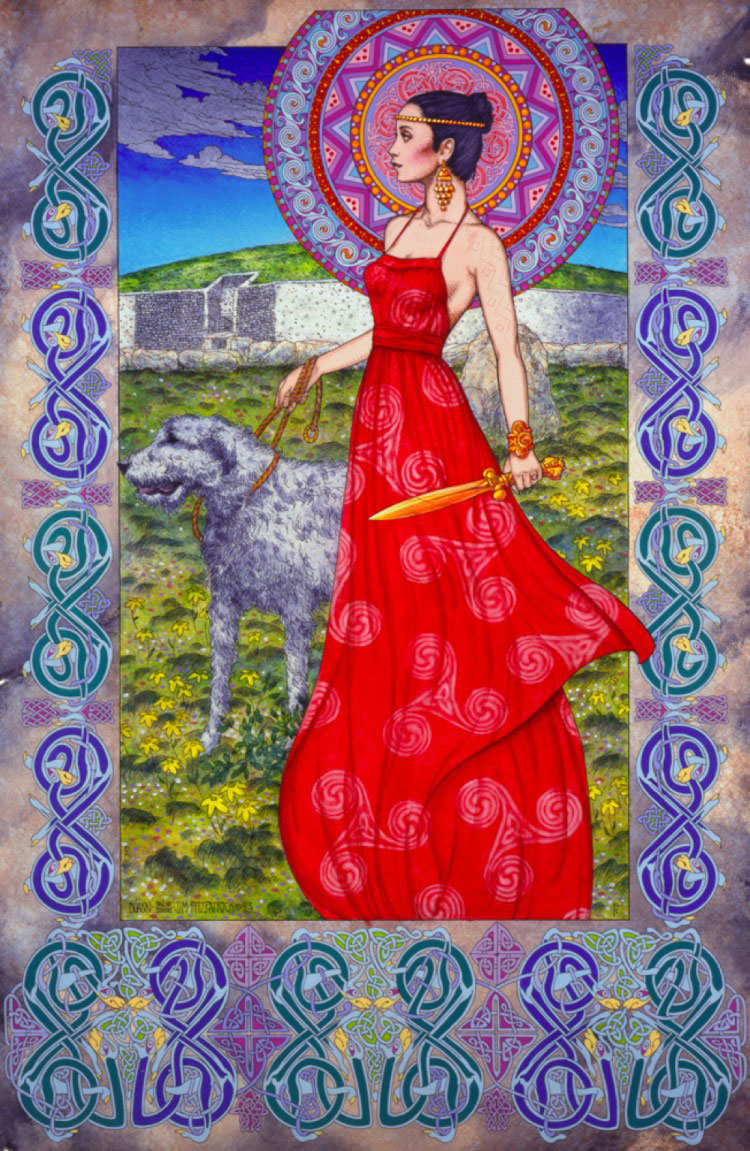
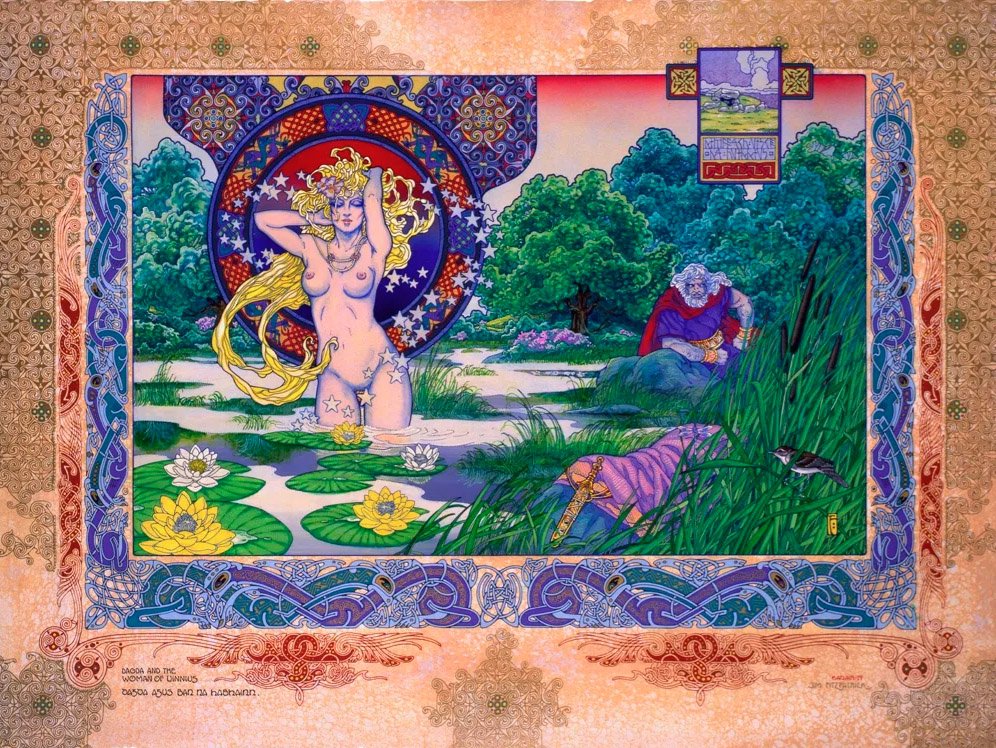
Dagda and the Woman of Uinshin by Jim Fitzpatrick, this is a variation of the myth that is found at Newgrange. This story is set at the river Uinshin at Lough Arrow in Connaught close by the massive
cairn at Heapstown. Here the Dagda seduces the Morrigan as she washes her hair in the river.
After the Birth of Aongus, the Dagda took possession of the mound from Elcmar and lived there for
many years, presumably with Boann, the personification of the nearby river Boyne. The child Aongus grew
up to become the god of love of the Túatha Dé Danann. He
is always associated with birds, especially swans, which proliferate in the Boyne Valley.
During the Dagda's
reign at Brú na Boinne, which means the Palace on the Boyne, the
mound was always associated with music, magic and wonder. It is the most mentioned
monument in ancient manuscripts, and was called by many names such as
'yonder Bru of the many colored Chequered Lights'.
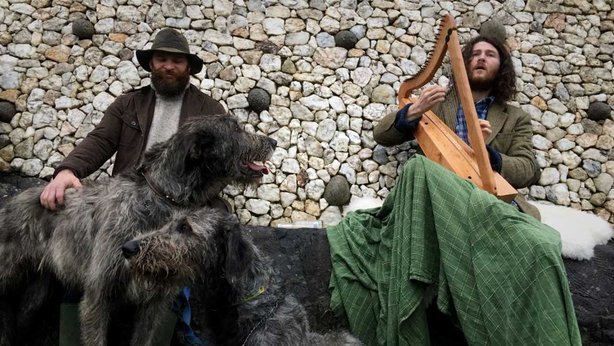
The Bard of Bundoran at Newgrange on the winter solstice.
The Dagda himself was a musician and played the harp. Corran the Harper, associated with the folklore at the Caves of Keash in County Sligo, served as a harper in the Dagda's Household and was dispatched from Newgrange to help hunt the huge sow Cailceis.
Aongus Og takes Ownership of Newgrange
According to the story, one day Aongus went to his father the Dagda and asked for possession of the mound for
a day and a night, to which the Dagda agreed. When he came back the next
day to reclaim his abode, his son informed him that since all eternity is made up of day and
night, the Dagda had given Aongus the mound for ever. And so it became
the Brú of Aongus Og, the new owner.
At the end of the tale called the Pursuit of Diarmuid and Grainne, Aongus appears at Benbulben in County Sligo to reclaim the body of Diarmuid, which he takes back to Newgrange with him, so that me can breath an aerial life into him, and they may continue to converse.
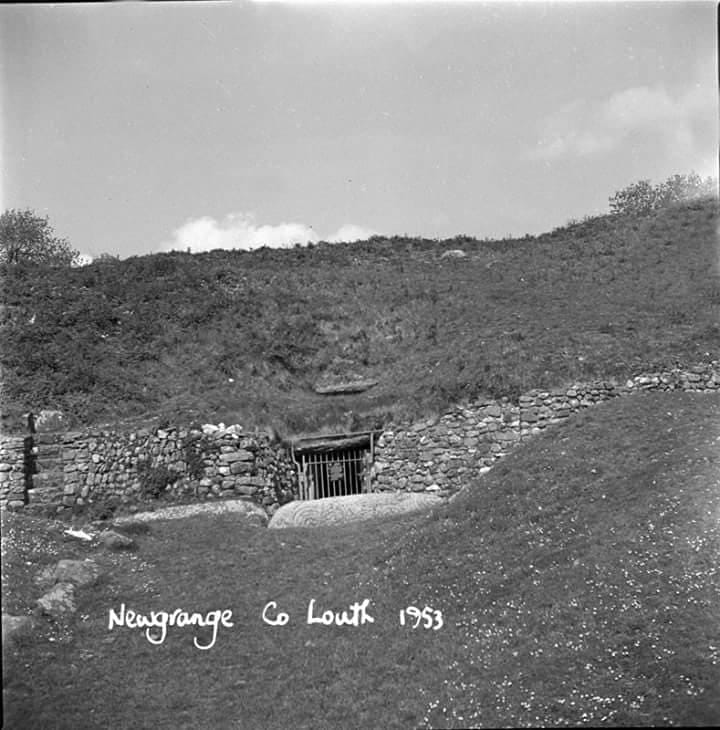
Pre-excavation and restoration: Newgrange in 1953. Notice the steps on the left side of the photo leading up to the carved stone over the roof-box.
Other Myths
Newgrange
is mentioned in many Celtic stories and sagas; in one tale three sons of kings are advised
to go to the Brú at the Boyne and fast for three days, after which they are
rewarded with land, wives and wealth.
It is the place where the Ulster
hero, Cú Chulainn was conceived in a tale from the Ulster cycle. Here again it
is interesting to note that in the early mythology the mound-womb is a
place of conception and birth, and death is viewed from a more balanced perspective. The obsessive associations with death and funerals
tend come from later Christian and antiquarian writings.
"The Otherworld Hall on the Boyne" by Professor John Waddell. Two distinct but related themes are considered: the mythology associated with Newgrange and the Boyne Valley and its relationship with archaeology, and whether elements of a Neolithic cosmology could survive thousands of years.
There is an ancient Irish text which tells of the miraculous birth of Cú Chulainn. The event occurs while the King and the heroes of Ulster are out hunting a flock of enchanted birds who have been ravaging the countryside. The group, which includes follow the birds to Newgrange in the Boyne Valley, where they are overtaken by a snowstorm and take refuge for the night. Cú Chulainn's father, Lugh of the Long Arm, appeared to his mother Dechtire, half-sister of the King, and another wonder-child was conceived within Newgrange. Cú Chulainn later returned to the Boyne Valley where he killed three brothers at Dowth.
When Cormac mac Art, the glorious High
King of the Celtic Golden Age died, he could not be buried at Newgrange,
as the River Boyne rose up against the funeral procession. He was buried instead at Rosnaree across the river from Newgrange. It is thought
that this may be early political writing by the hand of a rival clan, and also part of the propaganda movement of the Christian scribes who transcribed and edited these oral stories.
The symbolism of Newgrange fits in well with Christian lore from a much later times: the magical child is born in the middle of winter, who will later spend
three days in a stone tomb and emerge reborn. These symbols, which were surely part of the original rituals of the site, are still in use by modern people today at Christmas and Easter.
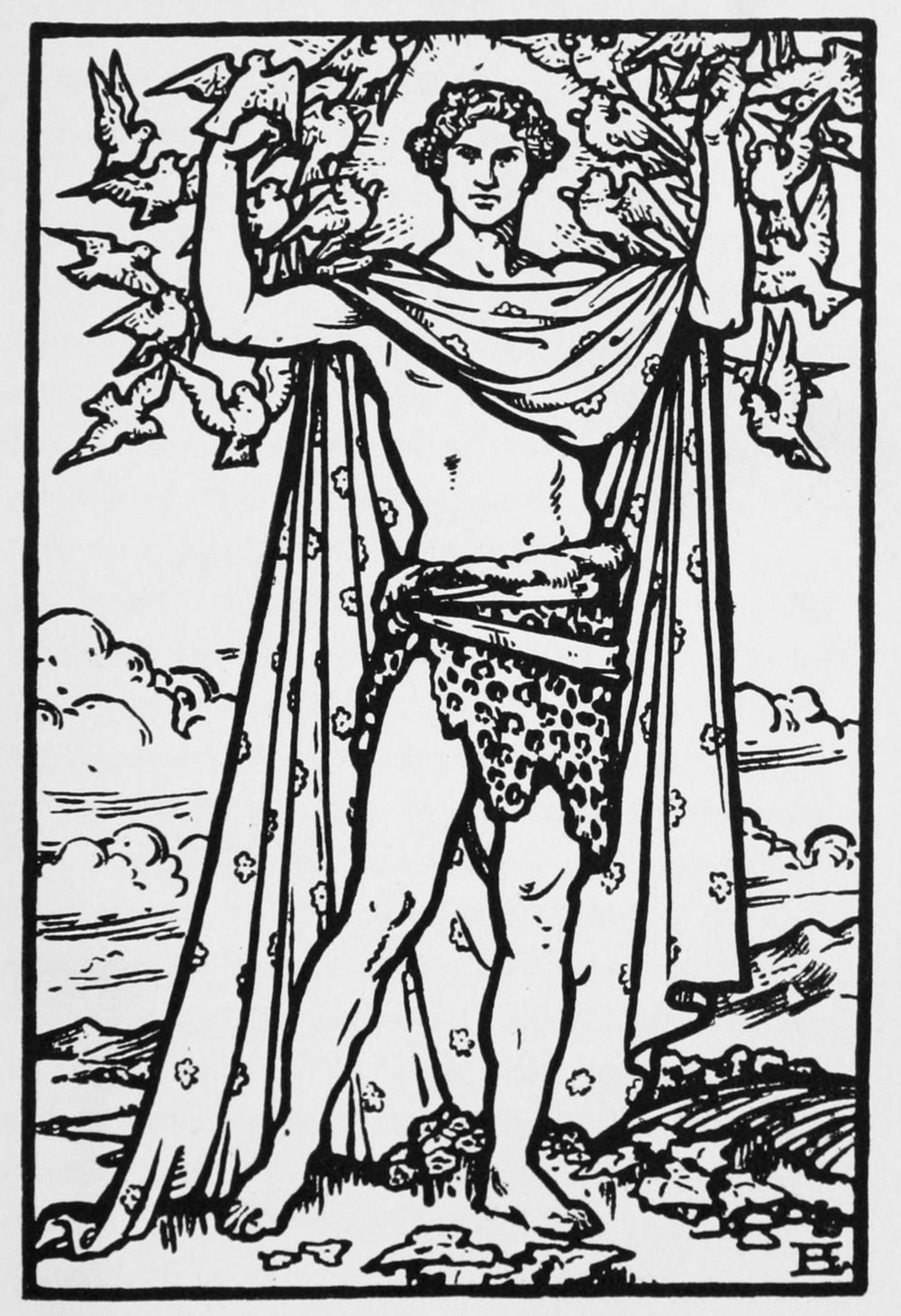
An illustration of Aengus Og at Newgrange, 1914.
W. Y. Evans-Wentz
IN THE VALLEY OF THE BOYNE
In walking along the River Boyne, from Slane to Knowth and New Grange, I stopped at the cottage of Owen Morgan, at Ross-na-Righ, or 'the Wood of the Kings', though the ancient wood has long since disappeared; and as we sat looking out over the sunlit beauty of Ireland's classic river, and in full view of the first of the famous moats, this is what Owen Morgan told me:--
How the Shoemaker's Daughter became the Queen of Tara.--'In olden times there lived a shoemaker and his wife up there near Moat Knowth, and their first child was taken by the queen of the fairies who lived inside the moat, and a little leprechaun left in its place. The same exchange was made when the second child was born. At the birth of the third child the fairy queen came again and ordered one of her three servants to take the child; but the child could not be moved because of a great beam of iron, too heavy to lift, which lay across the baby's breast. The second servant and then the third failed like the first, and the queen herself could not move the child. The mother being short of pins had used a needle to fasten the child's clothes, and that was what appeared to the fairies as a beam of iron, for there was virtue in steel in those days.
'So the fairy queen decided to bestow gifts upon the child; and advised each of the three servants to give, in turn, a different gift. The first one said, "May she be the grandest lady in the world"; the second one said, "May she be the greatest singer in the world"; and the third one said, "May she be the best mantle-maker in the world." Then the fairy queen said, "Your gifts are all very good, but I will give a gift of my own better than any of them: the first time she happens to go out of the house let her come back into it under the form of a rat." The mother heard all that the fairy women said, and so she never permitted her daughter to leave the house.
'When the girl reached the age of eighteen, it happened that the young prince of Tara, in riding by on a hunt, heard her singing, and so entranced was he with the music that he stopped to listen; and, the song ended, he entered the house, and upon seeing the wonderful beauty of the singer asked her to marry him. The mother said that could not be, and taking the daughter out of the house for the first time brought her back into it in an apron under the form of a rat, that the prince might understand the refusal.
'This enchantment, however, did not change the prince's love for the beautiful singer; and be explained how there was a day mentioned with his father, the king, for all the great ladies of Ireland to assemble in the Halls of Tara, and that the grandest lady and the greatest singer and the best mantle-maker would be chosen as his wife. When he added that each lady must come in a chariot, the rat spoke to him and said that he must send to her home, on the day named, four piebald cats and a pack of cards, and that she would make her appearance, provided that at the time her chariot came to the Halls of Tara no one save the prince should be allowed near it; and, she finally said to the prince, "Until the day mentioned with your father, you must carry me as a rat in your pocket."
'But before the great day arrived, the rat had made everything known to one of the fairy women, and so when the four piebald cats and the pack of cards reached the girl's home, the fairies at once turned the cats into the four most splendid horses in the world, and the pack of cards into the most wonderful chariot in the world; and, as the chariot was setting out from the Moat for Tara, the fairy queen clapped her hands and laughed, and the enchantment over the girl was broken, so that she became, as before, the prettiest lady in the world, and she sitting in the chariot.
'When the prince saw the wonderful chariot coming, he knew whose it was, and went out alone to meet it; but he could not believe his eyes on seeing the lady inside. And then she told him about the witches and fairies, and explained everything.
'Hundreds of ladies had come to the Halls of Tara from all Ireland, and every one as grand as could be. The contest began with the singing, and ended with the mantle-making, and the young girl was the last to appear; but to the amazement of all the company the king had to give in (admit) that the strange woman was the grandest lady, the greatest singer, and the best mantle-maker in Ireland; and when the old king died she became the Queen of Tara.'
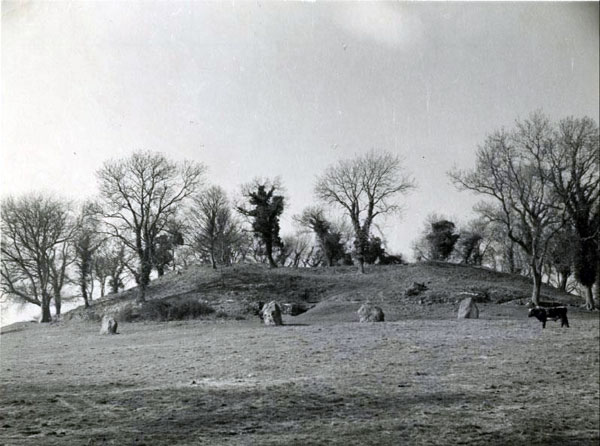
The pre-excavation appearance of Newgrange in 1950, with the cow both providing a scale to the size of the mound, and representing Boann, the goddess associated with the River Boyne.
After this ancient legend, which Owen Morgan heard from the old folks when he was a boy, he told me many anecdotes about the 'good people' of the Boyne, who are little men usually dressed in red.
The 'Good People' at New Grange. --Between Knowth and, New Grange I met Maggie Timmons carrying a pail of butter-milk to her calves; and when we stopped on the road to talk, I asked her, in due time, if any of the 'good people' ever appeared in the region, or about New Grange, which we could see in the field, and she replied, in reference to New Grange:--'I am sure the neighbors used to see the good people come out of it at night and in the morning. The good people inherited the fort.'
Then I asked her what the 'good people' are, and she said: --'When they disappear they go like fog; they must be something like spirits, or how could they disappear in that way? I knew of people,' she added, 'who would milk in the fields about here and spill milk on the ground for the good people; and pots of potatoes would be put out for the good people at night.'